People Make Publishing: The Book Attachment

Rob Buchanan is the Sales Coordinator in Marketing and an experienced Twinkie chef.  It is almost impossible for me to get rid of a book. The first books I ever bought were paperbacks of the Belgariad series by David Eddings. I bought them when they were fairly new back in the late 1980s. I didn’t take care of my books back then like I do now, so they have seen a lot of wear and tear. I’m not sure they would survive another reading, so if I ever get the desire to read the series again, I will probably have to … Continue reading People Make Publishing: The Book Attachment

Doc Martyn’s Soul: Buzz Words

Buzz words abound in all businesses; certainly they have a prominent place in publishing. Some buzz words—content, metadata, discovery, analytics, for example—are perennial, always seeming to hover around the peripheries of publishing, creating a shadow, partly because of the weight they carry and partly because no one seems to know what to do with them. For years, ebooks has been a buzz word. You could choose an adjective at random and it would fit the relationship that publishers have had with the word ebooks: scary, exciting, innovative, repressive, paranoid, overwhelming, cash cow! Other words come and go more frequently. MOOCs … Continue reading Doc Martyn’s Soul: Buzz Words

The Marketeers Club: A Multitude of Firsts

The first time I visited New York, I was a high school freshman traveling with my parents. I had day-dreamed about going to the city, falling in love with the hustle of millions of different people; the visions included me living in the middle of it. Granted, those visions weren't specific to what type of work I would be doing or exactly where I would live, but I can assure you, it was fantastic and high heels were involved. My dad grew up in New Jersey and my mom had lived and breathed musical theater her whole life, so when … Continue reading The Marketeers Club: A Multitude of Firsts

The Marketeers Club: Pete Seeger

I’m old. I’ve hit the point in my life that when I hear of someone passing who made an impression on me, I stop and think about the first time I saw or heard them. I know this is a little morbid, but I regularly check the obituaries just to see if someone I know has died.  Pete Seeger passed away on January 27, 2014. I remember seeing him on an American Masters episode on PBS, singing “Where Have All the Flowers Gone.” I really like folk music and he was one of the greats. As part of my responsibilities … Continue reading The Marketeers Club: Pete Seeger

Doc Martyn’s Soul: Teaming Up on Social Media

Aligning Acquisitions and Marketing to Create a Seamless University Press Presence

A social media presence is, by now, a standard component of most university presses. Almost every press spends time and money on social media efforts, attempting to create a presence that befits the overall mission of the press and conveys it to the wider world. But which part of the press should drive social media? To my knowledge, most presses push social media through their marketing departments. Thus, social media becomes a function of marketing, quickly taking on that department’s characteristics and sensibilities. Running social media through marketing makes the most sense. It would be difficult, after all, to argue that social media is not a marketing tool. But what other roles does or should social media play in a university press world? And who else should be involved in the creation of social media content?

To my mind, the symbiosis between marketing and acquisitions seems most relevant to the overall social media presence of a university press. Acquiring editors have been using the precursors to social media for a long time in order to stay in touch with their authors, be a part of the communities interested in their lists, and even to sign books. These traditional forms of communication include letters, email, phone calls, websites, conference attendance, and so on. Each of these was or is a form—to one degree or another—of social media. As such, contemporary social media constitutes another opportunity to engage with those same authors, communities, and books.

Many acquiring editors are actively engaged in social media. In fact, I think it probable that more acquisitions editors have their own Twitter accounts than do marketers. I applaud acquiring editors for being ahead of the adoption curve, for actively pursuing their own platforms from which to position themselves within their fields. I urge marketers across the UP world to do the same thing. Just because we do not sign books does not mean each of us does not have a thriving community of which to be a part or a thought-provoking message to share with our peers, authors, and beyond.

Continue reading “Doc Martyn’s Soul: Teaming Up on Social Media”

The Marketeers Club: Canine Literature

As we approach the winter equinox—the long nights stretching ever longer, the cold snap threatening ever colder, the specter of drones dancing in my head—I find myself craving comfort and, dare I say it?, even joy. Lucky for me, I have the solace of man’s best, and most-grounded friend, waiting for me when I return home at the end of the day. This is no small grace, as I was painfully made aware after the passing of our beloved Polly, a German Shorthaired Pointer mix, more than a year ago. We endured a year of mourning, and when we finally could be dog-less no more, we made a trip to the Humane Society. My husband had spotted online a three-year-old female German Shorthair named Reese. While I wavered about both our commitment and our ability to channel her prodigious energy, my husband announced he would not leave the shelter without a dog.

So, once again, our family benefits from the singular pleasure of being greeted at the door by a wet nose and full body wag. Reese does us the added honor of announcing each arrival home with a small bark. (Although we have had doubts about the suitability of her name, Reese responds to it, which is the most critical issue for a dog who can leap like a gazelle and run seemingly forever.)

On the darkest, coldest winter mornings, Reese faithfully reports for duty as a running partner. And just when my resolve starts to weaken at the front door, she begins to tremble with excitement. Turning back is no longer an option. With four legs and a low center of gravity, she navigates ice like a champion. German Shorthairs are sometimes trained as sled dogs, which can be tricky for the biped running with her, but great when facing a hill. Once home again, Reese finds the warmest, sunniest spots in the house and focuses on recovery like a professional athlete.

Dogs and books are great companions on dark cold nights and even better if the two are combined—reading with a dog, reading to a dog, or reading about dogs. For example, on the first night home with our family, Reese understood when it was time for our young daughter’s story time, and so found a spare blanket and panda pillow on which to rest. She visibly relaxed for the first time—curling up and going to sleep, as she has so many nights since.

Reading books about dogs has been one of our family’s shared joys. Most readers will agree that once you start reading books in one genre, it can be hard to stop, which explains our shelf of dog literature (good books about dogs). From dog adoption and training we ventured to fiction, then to remembrances of particularly beloved dogs, animal science research about dogs, and, most recently, to children’s books about dogs. The genre of canine literature is growing exponentially and there’s no chance of keeping up. Nonetheless, at a time of year when dogs shine as an especially brilliant creation, this idiosyncratic list of our family’s favorite canine books is my ode to the animals who help us be more human and more joyful.

Dog Adoption and Training

Successful Dog Adoption by Sue Sternberg

Provides very helpful advice about what to expect from various breeds and specific tips on what to focus attention on when visiting a shelter for a possible adoption.

No Bad Dogs: The Woodhouse Way by Barbara Woodhouse

As the back cover indicates, “There are no bad dogs, Barbara Woodhouse believes—only inexperienced owners. . . . Woodhouse passes on to the reader the simple, effective techniques as well as the infectious, positive attitude that have enabled her to make the most unruly or nervous dog happily obedient.” My husband learned many training tips from this enjoyable book.

Nonfiction about Beloved Dogs

Colter: The True Story of the Best Dog I Ever Had by Rick Bass

“‘How we fall into grace. You can’t work or earn your way into it. You just fall. It lies below, it lies beyond. It comes to you, unbidden,’ writes novelist and essayist Rick Bass of the arrival of his ‘goofy little knot-headed’ genius of a pointing dog. As they roam the remote western Montana valley where Bass lives and hunt the golden autumn plains in the eastern part of the state, Colter the dog unfailingly ushers Bass the man into ‘an unexplored land’ where the two become ‘as alive as we have ever been: our senses so sharp and whittled alive that we could barely stand it.’ . . . [Bass’s prose] result[s] in luminously transcendent passages on the education and sorrowful loss of a brilliant and mischievous chocolate brown pointer that will transfix anyone who has ever loved a dog.”—Publishers Weekly

The Difficulty of Being a Dog by Roger Grenier, translated by Alice Kaplan

From the cover copy: “Forty-three poetic, lovingly crafted vignettes between these covers explore both history and literature, digging elegantly to the center of a long, mysterious, and often intense relationship between human beings and dogs.

The Dogs of Bedlam Farm: An Adventure with Sixteen Sheep, Three Dogs, Two Donkeys, and Me by Jon Katz

This “50-something ‘suburban rookie’ buys a farm in upstate New York, stocking it with three border collies and a small herd of sheep. . . . This leaves plenty of latitude for adventures—lost sheep, horrible weather, the dramas of dog training, and lamb birthing. Soon the introspective author realizes that his interactions with dogs are about ‘trying to become a better human.’ After all, his dogs have unfailingly high expectations of him. . . . These stories offer readers a potent stew of triumphs and failures, all tied together by the constancy of complicated, joyful, lovable dogs.”—Publishers Weekly

A Life With Dogs by Roger Welsch

From the cover copy: “They can make a grown man coo baby talk in public and a strong woman weep like a little schoolgirl. They seldom perform any practical function in our modern, mechanized society, yet people are willing to spend more on vet bills than on their kids’ college tuition. They pee on our carpets, shred our living room furniture, and poop on our sidewalks, yet we love these critters more than we love life itself. Why do little beasts have such control over us simple human beings? That is the question dog nut Roger Welsch explores.”

Fiction about Dogs

Ordinary Wolves: A Novel by Seth Kantner, winner of the Milkweed National Fiction Prize

Ordinary Wolves is the story of a boy growing up in rural Alaska. From the jacket: “Seth Kantner captures America’s struggle for its soul in this original debut novel. . . . [the protagonist] finds his way, navigating between sled dogs and ‘snowgos,’ between ancient ways of the wolf pack and the ever-approaching drone of the world beyond.” My husband highly recommends this book.

A Dog’s Purpose: A Novel for Humans by W. Bruce Cameron

I bought this book because of its cover blurb from Alice Walker. From the jacket copy: “This is the remarkable story of one endearing dog’s search for his purpose over the course of several lives. More than just another charming dog story, A Dog’s Purpose touches on the universal quest for an answer to life’s most basic question: Why are we here?”

Dog: A Short Novel by Michelle Herman

“Rosen, who prefers to be called J.T., is a poet and a college professor living in a small midwestern town. . . . After an early and disappointing love life, she has more or less sworn off men—or have they sworn off her? She lives an orderly and careful life that revolves around her work, her teaching, and her little house. Then, on a whim, she adopts a nine-week-old rescue puppy. Phillip, aka Phil, is a dog who is as careful with his emotions as she is, which appeals to Jill. Soon he has her out walking, meeting her neighbors, changing her routine, and examining her life. What develops is a very real connection between two creatures and the mutual healing it brings. Told with humor, insight, and intelligence, this novel is as thought-provoking as it is charming.”—Booklist

Therapy Dogs
9780803224513Where the Trail Grows Faint, A Year in the Life of a Therapy Dog Team by Lynne Hugo and [published by unp]

“Beautiful in its use of language and unsettling in its observations, this story was the worthy recipient of the River Teeth Literary Nonfiction Book Prize. Recommended not only for dog lovers interested in learning more about the training and accomplishments of a therapy dog but also for nurses, social workers, gerontologists, and anyone facing the prospect of long-term care for aging parents.”—Library Journal

Continue reading “The Marketeers Club: Canine Literature”

The Marketeers Club: Bubble and Squeak

9780803259942On occasion I like to look through the many cookbooks my wife, Becky, and I own, to find a recipe we have never tried. Recently I was looking through one University of Nebraska Press book, Jane Grigson’s Vegetable Book, and I found a recipe for something called Bubble and Squeak. I loved the name so much I immediately decided I had to try to make it. I was a little discouraged to learn that Bubble and Squeak is fried beef and cabbage, because neither Becky nor I like cooked cabbage. However, when I read further and discovered that the dish is served with Wow Wow sauce, I was again hooked. I was surprised to find out that Wow Wow sauce is a real thing. I thought Terry Pratchett had just made it up for his Discworld books.

In Jane Grigson's Vegetable Book the author lists the recipe for Bubble and Squeak as published by Dr. Kitchiner in his 1871 book Aspicius Redivivus, or The Cooks’s Oracle. This is a book that Grigson describes as “the raciest, most opinionated, least practical cookery book ever written.” If I hadn’t already been pulled in by the name of the recipe, or that it is served with Wow Wow sauce, that quote alone would have been enough to suck me in.

The recipe is not very precise, which usually is not helpful for the way I cook. I like to have a recipe that lists specific amounts of each ingredient. History tells me that, if left to my own imagination, the result will be an inedible catastrophe. However, I thought that even I couldn’t mess up this recipe.

The first part of the recipe calls for slices of cold boiled salted beef sprinkled with a little pepper and lightly browned in butter. I started with 1½ pounds of an inexpensive steak. The recipe never mentions what cut of beef to use and, after all, I didn’t have a lot of confidence in the recipe, so I couldn’t see using expensive beef. I also didn’t boil the meat; I simply fried it in some butter in a cast iron skillet until it was thoroughly cooked.

The second part of the recipe simply states to boil a cabbage, squeeze it dry, chop it small; remove the beef from the frying pan and replace it with the cabbage; sprinkle with salt and pepper; keep the pan moving for a few minutes; then lay the cabbage in the middle of a dish with the meat around it. Instead of boiling an entire cabbage I chopped up half a cabbage and boiled that. This turned out to have both positive and negative results. The positive is that I have no idea how long to boil a whole cabbage, but it is easy to tell when chopped up cabbage is done. When the cabbage looked tender, I poured it into a strainer and pressed out as much water as possible. The negative part of this operation is that pressing out the water also made the cabbage sort of mushy. I removed the beef from the skillet, put the cabbage in, and put it back over a medium heat. The cabbage started to brown very quickly, so it didn’t cook very long. 

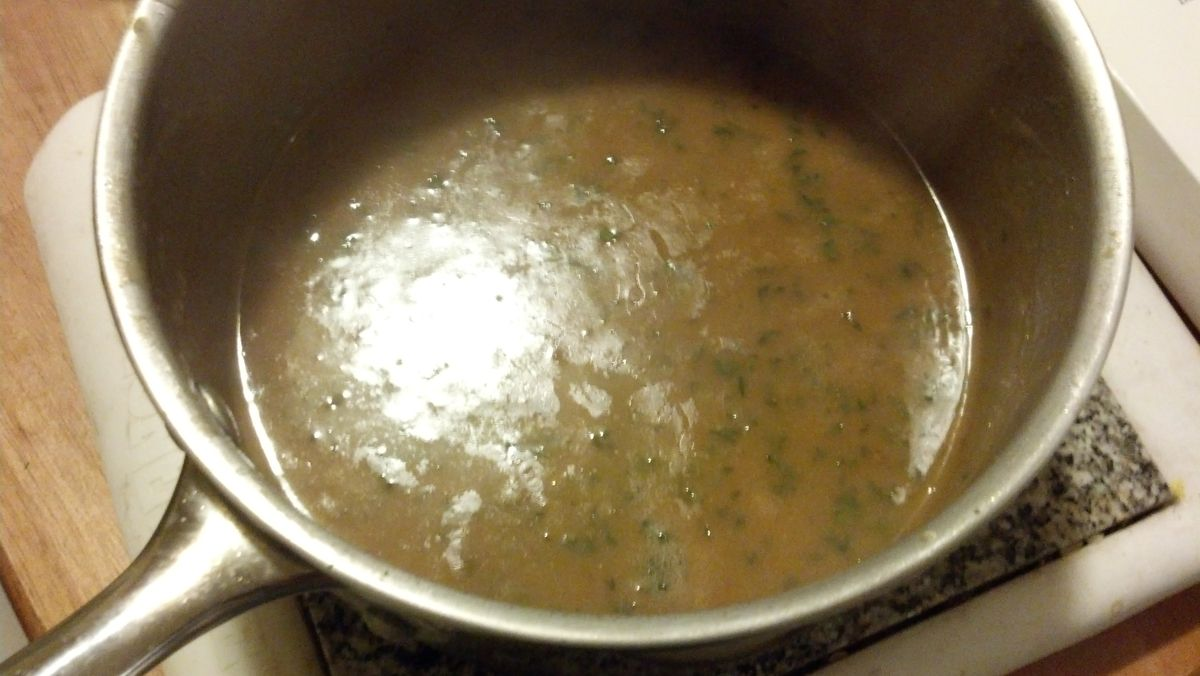
As I mentioned earlier, without specific information on a recipe I tend to get terrible results. This was a problem for the Wow Wow sauce. The recipe for it provided by Dr. Kitchiner is “beef stock, sharpened with a tablespoon each of vinegar, mushroom ketchup, and port wine, and a teaspoon of made mustard. Finally you add plenty of chopped parsley and two or three pickled gherkins.” I felt I could get by with the somewhat vague recipe for Bubble and Squeak, but I thought I needed some idea of how much beef stock to start with for the sauce. So I looked for Wow Wow sauce on Wikipedia and found that a recipe for it was published in Nanny Ogg’s Cookbook, a cookbook Terry Pratchett wrote from the perspective of Nanny Ogg, one of his Discworld characters. Given that I am a big fan of all things Terry Pratchett, I actually own a copy of Nanny Ogg’s Cookbook. The recipe for Wow Wow sauce is:

Butter, about the size of an egg

1 tablespoon plain flour

30 ml beef stock (this is 1¼ cups)

1 teaspoon English mustard

1 dessertspoon white wine vinegar

1 tablespoon port

1 tablespoon mushroom concentrate

Salt and black pepper

1 heaped tablespoon dried parsley

4 pickled walnuts, chopped

Buchanan_wow wow sauce

Wow Wow sauce

The mushroom concentrate needs to be made the night before and, since I was making this right before Thanksgiving, I didn’t have the time. However, Worcestershire sauce can be substituted for the mushroom concentrate and for the port, which is good because I didn’t have any port, either. While I was frying the beef and working on the cabbage, Becky worked on the Wow Wow sauce. If you would like to see how the sauce comes together, you will have to look on page 60 of Nanny Ogg’s Cookbook.

Continue reading “The Marketeers Club: Bubble and Squeak”

The Marketeers Club: Great Books Make Great Gifts

I was eight years old when I learned that books make great gifts. For Christmas that year, my aunt (who was a teacher and in the business of encouraging kids to read) sent a box of goodies: books by Beverly Cleary, Judy Blume, and a copy of Mrs. Frisby and the Rats of NIMH. I read from that box of books from the time I got home from school until bedtime, only taking a break for dinner because I had to. ("One more page!" I'd tell my parents after they’d told me for the third time that dinner was ready.) … Continue reading The Marketeers Club: Great Books Make Great Gifts

The Marketeers Club: Muggles, Manuscripts, and Marketing

What makes a book a best seller? What makes a person pick up a book about wizards or hobbits and say ”Hmm, I think this sounds good”?

As marketers, we are constantly asking ourselves how to make a book a bestseller. We push our titles as hard as we can. We attend exhibits, pay for advertising, send out review copies, and produce online content. But is that enough? How do we push a title so far that it eventually breaks from the mold and takes off?

Everyone knows what Harry Potter is or has at least heard of it. The author of the Harry Potter series, J. K. Rowling, is probably one of the best-known authors in the world. What some people may not know, though, is that Rowling’s popular series was originally rejected by twelve publishing houses. According to telegraph.co.uk, after the manuscript was rejected, a small publisher by the name of Bloomsbury finally picked it up with the promise of a small advance to the author. To everyone’s surprise, Harry Potter became the best-selling book series in history. The seventh installment of the series, Harry Potter and the Deathly Hallows, shattered records as the fastest-selling book ever. 

How did a book that no one wanted end up taking off so fast?

Continue reading “The Marketeers Club: Muggles, Manuscripts, and Marketing”

The Marketeers Club: Neon is not a good look for Mommy

Since it’s my turn to write a blog post this week, and I’ve recently become a mother for the second time, the natural suggestion from the marketing group was to write something about motherhood. “Really? You want crazy?” I thought jokingly. My husband and I welcomed our second son into our family over the summer, making us a “two kids under the age of two” household. Plus, we have an additional family member in the house: a 100-pound polar bear (okay, a white Labrador) named Cooper. With the new baby on board, a toddler trying to get potty-trained, and a … Continue reading The Marketeers Club: Neon is not a good look for Mommy