
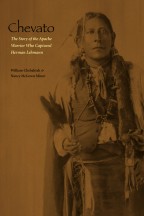
 If you’re a scholar or devoted reader of Native American or Texas and southwestern U.S. history, you don’t want to forego the chance to read Chevato. And don’t let the subtitle—The Story of the Apache Warrior Who Captured Herman Lehmann—bias your expectations. UNP’s November addition to the American Indian Lives Series combines enthohistory with extensive traditional historical research and narrative to tell not only the story of Chevato’s life but also the much broader and complicated story of Native American resistance and survival in nineteenth- and twentieth-century Mexico, Texas, New Mexico, and Oklahoma.
The life of the Apache warrior and shaman Chevato is at the center of the monograph in the form of oral histories told to William Chebahtah, Chevato’s grandson, by Thomas David Chebahtah, Chevato’s son. These oral histories are printed at the beginning of each chapter. Historian Nancy McGown Minor’s historical narrative follows. Based on extensive secondary and archival research, Minor’s narrative provides the detailed historical context needed for readers to fully understand and appreciate the content and veracity of the oral histories recounting Chevato’s life.
Although Chevato’s life is the genesis for Chebahtah and Minor’s historical narrative, his life story is far from the only history these author’s tell. Chevato’s life in fact became the catalyst for telling the story of Native American cultures—particularly, the Lipan and Mescalero Apaches and Comanche—under stress and attack by the forces of Mexican and American expansion into the Southern Plains and Southwest. By drawing on Chebahtah’s oral histories, published ethnohistorical accounts, and other primary and secondary sources, the authors show how the various tribes fought one another, Mexicans, and Texans to ensure their continued survival. Of particular value are the revelations these authors make about Native American practices of capturing and adopting enemies or the children of enemies (such as Herman Lehmann) to replenish tribes’ combat losses. Not all individuals taken captive were adopted, however. Many were killed out of vengeance by the families of warriors killed in combat, while others were captured for the purpose of being traded as soon as possible to other tribes or to people in Mexico.
Chevato also offers scholars and general readers significant insight into importance of community (versus individual) identity among Native American tribes and how those ties borne of communal identity made it possible for individuals and their relatives (as understood and recognized by Native Americans) to move between tribes. This is particularly important in understanding how Chevato, a Lipan Apache, became a recognized and influential member of the Mescalero Apaches in New Mexico and later of the Comanche people in Oklahoma, where through his relationship with Quanah Parker (the powerful Comanche son of another white captive, Cynthia Ann Parker), he introduced the peyote ritual and became a founding member of the Native American Church.
In spite of these strengths, the monograph has its weaknesses as well. The story/stories recounted in the oral histories included at the beginning of each chapter and what’s included in the historical narratives that follow don’t always coincide; perhaps as a result, the chronology of events recounted in the historical narrative is occasionally confusing or unclear (particularly the correlations between events recounted in one chapter and the next). Also, the content of the oral histories at the monograph’s end more often are Chebahtah’s reflections on his memories of Chevato than about Chevato. Most surprisingly, several footnotes were omitted from the text when it was printed.
 Readers interested in learning more about Native Americans in Texas and the Southwest in the decades prior to Chevato’s birth in 1852 and how those events helped set the proverbial stage for the events in his life should read F. Todd Smith’s From Dominance to Disappearance: The Indians of Texas and the Near Southwest, 1786-1859 (UNP, 2005). Other scholarly monographs that are likely to be interest include David LaVere’s Contrary Neighbors: Southern Plains and Removed Indians in Indian Territory (University of Oklahoma Press, 2000) and The Texas Indians (Texas A&M University Press, 2004).
 UNP blog