Ah, the first day of February. With it brings the promise of spring (I know, I know…it’s a few months away, but still), the joys of Valentine’s Day (see yesterday’s “Linking in Lincoln” post), and an entirely new month of UNP blog postings for your what-remains-of-wintertime enjoyment. It’s not quite ride-your-bike-in-shorts-and-a-tank-top-while-enjoying-a-snowcone-weather, so let’s stay inside where it’s warm and settle in for another posting on…
January 27, 1901: Opera composer Giuseppe Verdi died at age 87 in Milan, Italy.
Would you prefer an evening at the opera to a night at the movies? Rather take in a performance of "Aida" than watch the latest episode of “Grey’s Anatomy?” Then you should check out Opera and Drama by Richard Wagner, translated by William Ashton Ellis. In this rare book-length study, the composer discusses the enhancement of dramas by operatic treatment and the subjects that make the best dramas.
 January 28, 1986: The space shuttle Challenger exploded soon after liftoff, killing its seven crew members.
Many of us remember where we were when news broke of the tragic Challenger space shuttle accident. We also recall the teacher who was on board the Challenger and perished in the explosion—Christa McAuliffe. To read more about this outstanding woman and educator, read Teacher in Space: Christa McAuliffe and the Challenger Legacy by Colin Burgess.
January 29, 1861: Kansas was inducted into the Union, becoming its 34th state.
Discover the little-known facts about the act that created both Kansas and Nebraska and effectively abolished the Missouri Compromise in the forthcoming The Nebraska-Kansas Act of 1854, edited by John R. Wunder and Joann M. Ross (University of Nebraska Press, July 2008).
January 30, 1933: Adolf Hitler became chancellor of Germany.
The Holocaust is one of the most extreme and chilling examples of war crime on a mass scale. Read Atrocities on Trial: Historical Perspectives on the Politics of Prosecuting War Crimes, edited by Patricia Heberer and Jürgen Matthäus for a thorough examination of the concept of “war crime.” The essays in this volume address important and difficult questions, such as: What constitutes a “war crime,” and how has the concept changed over time? How do victors and vanquished deal with crimes that have universal as well as national dimensions? How is the historical reality of war crimes related to their judicial treatment? And how are perpetrators portrayed during investigations and trials?
January 31, 1919: Famed African-American baseball player Jackie Robinson was born.
From 1947, when Jackie Robinson joined the Brooklyn Dodgers, through 1959, when the Boston Red Sox became the last Major League team to integrate, more than a hundred African American baseball players crossed the color line and made it to the Major Leagues. Each of these players is profiled in Crossing the Line: Black Major Leaguers, 1947-1959 by Larry Moffi and Jonathan Kronstadt, which includes their statistics and capsule biographies, their triumphs and trials.
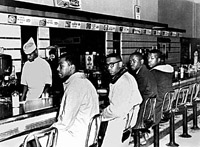 February 1, 1960: Four black college students, who had been refused service at a Greensboro, N.C. Woolworth’s lunch counter, began a sit-in protest, sparking a chain of similar non-violent protests and garnering attention for the civil rights movement.
Years before the 1960 Greensboro sit-in, Marvin V. Arnett was living amidst the torrent of racial tension and violence in 1940s Detroit. Read her first-hand account of these turbulent times, from her birth during the Great Depression to the Detroit race riot of 1943, in her book, Pieces from Life’s Crazy Quilt.
That brings an end to today’s installment of TWIH. Have a great weekend and be sure to check back in on Monday for a posting on February UNP author events and a review of Ted Kooser’s Valentines by fiction writer and essayist Kate Flaherty.
 UNP blog