
 “The Same Ten Questions”
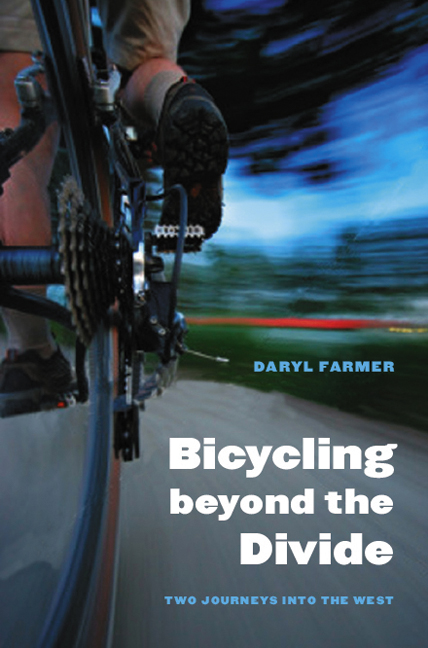
Both Mike Barenti and Daryl Farmer penned travel adventure narratives published this month by the University of Nebraska Press. The former wrote of his two-month kayaking journey from Idaho’s Salmon River to the Pacific Ocean in Kayaking Alone and the latter of his twice-made cross-country bicycling tour (trips spaced twenty years and seventy pounds apart) in Bicycling beyond the Divide. We set out on our own quest to discover the impetuses behind these parallel yet disparate expeditions and the lessons learned by each of these men as they reflected on their travels in writing. We posed the same ten questions to both authors. Let’s see how their answers stacked up.
1. What inspired you to set off on your journey?
Barenti: No one thing inspired me, but the biggest single factor was my work as a newspaper reporter. I reported on salmon and the Columbia River for my job with the Yakima Herald-Republic, and while I thought I did a good job, I also thought my coverage was somewhat piecemeal—which sometimes is the nature of newspaper reporting. I also had my own questions about the river and society’s relationship with the river that I wanted to explore, and at some point I got it in my head that the best way to really understand everything was to see a big long stretch of river. Since I love to kayak, a long kayak trip seemed like a natural fit.
Farmer: Like all the best stories, this one begins with a crush on a girl. Her name was Sandy, and after our junior year, she moved back to her home state of Oregon. Having scarcely been out of Colorado, Oregon seemed entirely exotic to me then, not only because of her, but also because of the ocean, which I had never seen. I started reading about the natural areas of the state, and knew I wanted to visit. Then one day in my high school library, I was reading a magazine called Campus Life and there was an article about bicycle touring. It was spring. That February, I’d finished my final basketball season and it was becoming clear that the scholarship I’d long dreamt of was not forthcoming. Escape by way of bicycle seemed the perfect antidote. As I started planning the trip, I began reading about more of the natural areas of the West. I actually planned the trip around the locations of National Parks.
It took me to years to plan and save the money for the trip. When I got to Oregon, I did see Sandy, who was then married and had a son. But it didn’t matter—by then my ride was about the journey, and not about the girl!
What inspired me to take the trip again twenty years later were three things: I needed to get in shape, I wanted to see those places again, and I wanted to write about both experiences.
2. How did family and friends react when you told them of your plans?
Barenti: My wife (we were engaged at the time) was very supportive, although I learned after the trip she also was a little worried about my safety. My parents were definitely worried about safety. I think a lot of my friends, especially the ones I kayak with, wanted to come with me for one portion or another of the trip. I didn’t object, but also decided I didn’t want to have any type of set schedule, and let them know that they would have to work around that fact. So in the end, I didn’t paddle with any of my friends.
Farmer: Initially, on that first trip, my father didn’t want me to go. On the surface, he wanted me to finish college and get a job. But beneath that, I think, was a deeper concern for my safety, for all the things that could happen to a naïve 20-year-old on a bicycle. My mom was worried too, but I think she sensed that I needed to grow up a little, and this would help me. In the end, they were proud of the trip, and now they have a book dedicated to them!
On the second trip, my wife, Joan, was very supportive. For a time we’d discussed taking the trip together. She herself once rode from Jasper, Canada to Missoula, Montana by herself, so she knows a little bit about bicycle touring. But without me saying so, she understood that it was something I needed to do alone, and she encouraged me to do so.
3. Did you ever doubt your ability to finish what you set out to accomplish?
Barenti: I never doubted my ability to finish, which is strange because in hindsight, it’s clear so many things could have gone wrong.
Farmer: Not on the first trip because, though I had sketched out a rough map of places I wanted to go, I was really not tied to a specific schedule or destination. My goal was just to go where the road took me.
But on the second trip, I had my doubts. I was out of shape, and I hadn’t ridden the bike much for years. My second day out, I rode over Hoosier Pass, which is over 11,000 feet. It was only four miles to the summit, but I stopped a lot. It took me all morning to get to the top. But I figured if I could make it, I’d be okay the rest of the way.
4. What was the highlight of your trip?
Barenti: It’s hard to point to just one thing, which I know sounds like a cop-out. I tend to over analyze things sometimes, which is probably an occupational hazard of being a writer and journalist, but at certain points in my trip, simply because of the sheer physicality of it, I could put that tendency away and just sort of exist in the moment. That was nice, although hard to write about.
Farmer: I couldn’t pick just one highlight. I met so many great people, and the whole experience kindled and rekindled a love for the West that lasts to this day. But making it across Nevada on the second trip was a highlight for me—it felt like a sort of victory, because on the first trip I had had a difficult time making it across the state.
5. What was the lowest point during your travels?
Barenti: I had two low points. The first came right at the beginning, which surprised me, but now makes sense. I had trouble coping with the sheer distance of the trip. I mean, the first day I paddled maybe twenty-five miles, which is a decent distance in a kayak, but then thinking about the trip it was like, “crap, I still have 875 miles to go.” All those river miles really weighed on me.
The second came after I made it out of the Columbia River Gorge. For me, the gorge starts just downstream from Umatilla, Oregon and stretches almost to Portland. Because of local weather conditions, it’s really windy, and I was dealing with thirty and forty knot headwinds on an almost daily basis along that stretch of river. In a kayak, that’s just exhausting. After I made it below Bonneville Dam, all the effort caught up with me. I just sort of crashed for a few days and was low both physically and emotionally.
 Farmer: You would think I would say when my bicycle was stolen in Oregon, and that might be right. But I don’t remember it that way, because that theft and all that came after it was a turning point in terms of the narrative. In other words, I think the book is better because my bike was stolen. The low points came during periods of loneliness, especially on the second trip when I missed Joan.
6. What was the most beautiful and/or awe-inspiring sight along the way?
Barenti: Again, it’s hard to point to just one thing. After I finished kayaking one day, I hiked up a ridge where I could look down on the Columbia River. I was up high enough to look down on an osprey while it fished. Ospreys always seem like they hit the water pretty fast when they go after fish, and this one was no different. But when it came up from the water, I lost track of it against the river. The Columbia’s water is a very dark green and ospreys have dark backs, so the bird blended in with the water. Even though I lost sight of the bird, I could see the ripples made by water falling off the invisible flying bird hitting the river. It was amazing to watch.
Farmer: There were so many! Seeing a grizzly bear in Yellowstone was definitely one of those moments. And while kayaking in the San Juans, we had Orcas swimming very near us. Seeing the ocean for the first time, camping on the beach, and watching the sun set over the Pacific was another. But there were a lot of those moments. I think that something about being on a bicycle—feeling the wind against your skin, smelling the pine trees, listening to the birds—just lends itself to a heightened sense of awareness, with a connection to the natural world. Food tastes better, the world seems more beautiful. At times I’d just get these electric tingling eye-watering waves of joy.
7. Which single experience during your trip was most life-altering?
Barenti: You know, I hate to say this, but I’m not certain this trip was life altering. Of course I didn’t really set off with the goal of altering my life, so you know… I think the trip did reinforce some things for me. I’m from Virginia originally, but I love the Northwest and can’t imagine living anywhere else, although circumstances do change. And I think the trip connected me more to the place I now call home and makes it feel like home. In the years since I took the trip, I’ve been back to some of the places I traveled through, and now I have my own personal stories about those places. My wife has had to listen to me talk about how I camped someplace or how long it took me to get through the gorge because of the wind. Stuff like that. I’m sure when my kids get older I will bore them to no end talking about that stuff. Isn’t that what fathers are supposed to do?
Farmer: I think meeting Randy Randall in Oregon, after the bike was stolen, and listening to him tell his story about Vietnam, his PTSD, the drugs and violence, and then his description of the hand of God touching him on the shoulder. I’m not one to wear my faith on my sleeve, but you can’t be around Randy and not be inspired by him.
8. Did you know that you wanted to write of the experience before you began your adventure? What compelled you to chronicle your journey in writing?
Barenti: I did know I wanted to write about the trip before I took it, but I also gave myself permission not to write about it if at the end I found I didn’t have enough material for a book. I knew when I took the trip that it would be a good way to look at the pressing environmental issues we face in this country, especially what to do about Columbia River salmon.
Farmer: Not on the first trip, but when I left on the second trip, I already had the book contract. On the first trip, I kept a journal daily, but I never imagined it being read by anyone other than myself. I just wanted to remember everything and have a record of it for later.
9. Did you find the writing process difficult? What was your greatest challenge?
Barenti: I love to write, but I have to work at it, maybe more so than some other writers, so it’s always a difficult process.
With this book, dealing with the science, particularly the salmon biology, was definitely the hardest part. Integrating the science in a way that didn’t disrupt the book’s narrative was challenging. It also took a lot of work to keep the scientific information accurate. There’s always what I like to think of as a flattening out process when you take something from a scientific paper and re-write it for a general reader. There’s a lot of information that a scientist needs, but that a lay reader doesn’t, and as a writer you try to winnow that out. But that flattening process can introduce errors, and it takes a great deal of effort to make certain it doesn’t happen. I went back again and again to a variety of scientists, often letting them review chapters for accuracy as I worked on them.
Farmer: It wasn’t so difficult to write the initial draft. The challenging part was deciding what to leave out, because I had so many memories from the first trip, and I’d kept meticulous notes on the second.
10. What message do you hope readers take away from your book?
Barenti: I don’t know that I have a message I want the readers to take away from the book. I hope instead that the book makes them think not just about the Columbia River and its problems, but about the full range of environmental problems we face around the world, while providing a framework for looking at those problems so that maybe we, as a society, can start to find some solutions.
Farmer: I hope the book inspires people to bicycle more. It’s such a great way to travel. If more people bicycled to work, think of the problems it would solve: health problems, money problems, pollution problems, traffic problems, parking problems.
Also, the book is a celebration of the country, beyond a shallow show of patriotism. The West in particular is filled with interesting people and beautiful landscapes, and so full of stories waiting to be told!
***
We hope you enjoyed our interview with Mike Barenti and Daryl Farmer. Perhaps they will inspire you to set off on your own adventure—whether in a kayak, on a bike, or from the comfort of your armchair reading one of these exciting books.
 UNP blog