
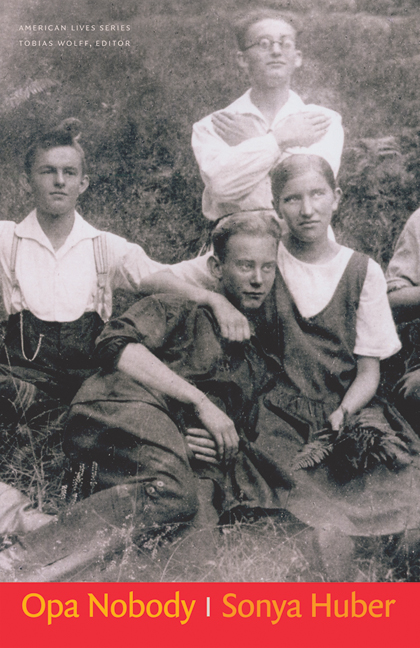
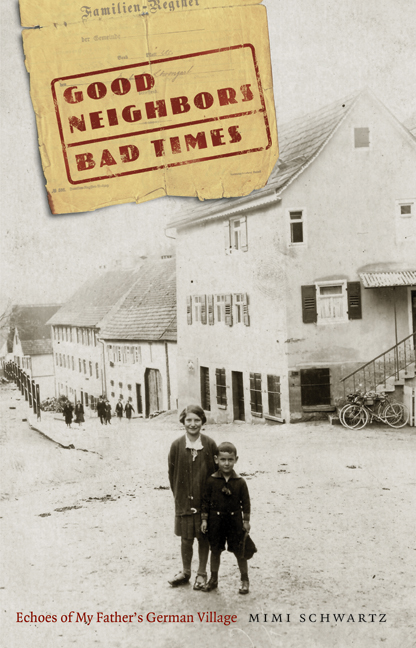
Authors Sonya Huber and Mimi Schwartz both penned fascinating creative nonfiction works newly published by the University of Nebraska Press. Huber’s is a memoir and recreated family history that tells a layered story of an overlooked history of socialism in Germany before and after Nazism entitled Opa Nobody. Schwartz’s memoir, Good Neighbors, Bad Times, focuses on recovering the Nazi-era history of her father’s German village where Jews’ and Christians’ claims of congeniality were often proved true. Both women faced a number of challenges in writing non-fiction accounts of the lives of others. How does a creative writer do justice to her subjects as well as her craft? How does she practice artistic freedom and expression within the confines of a story largely about people other than herself? In their guest blog postings, Huber and Schwartz address these questions and speak to the uniqueness and importance of the creative nonfiction genre.
*****
 Accountability and Joy
By Sonya Huber
I felt compelled to write Opa Nobody, but my fear of the outcome was almost as big as my desire to write. Throughout the research process, I worried that I was bothering people, dredging up too many buried feelings with my questions. I worried that I was inevitably getting it wrong, that I was missing sources and doing other sources a disservice by misunderstanding them. I worried that the final outcome for all of this work would be hurt feelings for anyone and everyone mentioned in the book. In my writing classes, my students and I regularly discuss ethics and the predictable and surprising fallout that can result from a work of family-based memoir. I worried about these consequences, and I knew as I wrote that my internal “writer” would be unable to reach the ideals of responsibility, transparency, and accuracy so cherished by my internal “editor.” Every day when I sat down to write, the “writer” in me took over—this reckless person who elbowed into the story, flung around metaphor, and pushed toward the points of maximum conflict and difficulty. Then the “editor” came back and worried over the pages, always desperately behind, looking for the holes and the blind spots.
My relatives in Germany have now received their copies of the book, as have friends and family in the United States. A new “blind spot” has been revealed: I realized that I never dared to dream about positive reactions. I held my breath as those closest to me read their copies, and I flinched when I opened my e-mails. I never anticipated the wonderful messages of praise; I did not adequately imagine the generosity of my family. These people who had been so forthcoming with their stories and their memories have now been as equally giving with their support. I have realized in the weeks since publication that a public focus on the sins of memoir and family history—and my research interest in critical response to controversial works of memoir—had obscured for me the productive beauty of the genre and the reasons why I am committed to it. I did not imagine that my relationships with my subject matter—my German family—could continue to shift and develop, even after publication. I thought I had said everything possible about my relationship with my imagined Opa, but I find that as family members send me their reactions, I feel a web of connections drawing through and beyond the text as if an electrical circuit has been established. I thought that publication equaled the end of an exploration, a sign that the last chance to fix my mistakes had passed. Instead, new conversations have begun.
*****
 The Ups and Downs of Telling Other People’s Stories
If it’s nonfiction, why change the name of your father’s village—and also of the villagers? It’s a question people ask about my new book, Good Neighbors, Bad Times: Echoes of My Father’s German Village. My answer is: Privacy. When people are neither famous nor infamous, and they prefer to have pseudonyms, why not? Most readers of memoir, I’ve found, don’t care about names; it’s the stories that matter—and the obligation to get them as true as possible on the page. Readers also want you to let them know what you are doing and why. That’s why I wrote this in my Author’s Note in the front of Good Neighbors, Bad Times:
The people I met, the stories they told, the facts of village life and history, are true as I learned them. Nothing is made up—except for people’s names; the name of the village, which I call Benheim; two other place names; plus some identifying details that I changed to protect the privacy of the non-famous.
Of course, inventing pseudonyms doesn’t work for family members. My father, or rather his voice in my memory, is central to my book. All through my childhood I heard him say, In Benheim we all got along before Hitler. In Benheim we respected each other. And echoes of those stories, forty years later, propelled my writing along. My father died in 1973, before I started Good Neighbors, Bad Times, but I think he’d be pleased with what I captured of his old world. I even imagine him saying, “You got it right!” They are the magic words a creative nonfiction writer hopes for, signaling that real people, whether their real names are used or not, believe that their lives feel true on the page.
More than accuracy is involved. A writer must capture what I call the “emotional truths” of her characters: the spirit of who they are, what they said, worried about, and thought. Yes, dates, numbers, and other facts must be correct: I fled Hitler in 1937, not 1938. I had three brothers and two died. My mother was a seamstress, not a baker. But correct facts alone won’t reveal how fleeing in 1937 left scars today and what the emptiness of losing two brothers was like. Even small humiliations, ones like your bread not rising and turning golden like your sister-in-laws’ breads, need to produce, “You got it right!”
To make that happen requires the craft of creative nonfiction: description, dialogue, and dramatic narrative. It requires imagination to fill in what isn’t in archives, transcripts, and pages of notes. It requires a willingness to bear a big responsibility: to be honest and fair to your real-world characters. I felt that responsibility in my first book, Thoughts from a Queen-Sized Bed, which was about my life in a long marriage. But I felt it even more in Good Neighbors, Bad Times, writing about subjects who didn’t know me and so generously let me into their lives. I wanted to be worthy of that trust.
I rely on two guidelines to encourage my honesty and fairness. One I started using when writing about my husband, and it goes like this: If I call him a moron, he gets to call me a moron. In other words, I must give him voice; I must empower him to tell his side of the story—and it seems to have worked. Six years after publication, we are still together!
The second guideline comes from memoirist Kim Barnes who wrote the best-selling memoir, In the Wilderness. She was very nervous that her father, in particular, would be angry at her version of her rebellion against the Pentecostal religion of her parents, but he wasn’t. He only wanted her to change a few minor facts, and much relieved, she realized:
One thing that we always assume, wrongly, is that if we write about people honestly they will resent it and become angry. If you come at it for the right reasons and you treat people as you would your fictional characters—you know, you don’t allow them to be static—if you treat them with complexity and compassion, sometimes they will feel as though they’ve been honored, not because they’re presented in some ideal way but because they’re presented with understanding.
(from an interview in Fourth Genre, Volume 2, issue 2)
Two of my characters have read my newly published Good Neighbors, Bad Times and both have liked it, but I’ll be uneasy until all responses are in. In the meantime, I keep rereading an e-mail I just received from one of three sisters I wrote about. They all survived in the village as half-Jewish little girls who weren’t deported:
For three days I did nearly nothing else but reading [your book] and now I am almost speechless, that means words especially English are not enough to express how impressed I am. Your voice in the book is so near to me.
She had been trying to write about her experience, she goes on, but had been blocked. Reading my book gave her permission to try again: this time talking about the bad and the good: “I have a photo, showing me as a child leaning at the wall of our house . . . with a fissure on it. . . . And I would tell how life brings the cement to fill it.”
Her words affirm for me the power of this genre called creative nonfiction. More than its cousins, fiction and journalism, it is in this genre (when “You get it right!”) that one voice encourages others to speak.
*****
For more information on Opa Nobody, visit http://nebraskapress.unl.edu/product/Opa-Nobody,673370.aspx.
For more information on Good Neighbors, Bad Times, visit http://nebraskapress.unl.edu/product/Good-Neighbors-Bad-Times,673371.aspx.
 UNP blog