
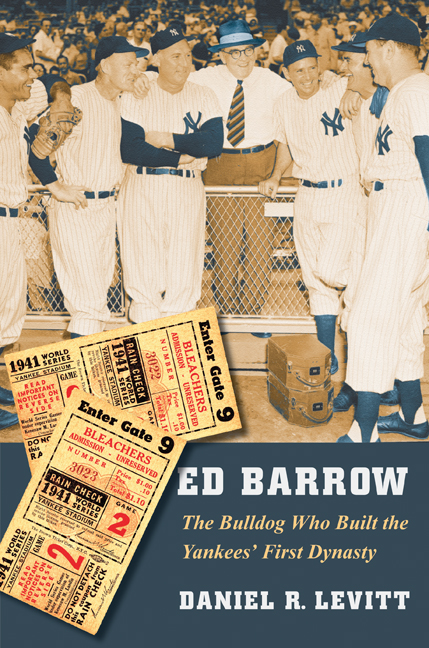
 Daniel R. Levitt, author of Ed Barrow: The Bulldog Who Built the Yankees’ First Dynasty, answers our questions about the origins of this engaging biography, the man behind the story, and the major happenings in the history of baseball directly influenced by this "bulldog" of baseball.
Why did you pick Ed Barrow for your biography?
I’ve always been fascinated by team building. Why do some franchises win consistently while others spend years without making the playoffs? My first book, Paths to Glory: How Great Baseball Teams Got That Way, which I coauthored with Mark Armour, focused on a number of teams, some great, some not so great, and examined why they developed the way they did. As the architect of the Yankees’ dynasty—one of the longest runs of sustained success in the history of American sports—Barrow makes for a terrific subject.
When did Barrow take over the Yankees, and what level of success did he achieve?
The Yankees hired Barrow as their de facto general manager after the 1920 season. Up until that time the franchise had never won the pennant. With Barrow on board, the Yankees captured the 1921 pennant and during his tenure won a total of fourteen pennants and nine World Series victories.
So how did Barrow create such a dominant team?
There were two questions relative to Barrow and the Yankees that I sought to answer: how did baseball’s competitive environment evolve, and how did the Yankees come to dominate it? The economics of team building at the time were quite fluid. In the early 1920s, Barrow followed up on the purchase of Babe Ruth from the Boston Red Sox and spent over $400,000 acquiring owner Harry Frazee’s best players. When that avenue dried up and major league teams were under little pressure to sell off their talent during the roaring twenties, he needed another talent source. Barrow and his great scouts correctly identified the top players in the then independent minor leagues, and Barrow purchased several future Hall of Famers. When the rules for minor league team ownership changed in the early 1930s, Barrow, at the instigation of owner Jacob Ruppert, developed the best farm system in the American League.
Anything interesting in the process of changing those ownership rules?
In the book I quote and analyze at some length the 1931 winter meeting that led to the new rules governing minor league ownership, effectively eliminating the obstacles to a functional farm system. The meeting itself reads more like a farce than any rational analysis of the situation, as the owners and baseball commissioner Landis struggle not only with what rules they want, but what the existing rules actually were and how they were enforced.
What did Barrow do before joining the Yankees?
Prior to jumping to the Yankees at age 52, Barrow had held just about every job in baseball except player. In the late nineteenth century, he managed and owned a minor league team and later became a minor league president. To help generate interest for his league, he brought in heavyweight boxing champion Jim Corbett and female pitcher Lizzie Arlington. He also participated in one of the first attempts at night baseball in 1896. During the American League’s bid for equality with the National in 1901, Barrow ran the Toronto franchise in the high minor leagues. During this chaotic period, Barrow spent his time trying to get his Toronto team into the American League and battling to keep his players from jumping to the majors.
In 1903, Barrow received his first shot at the majors when the Detroit Tigers hired him as manager. In midseason 1904, Barrow resigned under pressure from Frank Navin, destined to become one of the key executives in the history of Detroit baseball. Like Barrow, Navin was young and ambitious, and the two would cross swords many more times until Navin’s death.
Later Barrow became president of the International League, a minor league just below the level of the majors. He led the International league during its disastrous conflict with the self-proclaimed major Federal League in 1914 and 1915. To survive, Barrow schemed to have a modified version of his International League recognized as a third major league within Organized Baseball. Despite his best efforts, Barrow’s political talents were not up to the task, and after some apparent successes, the major leagues rejected his pleas.
Anything else?
Perhaps most notably, in 1918, Barrow managed Babe Ruth and the Boston Red Sox to their last World Series title before the "curse." During his years at the Red Sox helm, he had several high profile confrontations with the childlike Babe. Barrow was also at the center of the Carl Mays controversy that nearly tore the American League apart.
Was Barrow involved in the sale of Babe Ruth to the Yankees?
When Red Sox owner Harry Frazee sold Babe Ruth to the Yankees after the 1919 season for $100,000 and a loan of $300,000, Barrow was still manager of the Sox. When Frazee broke the news to the frustrated, but not completely surprised Barrow, Barrow maintained some hope that Frazee might release some of the cash proceeds to help rebuild the team. Unfortunately, the cash-strapped Frazee plowed little if any of his windfall back into the Red Sox.
What about the sale itself? Why did Frazee sell the greatest player in the history of baseball?
For roughly eighty years after the sale of Ruth, the notion that Frazee sold Ruth and other players because he needed the money moved beyond conventional wisdom and into the realm of historical fact. I am not aware of any serious baseball histories that dispute this view. Recently, however, a revisionist history has taken root suggesting that, in fact, Frazee was financially well-off and did not sell Ruth because he needed the money, but because he actually believed the team would be better without the youthful star. Shockingly, this revisionism has now been accepted by many as the new conventional wisdom.
Using recently available and unexamined information—including the New York Yankee financial records on file at the Baseball Hall of Fame and the Frazee papers at the University of Texas—I debunk the new revisionism and show conclusively that Frazee sold Ruth because he was in desperate need of the money.
At the time of Barrow’s hiring by the Yankees, how were baseball franchises run, and how did Barrow fit in?
Most baseball teams were still run like small businesses. They were run by a team president, typically a major stockholder, and the manager. The distribution of authority between manager and president depended mainly on the level of control the president wished to retain for himself. As a de facto general manager, Barrow was thrust into a baseball position that remained largely undefined. The Yankee owners recognized they needed a baseball man to help make player personnel decisions and mediate between the owners and manager. They willingly delegated much of their authority over the players to Barrow and over time allowed him to reorganize and assume control over nearly all of the front office.
How did Barrow’s reign end?
With the death of owner Jacob Ruppert in 1939, the ownership of Ruppert’s estate passed to a trust for the benefit of three beneficiaries, two nieces and a young lady friend. The trust named Barrow president of the Yankees, and for several years he sat the pinnacle of his beloved franchise. Estate tax issues quickly materialized, however, and the trust began evaluating sale options. Several potential sale alternatives were languishing when America entered World War II, virtually eliminating all non-war related economic activity.
Nevertheless, the estate tax issues could not be postponed indefinitely, and Barrow and the trust began discussions with a triumvirate of construction magnate Del Webb, wealthy sportsman Dan Topping, and baseball maverick Larry MacPhail. Barrow and MacPhail had feuded publicly for many years and Barrow hated to see "his" team go to his rival. At one point early in the sale negotiations, Barrow declared that MacPhail would take control of the franchise "over [Barrow’s] dead body." Nevertheless, in January 1945, the trust sold the Yankee organization to the three for the war-depressed price of only $2.4 million.
*****
For more information on Ed Barrow: The Bulldog Who Built the Yankees’ First Dynasty, please visit the book’s Web page at http://nebraskapress.unl.edu/product/Ed-Barrow,673413.aspx.
 UNP blog