
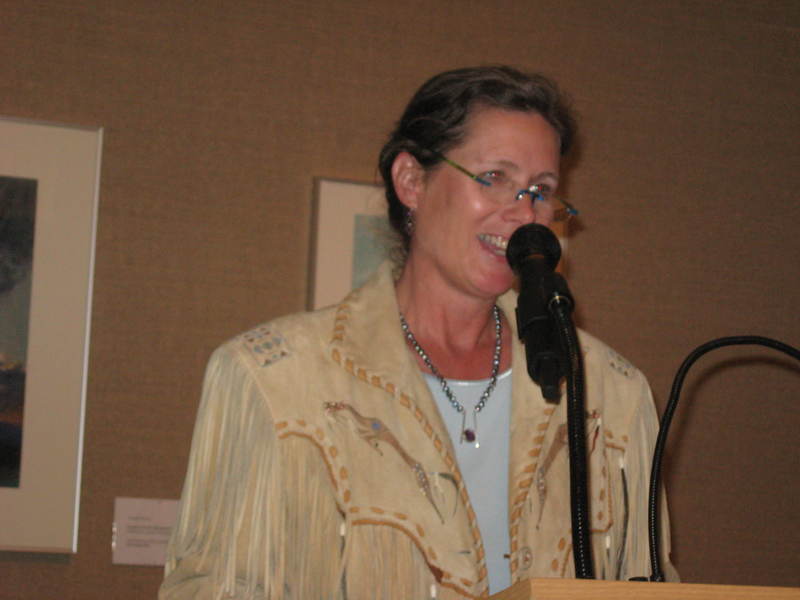
 Stephenie Ambrose Tubbs, author of Why Sacagawea Deserves the Day Off and Other Lessons Learned from the Lewis and Clark Trail, spoke to a crowd of 50 Lewis and Clark enthusiasts at the Great Plains Art Museum last week. Tubbs discussed the extraordinary symbolism that has been attached to Sacagawea’s legacy as well as the importance of the Lewis and Clark expedition to capturing and developing the lifelong environmental interest of young readers, answered questions from the audience, and read from the title chapter of Why Sacagawea Deserves the Day Off:
"Again I ask that we reconsider the historical Sacagawea and give her credit for who she was. For  example, although in popular culture she is celebrated as a guide, we do not celebrate her greater genius, which would seem to be her memory for landscapes, her ability to translate between highly different languages and worldviews, and her understanding of harvesting foods and moccasin reading. In modern times she might have been an engineer or a crime scene investigator or a foreign correspondent with those skills. In her world landmarks told stories and because of that they stayed fixed in her mind. Think of Beaverhead Rock. She remembered those places because as a young child she would travel there with her people looking for bison and roots. These travels were based on the seasons and the stories associated with the places they went. The landmarks told stories, and Sacagawea must have been a very good listener."
"And observer. When it comes to being the champion observer of the expedition, most folks feel no one holds a candle to Meriwether Lewis. But several times during the expedition Sacagawea proves to be in his league. She noted where the bark of a ponderosa pine tree had been harvested by Natives, and she likely knew where to find the wild artichokes stashed by the prairie mice. She gave Lewis the bitterroot and showed him how to eat it; she gave Clark the white apple and the fennel root, which he also credited her with finding.
I think she often gets shortchanged in acknowledgment concerning her talents as a mother. The fact that nowhere in the journals is there a complaint about an inconsolable infant testifies to her talent and instinct as a mother. Who was there for her to ask advice? She depended on what she had observed in both the Lemhi Shoshone and the Hidatsa cultures to know how to take care of and raise her son. The proof of her goodness as a mother can be seen in the life of her son, who went on to be a highly qualified guide and interpreter in his adult life.
Some people marvel at her endurance. They can’t believe that a woman could keep up with a bunch of hardy young soldiers. Well, what if they had a hard time keeping up with her? I think Clark gives her a pat on the back for her endurance when he writes in his letter to Charbonneau that she accompanied him on the long, dangerous, and fatiguing route.
But she needs no defenders.
Maybe most of the claims we stake on Sacagawea’s memory are because we want her to be our friend. We want her approval, her glad tidings, her ermine tails, her stale bread, her lump of sugar, her blue-beaded belt, all of the gifts she gave. We want to hold them close. Imagine if that blue-beaded belt were somehow found and put on the market today. It might fetch more than the iron boat on eBay!
We want her friendship for the very reason John Luttig noted when she died at Fort Manuel in 1812. "She was a good and the best woman of the fort." Her integrity was intrinsic; she needs no mythology or statue. From the very beginning of her appearance in the journals she stood for something without perhaps even knowing it. Yet she was the real thing.
A woman. A mother. A wife and a sister, a friend, a woman who knew where she belonged. A woman who was strong, worked hard, and loved her children. None of these things necessarily makes her a hero, but in a sense it makes her the best kind of hero: one we can recognize and celebrate in ourselves. So let’s pull up our claim stakes, pull out our flagpoles, and finally after all these years let her have a day off, let her rest in peace, let her lay down all of the burdens collected from sea to shining sea."
Why Sacagawea Deserves the Day Off and Other Lessons Learned from the Lewis and Clark Trail is due in the University of Nebraska Press warehouse early in the fall. Sign up to be notified by e-mail when the book becomes available here.
 UNP blog