
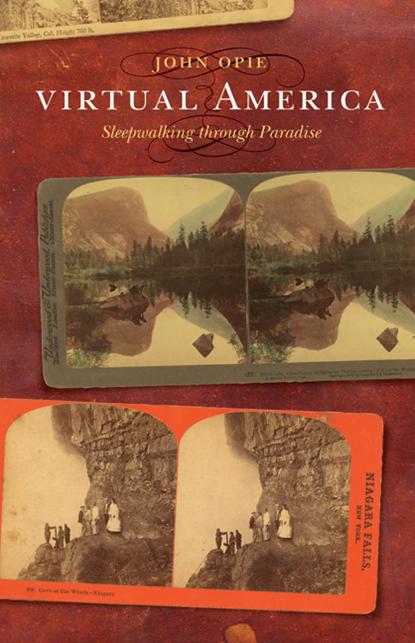
 When I left Omaha for Philadelphia in June to present a paper on place at the Association for the Study of Literature and Environment symposium "Keyboard in the Garden," I couldn’t have selected a better, more appropriate book to take with me. Paradise is place, the environmental historian John Opie suggests in Virtual America: Sleepwalking through Paradise (UNP, June 2008), but Americans by and large have lost their sense of place–of rootedness–and belonging to and in place. This pervasive feeling of placelessness, as Opie terms it, isn’t new in American history, however. Questions about place have puzzled American artists and scholars for decades, centuries even, if a person considers Henry David Thoreau and his contemporaries. Similar anxieties motivate contemporary writers and thinkers such as me (the paper I presented was, ironically, titled "The Puzzle of Place") and result in all manner of artistic production: visual, textual, and virtual. Interestingly, Opie argues that it is this artistic production in America that contributed to, if not caused, Americans’ sense of placelessness, of sleepwalking through Paradise, by portraying place as something other than what it was and contributing to the manufacture of a built environment that altered the land to correspond with people’s conceptions of nature and place. The emergence of a virtual reality afforded by computers, the World Wide Web, and the Internet, Opie contends, has exacerbated Americans’ disconnection from place by further interfering with their ability to discern what actually is there, in a particular place, wherever in America there is; at the same time, paradoxically, Opie believes virtual reality offers opportunities for (re)discovering authentic individual and national identity by aiding in the recovery of the particularities of place.
Unlike many environmental writers, Opie does not condemn technology as the sole or primary cause for the disconnection between people and nature or place. Convincingly, Opie argues that Americans (and others) constructed virtual realities using art, science, and technology from the time their ancestors first encountered the American landscape. Opie’s most revealing examples include the many World’s Fairs and the future realities they showcased in their many exhibits. None of these "facts" are likely to be new to many people, however, least of all environmental historians, geographers, or ecocritics. Indeed, Virtual America echoes what other and younger environmental historians such as Dan Flores (in Horizontal Yellow) have suggested–namely, as Opie writes, "The heart of an authentic America is less in the big picture or larger philosophies than in the specific sites of vivid human experience" (149)–and thus the book does not contribute new "factual" knowledge to the ongoing conversations about the significance of place and nature in American society, culture, and history. To expect that, however, would be to miss Opie’s objective–and the value of Virtual America. Opie, now in his 70s, admits the book is not a traditional history. It is, instead, a collection of connected reflective (and at times personal) essays in which he draws on his lifetime’s work and experience to synthesize and consider his understanding of place, his understanding of Americans’ sense of placelessness, and his ideas for how individuals (and, by implication, American society) can capitalize on the affordances of technology to recover and discover anew a sense of home–that is, of authentic place and of the authentic individual and national identities grounded in place.
For more extensive treatment and analysis of the ideas informing Virtual America or about American environmental history, a field Opie helped to establish as founder of the American Society for Environmental History and founding editor of the journal Environmental History, read Opie’s earlier books, including Nature’s Nation: An Environmental History of the United States (Wadsworth Publishing, 1998), Ogallala: Water for a Dry Land (2nd ed., UNP, 2000), and The Law of the Land: Two Hundred Years of American Farmland Policy (UNP, 1994).
 UNP blog