
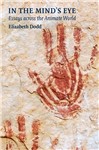
Read the first pages from In the Mind’s Eye: Essays Across the Animate World by Elizabeth Dodd:
"On the long, hairpinned climb from the Valley of the Gods, heading north from the town of Mexican Hat, I meet only one other vehicle on the road, a pickup headed south. So in midafternoon, when I see the guy with his thumb out and a hopeful look on his face heading north along Cedar Mesa, I think it must be up to me, although I vowed years ago to never, ever, not-even-once stop again for another hitchhiker. I slow the car."
"This traveler’s a young man, wearing a Marines t-shirt and magnificent sunglasses, with a pack on his back indicating that he’s just climbed up from one of the canyons that transect and drain the mesa—eight hundred, maybe a thousand feet. There’s a different code of ethical behavior in the wilderness, and he’s still crusted with its dust and dried mud, but I remain a little wary, wondering if this is the smartest thing I’ve ever done.
“What’s your story?” I ask without opening the door. He’s already smiling broadly, dropping his pack to the ground by his feet. He says he’s finished three days of backpacking in Grand Gulch, from Kane’s Creek to Bullet Canyon, and is headed back to the ranger station along Route 261.
“So your loop includes a long hike on asphalt?” I ask him.
“They told me someone would surely pick me up,” he says. “But you’re the first car I’ve seen. Thanks for stopping; you’ve saved me hours of walking.”
I clear out the passenger seat, he crams his pack on top of my already dusty gear in the back, and we continue north. I learn that his name is Aaron, and he’s not a Marine; that’s his younger brother’s shirt. In fact, he’s just out of the Peace Corps, his wife is in Salt Lake visiting relatives, and in the fall he’s starting a master’s program in education at the University of Chicago. Then he tells me excitedly about his hike—bitterly cold the first night. “Nineteen degrees,” he says with the precision of someone to whom each calibrated drop in temperature was significant. After that, beautiful weather. And he reached several Ancestral Pueblo ruins, even though his route came nowhere near to completing the sixty-mile length of the primitive area boxed in attractive green on the map. He’s still elated, uplifted from the trip, and I recognize both the place names he describes—Turkey Pen ruin, Jailhouse ruin—and the near-rush of narration, the delight in telling someone who’s interested— me, in this case—what he’s seen. I’m planning to day-hike in, still uncertain an old foot injury will let me pack the excessive weight of my too-roomy, two-person tent. He sells me his map for half of what he paid for it—“I believe in karma,” he says— and unfolds it on his lap, pointing out where he camped, where the water was clear rather than runoff muddy. In the parking lot, we shake hands, wish each other luck, and prepare to go our different ways.
That night I sleep on BLM land just up the road, overlooking Lyman Canyon, marked on the map as an intermittent stream a few hundred feet below the rim. There I pitch the tent on a few inches of soil above sandstone, hardly enough to hold the stakes in place. A high mesa to the east changes color as I sit watching, cooling in the evening; a tiny bit of snow clings to its upper reaches, but the rock glows various shades of vermilion, rufus, ocher, and I recognize for a moment the perfect shade of a stone I picked up days ago, grinding from it a few experimental grains as if to approximate paint. Then, briefly, the rock seems to shine from within, the way the dying heart of a campfire would have if I’d kindled one, just in the last moments before it would be time to scatter the coals, douse them with water, and listen to the hiss of ash-scented steam. Instead, I listen to the current in the canyon below, an allegro of motion, of flow, the world in its exquisite movement into spring.
The next morning, I’m on the trail before 8:00, a day-use permit tucked beneath the bug-splashed windshield in the unpaved parking lot. This is Kane Gulch, heading southwest; the water here is muddy, cold, and seems in a tremendous hurry to pass through the landscape, leaving everything behind to the dry heat of the coming summer. Almost immediately I begin the sinuous trek back and forth across this meltwater current, as the slope of the wash itself deepens toward actual canyon. Before 9:00, a red-tailed hawk startles from where it has landed to drink, and it lifts heavily, legs dangling their angled talons.
By 11:00, I’ve given up keeping my feet dry and no longer even try to cross the current; I slosh right through. Occasionally, mud sucks at my feet as they try to step free; other times the channel bed is slickrock sandstone, smooth and mostly level except for the downstream tilt that lets the water hurry away. And once, I slip and splash and get wet to the waist, worrying briefly that I’ve dipped the pack, but no, it’s only me, my shorts, and of course my shoes that are soaked from the clumsy dunking. So around noon, I find a dry cottonwood log to sit on, unlace the boots, and let my pale feet warm in the sunlight, wool socks dangling wetly, heavily, from a yucca spike. I take off my shorts, too, since no one is around, and sit in my underwear, drying off. Eating a peanut-butter-and-banana sandwich, I consider skeptically the ring of mud that rims each boot, the silty film that stains my legs, the faint dirty tinge that has darkened my spiffy blue orthotics, also set out to dry in the sun. In the sandy dust, the orthotics look like robot footprints, fleshless, toeless, futuristic in their shadow-cast of ball and arch, waiting for me to step into them again and move along.
For days, I’ve been thinking about the footprints that fleck the rock art of the American Southwest. Full sized, miniature. Single tracks or a series, left, right, left, indicating the route, the path, the journey—maybe even time (seven prints here, only four here). In Nevada, at Atlatl Rock, I saw what I want to call a classic footprint: the carved perfection of the idealized human form, toes down, a narrow heel like my own, but no apparent arch. Another footprint, equally well pecked, showed much less symmetry: the second toe was far longer than all the others (indicating it may be female; my own second toe is the longest on each foot). And that bonelike toe seemed damaged at its tip, bent, with the incised line interrupted as if in breakage. The foot pointed straight upward, heel aligned with earth and toes aligned toward sky, echoing the rock’s monumental verticality. Rested from a night in a nearby, nearly empty campground, I stood awhile, considering. Gawwwwd, the composition seemed to me to say, we walked nearly forever to get here. Just look what it’s done to me! In this it suggested something about the unidealized truth of the bipedal, perambulatory life. But who knows what specificity the artist meant in carving the foot’s deformity on this pinnacle of stone in a broad, red, and very dry valley?"
Elizabeth Dodd is a professor of English at Kansas State University. She is the author of several books, including Archetypal Light and Prospect: Journeys and Landscapes. To read a longer excerpt or to purchase In the Mind’s Eye, visit http://www.nebraskapress.unl.edu/product/In-the-Minds-Eye,673291.aspx
 UNP blog