
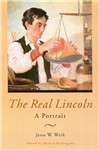
 Read from the editor's introduction of The Real Lincoln: A Portrait by Jesse W. Weik, edited by Michael Burlingame:
"When published in 1922, Jesse W. Weik's The Real Lincoln impressed one reviewer as "a singularly rounded, yet unstudied, unretouched portrait of Lincoln as a private man, not that vague abstraction, a public character." Weik's pages, she added, convey "the profound vitality of the man himself" and are "of far more absorbing interest than the smooth surfaces of such a book as Charnwood's Lincoln." Readers of Weik's study of Lincoln seem to "just glimpse him disappearing around the corner of yesterday, to catch an echo of his grave, jesting tones," to feel "the pressure of the atmosphere which enveloped him, the deprivations which left their marks upon him." The Real Lincoln, she said, should be regarded as "a complement or appendix" to William H. Herndon's 1889 biography of Lincoln, which Weik co-authored.1
William H. Townsend, a lawyer-historian in Kentucky who published several books on Lincoln, also found that the sixteenth president came alive in Weik's rendering. He told the author, "When I closed the book a moment ago, it seemed as though the Volk Life Mask of Lincoln on my library mantle piece ought to smile and say 'Goodnight' and that Volk's Cast of the hands, beside the Mask, would grip mine in a warm, living grasp at the close of an evening's confidential chat." The Real Lincoln, Townsend predicted, will "rank foremost among all the books ever written on the subject." Many biographers "have written about Lincoln, but your book is Lincoln himself."2
Other readers were similarly enthusiastic. The Indiana senator and Lincoln biographer Albert J. Beveridge found Weik's book "most engaging fromthe first page to the last." Apropos of the treatment of Lincoln's married life, Beveridge observed: "The best account that has yet appeared of Lincoln's marriage is the narrative of that event in this entertaining volume." The author, Beveridge noted, "gives specific instances of Lincoln's marital difficulties, and the authority for each of them. Indeed, he quotes the exact statements that witnesses made to him personally. It is this care in giving the source of his information that makes this unhappy narrative so impressive. One finds it hard to doubt such clear-cut and positive statements of observers who had no motive for misrepresentation, no axe of any kind to grind." On the discussion of Lincoln as lawyer, Beveridge remarked: "Weik's narrative contains intimate and personal facts about Lincoln as a practitioner not to be found elsewhere; and these are indispensable to an understanding of Lincoln." Thus the book is "invaluable to those who wish to know the man as he appeared to his associates at the bar—how he acted, how he talked, what clothes he wore, what food he ate, his manners, amusements, habits and the like." Beveridge vouched for the author's credibility: "I have known Mr. Weik since my college days in Greencastle, Indiana. Nobody ever questioned his veracity, and his lifelong adoration of Lincoln has in it something of fanaticism; yet the truthfulness of the man would not permit the perversion or suppression of any fact in what he writes about his idol." In sum, Beveridge concluded, "it is facts that Mr. Weik gives us, albeit many of those facts are not attractive to those who demand the impossible and unveracious. In short, here is a source-book on Lincoln, and, as such, a book to be welcomed."3 Privately Beveridge told Weik that it was "the best source book in all Lincolniana."4"
1-4 Refer to book for notes.
To read a longer excerpt or to purchase The Real Lincoln, visit http://www.nebraskapress.unl.edu/product/Real-Lincoln,672026.aspx.
Join the University of Nebraska Press in celebrating the 200th anniversary of Abraham Lincoln's birth! Save 25% off a selection of Abraham Lincoln books until the end of February. For more information, visit our Abraham Lincoln book sale page.
 UNP blog