
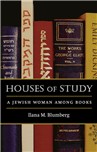
 Now available in a paperback edition, read from the Preface of Houses of Study: A Jewish Woman among Books by Ilana M. Blumberg:
"The story I tell in the pages to come begins in 1988, when I landed in Israel, eighteen years old and female. My crosscultural education began with a lesson in language. The term ‘‘yeshiva’’ (seminary), I quickly learned, did not apply to girls or women. In America, our teachers had talked about our year of study in ‘‘yeshiva’’ without distinguishing between male and female students and institutions. But when I got to Israel, conversations in Hebrew came to a standstill when Jews, both religious and secular, asked me why I’d come to Israel and I explained that I’d come to learn in ‘‘yeshiva.’’ I’d used the wrong term, they explained. Girls and young women went to mikhlala (women’s college), not yeshiva.
It was what we might call a semantic difference; it didn’t change what I’d come to do. But the existence of two terms for what I’d thought was one separate but equal endeavor alerted me to a new doubleness. This was not a division between ‘‘Torah U’Madda’’ but between men and women. Mikhlala conjured images of young women of marriageable age sitting in rows of desks, an extension of high school, with a married religious woman teaching them material in what Americans would call a mode of ‘‘frontal education,’’ the transmission of knowledge from the teacher’s side of the desk to the student’s. Yeshiva conjured rooms filled with long tables, men of all ages sitting on either sides of the tables, studying with each other, reading the Talmud aloud, debating its meanings, engaging in a lifetime practice that could be sustained without a teacher, though independent study alternated with shiur, rabbinic lessons about the material prepared. These were stereotypes to be sure, and stereotypes that would come to be violated regularly by girls, women, and mikhlalot (women’s colleges) in the years that followed. Nonetheless, when I arrived at Barnard College twelve months later, no one told me that ‘‘college’’ was not the term I was looking for.
Nearly twenty years have passed since I left my childhood family and home and made my first forays into the Beit Midrash and the university, the two ‘‘houses of study’’ I would inhabit independently as an adult. But any adult resolution I have achieved between these two worlds still yields frequently to my sense of deep conflict. For more than ten years conflict was so dominantly my experience that I assumed adulthood meant the force that pulled things apart."
To read a longer excerpt or to purchase Houses of Study, visit http://www.nebraskapress.unl.edu/product/Houses-of-Study,671916.aspx.
 UNP blog