
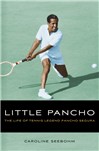
 Read from Chapter 2 of Little Pancho: The Life of Tennis Legend Pancho Segura by Caroline Seebohm:
"Pancho returned home from Quito in the spring of 1938. He had been three months away from home, in the cool high altitude, playing tennis every day. When he appeared at the Guayaquil Tennis Club for the first time after his absence, it was clear he was transformed. Stronger, faster, fitter, he was playing brilliant tennis. He was also extremely competitive. When he played with the members, he played to win.
The club players were impressed. Some of them also realized their little Pancho could be of immense use to them. Coming up was the annual tennis tournament between Guayaquil and Quito. The two major cities in Ecuador historically enjoyed an intense political rivalry, and the tennis tournament was no different. It was a fiercely fought match that represented the most important championship in the country. This year a group of members of the Guayaquil Tennis Club decided they should invite Pancho to participate in the tournament.
Pancho Segura? Play for the Guayaquil Tennis Club? A lot of people were outraged at the suggestion. The little cholo, the ball boy? He wasn’t a member, could never in a million years become a member. The idea was ridiculous. How could this poor care-taker’s son represent the cream of Guayaquil in such a socially important sporting event? Moreover, he was professional, wasn’t he? Hadn’t he taken money to play with the members over the years? So what if it was only fifty cents? The club could not coun-tenance any threat to its amateur status. The outcry was loud and persistent.
This was the first time Pancho experienced the reality of his position. He had innocently knocked on the door of a world that would never forget where he came from. At the age of sixteen, he was discovering how many obstacles there were for him to face if he continued his career in tennis, not only physical and mental but social. The physical and mental barriers he had already proved he could negotiate successfully; the social ones presented a more intangible and complex threat.
It took some cunning maneuvering to solve the problem of getting Pancho to Quito. There was no way he could represent the Guayaquil Tennis Club. He wasn’t a member and never could be a member. That was that. But his supporters found a way around this ruling by having the young player represent another club in town, which was happy to sponsor him in the tournament.
So Pancho Segura went to Quito. Thrilling, yes. It was his first major appearance on the national tennis circuit, a moment he had been working toward for years. But he was made to pay a painful price for his acceptance. His teammates were not at all pleased at being told to play with this social upstart, and they expressed themselves in the subtle and not-so-subtle ways of class superiority. Pancho may have been part of the team, but he was absolutely not a member of the club. They would not let him sit with them on the train trip to Quito, forcing him to travel by himself in a third-class compartment. He was not allowed to eat with them, either. The club players went out for pork chops, leaving him behind. Since, unlike them, he had no money, he was reduced to buying plantain chips from a street vendor.
Pancho accepted this treatment without bitterness. His job was to play tennis for Guayaquil, and with typical focus, he responded fervently to the challenge. He won all three of his matches, contributing to Guayaquil’s defeat of their longtime rival. “We beat the hell out of them,” Pancho observed with a satisfied grin. On the way home, his teammates were more respectful of the little cholo ball boy. He could win matches for them, it appeared. On the train back to Guayaquil, he was allowed to sit with the rest of the group.
After this triumph, Pancho was no longer an unknown player. Many people had watched him play in Quito, and they were not about to forget him. The speed! The anticipation! The unheard-of, two-handed forehand! Spectators were astonished at this phenomenon. One man in particular was startled by the talent shown by the dark little teenager from Guayaquil. He was Galo Plaza Lasso, president of the Ecuador Olympic Committee (he later became president of Ecuador). Plaza had been educated at Georgetown University in the United States and was an imposing, fair-haired man of considerable elegance. He decided to invite Pancho to join the Ecuador tennis team entering in the Bolivarian Olympics in Bogotá later that year.
Once more, there was resistance. Peru, a participating country, again brought up the issue of Pancho’s professional status, and again, his supporters scoffed at the allegation. Plaza went so far as to threaten to boycott the games if Pancho were banned. The Peruvians withdrew their objection, and Pancho was accepted as part of the Ecuador delegation."
 UNP blog