
 Memorial Day is nearly here (if you’re lucky, Memorial Day weekend has already begun), and barbecues, boating and other Memorial-Day activities are imminent. But I thought I’d focus today’s post on the history of Memorial Day and (of course) a corresponding title.
Memorial Day, originally called Decoration Day, was first observed on May 30, 1868, and was a way of honoring the soldiers who died in America’s Wars. You can view the order creating Memorial Day here. The day has changed some over the years – the name changed, obviously, and the VFW and American Legion began selling poppies to raise money for disabled soldiers, at some point, inspired by the poem Flander’s Field – but many traditions have remained the same. Cemeteries still hold services on Memorial Day, and descendents of veterans place wreaths and flowers on their graves.
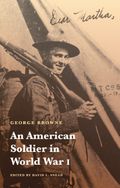
The University of Nebraska Press has published many stories of soldiers over the years. But An American Soldier in World War I, a collection of letters that George Brown sent his fiancée between 1917 and 1919, seems particularly fitting for Memorial Day.
George “Brownie” Browne was a twenty-three-year-old civil engineer in Waterbury, Connecticut, when the United States entered the Great War in 1917. He enlisted almost immediately and served in the American Expeditionary Forces until his discharge in 1919. An American Soldier in World War I is an edited collection of more than one hundred letters that Browne wrote to his fiancée, Martha “Marty” Johnson, describing his experiences during World War I as part of the famed 42nd, or Rainbow, Division. From September 1917 until he was wounded in the Meuse-Argonne offensive in late October 1918, Browne served side by side with his comrades in the 117th Engineering Regiment. He participated in several defensive actions and in offensives on the Marne, at Saint-Mihiel, and in the Meuse-Argonne.
This extraordinary collection of Brownie’s letters reveals the day-to-day life of an American soldier in the European theater. The difficulties of training, transportation to France, dangers of combat, and the ultimate strain on George and Marty’s relationship are all captured in these pages. David L. Snead weaves the Browne correspondence into a wider narrative about combat, hope, and service among the American troops. By providing a description of the experiences of an average American soldier serving in the American Expeditionary Forces in France, this study makes a valuable contribution to the history and historiography of American participation in World War I.
 UNP blog