
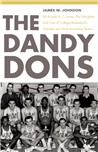
 Read from the Introduction of The Dandy Dons: Bill Russell, K. C. Jones, Phil Woolpert, and One of College Basketball's Greatest and Most Innovative Teams by James W. Johnson:
"I was twelve years old when my father took me to see my first college basketball game—the University of San Francisco against whom I can’t remember. But I do remember that it was during the 1949–50 season, the year after the Dons won the NIT, then the biggest college tournament in the country. Don Lofgran, Rene Herrerias, Ross Guidice. What a night.
If I saw another college game in the next five or six years, I can’t remember it. But I do recall seeing the 1955 and 1956 Dons play during the years they won the NCAA tournament. As a youngster I just appreciated good basketball. I wasn’t able to recognize the historic and cultural significance of the excitement on the court. Perhaps it has taken me fifty years to gain that perspective, but I’ve never forgotten the game Bill Russell and K. C. Jones brought to the hardwoods in those years. They changed basketball in terms of race, rules, strategy, and even popularity.
Fifty-one years later while watching the grainy, black-and-white highlight films of games I saw as a teenager, I recalled how different the game was back then. It was slower and much less physical. Over the years officials have allowed players to become more aggressive. Basketball is no longer a noncontact sport.
In the 1950s you didn’t see palming of the ball, pushing and shoving, or high levels of turnovers. Nor did you see tattoos, headbands, t-shirts under jerseys, or baggie pants. “We weren’t trash-talkers and in-your-face the way a lot of players are today,” said Mike Farmer, a forward on the 1956 championship team. What you did see were set shots when players’ feet rarely left the floor. The same was true on the defensive end, where teams took defense to mean a chance to rest up for their offensive. And then there were those underhand free throws.
With the USF Dons several things stood out. Gene Brown’s skills rivaled those of Michael Jordan with his twisting jump shots. Bill Russell jumped higher above the rim than anyone I had ever seen. K. C. Jones was inside his opponent’s jersey on defense. Opponents rarely got off set shots against the tenacious Dons’ defense. Only once in the highlight films did I see an opponent make a set shot, and that was Bernie Simpson of Cal, who drilled one from at least thirty feet away, far beyond today’s pro three-point line.
The game in the mid-1950s had more finesse—almost like slow-motion ballet—compared with what we see today. Athletes are more athletic and much bigger now, there’s no doubt about that. And coaches play a much greater role during a game as well. USF coach Phil Woolpert just let his team play. No plays were called out from the bench, and there were no special plays for Bill Russell. Coaches didn’t call repeated time-outs to tell the team what to do. Money and television have changed the game. During a game in the 1956–57 season, Cal’s Pete Newell and UCLA’s John Wooden entered into a psychological battle to see who would call the first time-out. Wooden gave in first, calling a time-out with four minutes left in the game. That time-out gave Cal a psychological lift that enabled the Bears to pull ahead and win. Today television demands a break every four minutes for commercials; coaches often hold out for those commercial timeouts to avoid using one of their own. At times teams resume play after a commercial time-out, run up and down the court a couple of times, and then abruptly stop playing again when the coach calls a time-out. Where’s the rhythm? Where’s the momentum? Whatever happened to just letting the players play?"
 UNP blog