
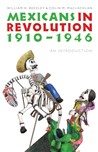
 Read from the introduction of Mexicans in Revolution, 1910-1946: An Introduction by William H. Beezley and Colin M. MacLachlan:
"For Mexicans in general, but especially those in the capital city, the late summer of 1910 brought the inauguration of new buildings, monuments, and institutions (including an insane asylum) to commemorate independence. The grand national celebration was held on September 16, with parades and speeches that drew official and unofficial visitors from Europe, the United States, Latin America, and Asia, particularly Japan. The centennial parades highlighted the story of Mexico’s past, through the stages of ancient Aztec glories, colonial civilizing efforts, and the Porfirian creation of a cosmopolitan nation. Through it all, the elderly president remained remote; the patriarchal patriot had seemingly become detached from daily activities, serving only as the national symbol. As the Díaz regime basked in the afterglow of the centennial celebrations, on November 20 insurrectionary battles erupted in distant Chihuahua and the revolution sputtered to life.
The first social revolution of the twentieth century had begun. The Russian, the Chinese, and the Cuban revolutions later lurched into existence in reaction to the old regimes in those countries. These revolutions drew on well-established socialist and subsequently communist philosophical responses to feudal, colonial, and imperial systems. Lenin, Mao, and Castro closed their societies behind the doors of ideology and promoted social changes driven by theories. The Mexican Revolution resulted from a decidedly different context and programs. The successes, not the failures, of the previous regime generated these revolutionaries. They took pride in their nation, its political stability, economic successes, and international reputation, but they wanted to share in its government, profits, and prestige. They recognized the opportunities for ambitious individuals and they wanted to see hard work and initiative rewarded. Once their struggle began, the revolutionaries eventually mobilized the majority of the nation’s people in a campaign to make the good life lived by the Porfirian elites available to everyone. Despite staggering obstacles to implementing social changes (including the deaths of some two million individuals, about one in seven Mexicans), the revolutionaries never wavered in their commitment. Once in power they adopted an empirical, practical, nonideological projects (unless one counts anticlericalism as an ideology), open to the social experiments by others. They built their programs on cosmopolitan pragmatism devised by foreign travel and innovative improvisation based on wartime experiences. This generation willed into law, if not completely into everyday practice, what before them had been unimaginable: the creation of a just, equitable, and good life for all Mexicans."
 UNP blog