
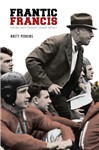
 Read from the first chapter, "Something Stirring on the Prairie" in Frantic Francis: How One Coach's Madness Changed Football byBrett Perkins:
"Because Francis Schmidt operated somewhere between oddness and madness, it has always been difficult to determine which stories about him are true and which are myths. Everything he did had a manic quality, making even the outlandish tales hard to dismiss. But the truth is fascinating enough. He worked eighteen hours a day, devoting most of his waking thought to football, and even a few hours of sleep failed to interrupt his passion. He kept a pad and pencil hanging from his bedpost so he could jot down ideas that came to him in the night. Besides coaching his own team during the football season, Schmidt attended as many football games as possible, whether they were at a university, a teachers’college, or an all-black high school. He filled notebooks with endless notes on what he saw, always looking for variations of plays or formations that might be new to him. There weren’t many. The diagramming—or creating—of football plays was his most famous obsession. Schmidt worked at creating plays the way a chain smokerworks a cigarette. Using Xs and Os to represent players and arrows and dashes to represent movement, Schmidt was a mad scientist seeking a cure for touchdown deficiency. His mind seemed unable to disengage from this pursuit, and he frustrated all who knew him by mentally disappearing during conversations, parties, and bridge games.There had to be a million possible plays, and Schmidt seemed determined to discover and document every one in a notebook, on a napkin, or on random scraps of paper. This prodigious output was always his blessing as well as his curse.
Schmidt certainly looked the part of a zealot, with lazy eyelids barely concealing dark, knowing eyes that hinted at maniacal possibilities. Those same eyes displayed dark circles and bags, the result of hours of obsessing instead of sleeping. He had a long, hawk-like nose and a mouth that always seemed on the verge of smiling at a cynical joke of which only he was aware. His short, prematurely graying hair was parted on the left with great precision and combed to the sides. The whole look was underscored by his trademark bowties. He was a curious vision by most standards and one unlikely to be missed. Standing 6 feet 2inches, which was quite tall for the time, Schmidt was usually the tallest man in the room.
Francis Schmidt was absentminded and myopic, often oblivious to his surroundings, which included other folks. People were a curiosity to him, and his dealings with them were devoid of subtlety. He was often referred to as “plainspoken,” and usually not in a complmentary sense. Telling reporters that an upcoming opponent was lucky and possibly undeserving of their win was the sort of plainspeaking most coaches avoided. Francis Schmidt was confident—almost to the point of delusion—and full of raw sarcasm, but he was not angry or mean-spirited; he just struggled subconsciously to reconcile the minutiae of social custom with a zeal for getting to the point. He was not an intellectual but he was clever and imaginative, and his mind worked relentlessly, unable to slow itself. Mentally, he was a bull in a china shop.
Schmidt’s players understood this. They loved him even while he was mispronouncing—and then forgetting—their names and confusing them with other teammates. They were wide-eyed and amused by his staggering use of profanity, a habit that kept school officials constantly wincing. The players even found Schmidt’s sarcasm and caustic wit fascinating, verbal curiosities the young men were unaccustomed to hearing from a professional adult. Schmidt had both a great sense of humor and an unintentionally humorous personality. The players smiled as they shook their heads at his antics.
His practices on the field were long and arduous. They were also confusing as Schmidt ruled with a capricious fist, tinkering with lineups and introducing newly devised plays even though the team had yet to fully grasp plays from the previous day’s lesson. He was a hands-on coach, giving animated demonstrations on the proper running of each play, but he was too impatient to delegate, leaving his assistants feeling frustrated and useless. He talked fast, machine-gun style. The players learned to accept the on-field version of Schmidt as a lovable caricature of obtrusive fervency. Off the field he remained mysterious, continuously vacillating betweene bullience and unapproachable thought."
 UNP blog