
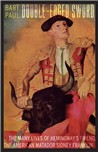
 Read the beginning of Chapter 1, "The Bull" from Double-Edged Sword: The Many Lives of Hemingway's Friend, the American Matador Sidney Franklin byBart Paul:
"He was born Sidney Frumpkin on July 11, 1903, one of nine surviving children to Abram and Lubba Frumpkin of Minsk and Kazan, respectively. His parents, both Orthodox Jews, emigrated from Imperial Russia in 1888. After eight years in this country and the birth of his first few children, Abram joined the New York City Police Department, eventually working out of Brooklyn’s Seventy-Eighth Precinct. The borough of Brooklyn was completing the transition from a semirural community of farms, shade trees and backyard gardens to a noisy city, becoming further transformed by the new immigrants from eastern and southern Europe. The city had been an independent municipality until just five years before Sidney’s birth, when it was incorporated into New York City. The Brooklyn Eagle, the paper that would eventually chronicle the rise of its hometown matador, was for a time edited in the late 1840s by Walt Whitman, another homeboy whose private life was also best kept from the public eye.
By the time the Frumpkin’s fifth child Sidney arrived, the family was living at 14 Jackson Place in a district known as Park Slope. They were just three blocks west of Prospect Park and five blocks north of Greenwood Cemetery, the two huge green patches left in the center of Brooklyn.
Most of what is known of Sidney’s childhood a century ago comes from two sources, both over half a century old. Each, although covering many of the same events, are quite different: parallel yet only partial narratives in very dissimilar voices, although the source for the mingled (and occasionally mangled) facts and fictions in both is Sidney himself. The first was a profile of Sidney by Lillian Ross that appeared in the New Yorker magazine under the title “El Único Matador” in 1949. The young writer traveled with Sidney for a time in Mexico as he toured with an American protégé. She extensively interviewed Sidney’s former friend Ernest Hemingway in Ketchum, Idaho, in December 1947 for the article—the first that would appear in the magazine under her own byline. The persona of Sidney that comes through in “El Único Matador” is brash, confident, slangy, eccentric, and boastful—a true American character. He also occasionally appears, if not foolish, at least lacking in self-awareness. After the article appeared, Sidney remarked of Ross: “She sits there like a little mouse, looking so cute, but there’s nothing but vitriol in her typewriter.”
Decades after meeting Sidney, Miss Ross’s memories of him remained vivid, full of detail and anecdote that did not make it into her profile. Her article, despite Sidney’s grumbling, kept him in the public eye, perpetuating his rather singular celebrity. Having been befriended by Hemingway and his fourth wife, Mary, while researching the article on Sidney, Lillian Ross would go on to write “How Do You Like It Now, Gentlemen?” a famous piece on the author that appeared in the New Yorker in 1950. Many of Hemingway’s friends shared Sidney’s complaint about Ross: her extensive use of the subject’s quotes without sufficient context made Hemingway look foolish. Unlike Sidney, Hemingway remained Ross’s friend and defended her and her work for the rest of his life. For her part, Miss Ross returned the favor, remaining a Hemingway stalwart, her fondness and respect for him undiminished. If there are any sides to be taken in the subsequent falling out between Sidney Franklin and Ernest Hemingway, for Ross there is no contest."
Bart Paul has been a critic for the Los Angeles Times Book Review, a writer of documentaries on subjects as diverse as President Truman, Masada, and Nazi atrocities in Poland, and an anthologized writer of short fiction. He lives outside Los Angeles where he raises horses and children.
To read a longer excerpt or to purchase Double-Edged Sword, visit http://www.nebraskapress.unl.edu/product/Double-Edged-Sword,674156.aspx.
 UNP blog