
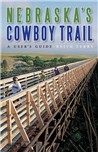
 Here's another feature from our holiday sale. Read from the Introduction of Nebraska's Cowboy Trail: A User's Guide by Keith Terry:
"The Cowboy Trail stretches 321 miles across the northern part of Nebraska. It begins in Norfolk, in the northeast area of the state, and extends to Chadron in the northwest. The trail follows the route of the old Cowboy Line, which was used by the Fremont, Elkhorn & Missouri Valley and later the Chicago & North Western railroads between about 1870 and 1992.
Nebraska geography changes dramatically from one end of the state to the other, and this adds to the adventure. In the east the soil is black, rich, and fertile and supports a wealth of grasses, flowers, and trees. In the west sand is abundant, the environment is more arid, and very different plants thrive there. In between, the transition from one to another is gradual and there are plenty of interesting sights for trail users. Because of these changes, each of the sections of the trail is interesting and attractive in its own way, and I can’t say that one is better than any other.
Because the Cowboy Line was originally intended for trains, you’ll find that the entire route is relatively flat, which makes the journey quite pleasurable. Where there were hills or valleys in the surrounding geography, the engineers who developed the course many years ago cut straight through the grade, built bridges, or bypassed problem areas. For example, the path in Norfolk is 1,518 feet above sea level and at Thatcher, west over 180 miles away, the trail is at 2,664 feet above sea level, which results in an average change of just over 6 feet per mile. As I said, inclines or declines along the trail are few and these will be almost imperceptible.
My journeys take me from Norfolk through Battle Creek, Meadow Grove, Tilden, Oakdale, Neligh, Clearwater, Ewing, Inman, O’Neill, Emmet, Atkinson, Stuart, Newport, Bassett, Long Pine, and Ainsworth. This is a continuous and relatively smooth-surfaced 144-mile stretch of the trail. The next section of the trail that is surfaced begins 32 miles west of Ainsworth at Arabia, a ghost town. It is 13 miles in length and leads into the city of Valentine. In total, walkers and cyclists have over 150 glorious miles of the Cowboy Trail to explore today.
The Nebraska Game and Parks Commission’s long-term plan is to convert the entire 321 miles into a usable hiking/biking path over the next several years. Renovating 1 mile of the trail costs approximately $30,000 and involves removing the iron rails and wooden ties, scraping off the aggregate stone filler, rebuilding or repairing bridges, adding signage, and spreading and compacting the new stone surfacing. I have traveled on some segments before they were completed and would advise you not to repeat my error. On some unimproved sections the path can be very rough and often the grass is quite high, making it hard to see what hazard might be lurking ahead. On others
the path has had the consistency of a sand dune, making it very difficult for walkers or bikers to get any traction at all. Currently, there are two unsurfaced sections of the trail. As mentioned earlier, one is 32 miles long and is just west of Ainsworth and the other is 132 miles in length and runs from Valentine to Chadron. Both will open bit by bit in the future, and when they do, this will result in lots more fun for all trail users.
To accommodate those souls exploring the trail, I describe in each chapter of this book where a person can camp, get a place to sleep, find a grocery store, or purchase a hot meal in the towns along the way. You will also find descriptions for a few destinations that are within 20 or 30 miles of the trail. These places have been highlighted because they are Nebraska treasures that will complement your holiday adventure and add to your enjoyment of the area."
 UNP blog