
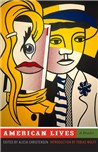
 Read from "Long Live the Red Terror!" by Fan Shen, from American Lives: A Reader edited by Alicia Christensen:
"Chairman Mao, the Great Leader, officially launched the Cultural Revolution in his May 17 proclamation in the People’s Daily, calling for the masses to smash the five-thousand-year-old Chinese culture and to rid the country of any foreign influence, in order to build a brand new communist culture. “Power to the Red Guards!” said the Great Leader. “Expose and destroy the hidden enemies who have been sleeping among your ranks!” ordered the Great Leader. Overnight, people young and old all rose at the summons of the Great Leader. After the giant bonfire, the fire of the Revolution spread fast and wide throughout the Big Courtyard.
No one could have imagined that such chaos was possible in the Big Courtyard, whose buildings were most stern-looking and whose life, for adults and children alike, was highly regulated. Situated at the west end of the long and wide Eternal Peace Boulevard that runs from east to west through the whole city of Beijing, the Big Courtyard is an enclosed compound with high, solemn gray walls that housed the headquarters of the People’s Liberation Army. A square park with short pine trees divides the Big Courtyard evenly into two parts: the residential area on the south and the business area on the north. The south side is a self-sufficient and orderly community, with sixteen identical four-story apartment buildings neatly arranged in four blocks, a hospital, a shopping complex, a huge public dining hall where all my friends and I bought our meals with food coupons since we were in first grade, and the Flying Wing School, which I attended since I was three. This is the whole sphere of my childhood and I never knew any freedom growing up in such an orderly place. Every minute of my life, from the moment I was awakened in the morning to the moment I was put to bed, was carefully planned by my parents and teachers. I was not allowed to go outside of the gray wall that encircled the Big Courtyard and I never played with children outside. Nor was I allowed to go beyond the little park lined with trimmed pine trees to the north side, which is called the “Little Forbidden City” and is guarded by soldiers. The north side always seemed to me like a ghost city with clean and quiet and empty streets leading to the three cheerless, dark-green office buildings on the right, and to several smaller brown buildings known as generals’ quarters on the left.
But in just a few days, the call of the Great Leader turned the quiet and orderly Big Courtyard into a big boiling cauldron, and the normal life that I had been living was shattered. The adults in the Big Courtyard and the senior students at our school formed various Red Guard teams and began writing big-letter posters and holding all kinds of rallies around the clock. My school was closed the day after we burned the books, and we were told to join the revolution. I was overjoyed. No school and a revolution! Nothing could be better! I especially enjoyed the freedom that I suddenly gained from my parents: they became so busy attending meetings that they were hardly home during the day and were forced to allow me more freedom to come and go, as long as I went out to read revolutionary posters and did not forget to take my sister to the public dining hall to eat.
Having been brought up in a very strict family, I took full advantage of my newfound freedom and went out every day to read posters or to simply get away from the apartment. No more torturous afternoon naps! For many days, I roamed the Big Courtyard with my friends and stood among adults reading the innumerable sensational and entertaining posters. At the outset of the revolution, the posters were hung in neat rows in out onto any space available. The larger ones were posted on the walls and windows of residential buildings or hung from long ropes strung among the pine trees in the park, and the smaller ones on lampposts and tree trunks. At first, most posters were serious debates among various Red Guard “fighting teams,” all of which bore impressive names like “Red Iron-Fist Corps,” “The Crimson-Terror Battalion,” and “The Scarlet-Blood Regiment.” It was a totally confusing war of words for a twelve-year old like me. For all I could make out, all the Red Guard teams claimed to be fighting for the Great Leader, but they could not agree on who were the hidden enemies that the Great Leader wanted them to expose. Oddly, they seemed to find the hidden enemies in other Red Guard teams, and they seemed to hate each other so much that they called each other “guards of capitalist dogs” and wanted to chop their opponents with “ten thousand knives” as if they were worse than Japanese Devils. It is truly amazing, when I think back on those posters, that the Red Guards used so much paper and ink to fight each other when they were all comrades under the Great Leader. But in those days, nobody saw the ridiculousness of the fight among Red Guard factions."
Hailing from the People’s Republic of China, Fan Shen is a professor at Rochester Community and Technical College in Minnesota. He has published three translated books and numerous articles in both Chinese and English. Alicia Christensen is the Bison Books editor at the University of Nebraska Press.
To read a longer excerpt or to purchase American Lives: A Reader, visit http://www.nebraskapress.unl.edu/product/American-Lives,674197.aspx.
 UNP blog