
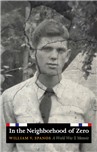
Read the beginning of Chapter 2, "Captivity" from In the Neighborhood of Zero: A World War II Memoir by William V. Spanos:
"After a rough crossing of the English Channel, the 106th Division arrived at the battered seaport of Le Havre, a city that had been virtually leveled during the Normandy invasion, where a convoy of U.S. Army trucks, “The Red Ball Express,” was waiting to transport us to our destination. During the crossing our officers had informed us that we were being assigned to an area in the Ardennes Forest, specifically a mountain area called the Schnee Eiffel, west of the village of St. Vith in Belgium near the Luxembourg border. We were, they said, going to replace the 2nd (“American”) Division, a renowned unit, desperately in need of respite, having been in combat since the invasion of Italy in September 1943. Although the ground we were to take over from the 2nd was on the front lines separating the Allies from the German forces, it was, we were relieved to hear, an inactive zone, providing the perfect conditions for easing a raw and inexperienced division into combat action.
On disembarking at Le Havre, my mind was preoccupied by the wintry cold and, not least, the question of what was to come when we had reached our destination. I was nevertheless struck by the discovery that the United States Army convoy that constituted this Red Ball Express was manned entirely by a unit of African American soldiers, who, saying nothing, went through the mechanics of organizing the expedition into the interior as if they were phantoms, not flesh-and-blood bodies. This impression, especially underscored by our conveyors’ spectral silence, exacerbated that uneasiness about the United States I had come to feel in Georgia, when I realized that the army I belonged to was segregated. Sometime during that long night it even occurred to me that our guides—black Virgils, I would now call them—were leading us not toward our salvation but to our doom.
The journey through northern France in light snow and bitter cold was surreal. The convoy drove with lights dimmed on winding local roads that took us through small and large villages, where French families huddled in the cold at the entrances of their homes silently waved to us as we passed through, occasionally handing containers of coffee to the men on the trucks when the convoy was stalled because of traffic congestion. In the truck bearing my antitank gun crew we sat together in gloomy silence, our anxiety minimizing the warmth of our huddled bodies. No jokes, no banter, no small talk. We were diminished. The size many of us had achieved in the process of training had withered away. To the French outsiders we may have looked like fearless warriors. On the inside, or so it seemed to me, we were young boys again who had been torn from our homes and transported like sheep across a void into a nameless and threatening space—a real nightmare—by a force whose power I had felt brush against the edge of my consciousness on several occasions since my departure from New York."
William V. Spanos is Distinguished Professor of English and comparative literature at the State University of New York at Binghamton. He is the author of many books, including America’s Shadow: An Anatomy of Empire and American Exceptionalism in the Age of Globalization: The Specter of Vietnam.
To read a longer excerpt or to purchase In the Neighborhood of Zero, visit http://www.nebraskapress.unl.edu/product/In-the-Neighborhood-of-Zero,674228.aspx.
 UNP blog