
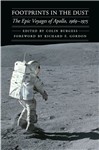
 Read the beginning of the Prologue, "Realization of a Dream of Ages" by Colin Burgess from Footprints in the Dust: The Epic Voyages of Apollo, 1969-1975:
"It was the spring of 1961, and the United States was in desperate need of some good news. The nation was experiencing considerable pain and undergoing an inescapable insight, with a mounting number of civil rights protests highlighting a desire for profound attitudinal change. At the heart of this movement was the spreading use of nonviolent “sit-ins,” for the most part courageously led by young black college students protesting against enforced segregation in department stores, supermarkets, theaters, libraries, and elsewhere. Over the next few years these demonstrations would escalate in size and turmoil, often marred by violence, deaths, and bloody divisions across the nation.
The Cold War with the Soviet Union also had tensions running high, and a disastrous attempted invasion of Cuba at the Bay of Pigs would prove a monumentally high-profile failure for the United States’s ambitious new president, John Fitzgerald Kennedy. The nation’s fledgling space program, it was realized, could provide that crucial good news, create a renewed sense of pride and motivation, and offer something around which all Americans could rally. But the National Aeronautics and Space Administration (NASA), while still finding its feet as a civilian space agency, was frustratingly guilty of moving too slowly and cautiously and not heeding ominous warnings of pending space activities emanating from the Soviet Union. In this climate of uncertainty the first human spaceflight carried out by cosmonaut Yuri Gagarin stole the thunder of NASA’s beloved Project Mercury.
Today there is widespread agreement that President Kennedy launched what became known as the space race primarily to revive the languishing spirits of the American people and to dramatize U.S. technology. The president and his advisors certainly had identified the next great battlefield.
On 25 May, just twenty days after Alan Shepard completed the first U.S. manned space flight, President Kennedy delivered a special State of the Union message to a joint session of Congress. In it he changed forever the course of the United States space program, saying in part, “I believe that this nation should commit itself to achieving the goal, before this decade is out, of landing a man on the moon and returning him safely to the Earth.” He then asked for an additional twenty billion dollars from Congress to expedite the program. Kennedy’s bold challenge was met with polite but hardly enthusiastic applause from Congress. The president then departed from his prepared remarks, the only time he did so in addressing Congress, by forcefully adding that “unless we are prepared to do the work and bear the burdens to make it successful,” it would make no sense in going ahead with the project.
A bold challenge had been laid before the American people; the gauntlet had been thrown down. With only fifteen minutes of manned space flight experience, the United States would set its sights on the moon and try to get there before the Soviet Union. Academic Amitai Etzioni, the so-called guru of the nebulous communitarian movement and later a senior advisor to President Jimmy Carter, would state in bitter criticism, “We are using the space race to escape our painful problems here on Earth.”"
 UNP blog