
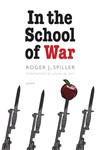
 Read from the introduction to In the School of War by Roger J. Spiller:
"After artillery deploys for battle, arranges itself into batteries, a commander usually orders a ranging shot, a round or two meant to estimate how far his guns will reach. Or so it was before modern science intervened. Although we don’t know for sure, someone among Henry V’s archers at Agincourt—masters of the lethal, indirect firepower that would turn that day in his favor—must have fired such a shot, adding one more tactical detail to the King’s picture of the field where he and his men were about to fight. Centuries later, Robert E. Lee reserved to himself the order for the first shot as he looked over the open fields at Fredericksburg and General Burnside’s Grand Divisions forming for their attack. In those days, after throwing a few cannonballs in the enemy’s direction, a commander could see for himself just when the enemy’s advancing troops might fall under the shadow of his imaginary artillery fan. Then he could decide whether to open up his artillery to spoil the attack or, waiting longer, to kill it outright—the “it” being hundreds or even thousands of other human beings.
A ranging shot, which was as much an artistic as a technical feat, could tell the enemy commander something about you, too. If the shot sounded tentative or forlorn, if the crack of the gun and the snap of the explosion were somehow not so sharp, your enemy might think your defenses were too thin and then press his own attack that much more resolutely. Never mind that we’ve known for a long time that these sounds are influenced by atmospheric conditions, topography, and any number of other technical factors such as the quality of the gunpowder or the design of the barrel. So knowing, we might doubt cannon fire could be understood in psychological terms, but on the fields of classical battle impressions counted. Then the best commanders were said to have a knack for imagining the battle to come, sizing up the ground, their enemies, and the morale of both sides, and calculating all this in the blink of an eye—a coup d’oeil.
Whether any of this had any scientific credence, generals and soldiers readied themselves by the means—psychological as well as material—available to them. A few strands of a loved one’s hair tucked away in a locket could be far more important to a soldier’s performance than the most stirring oration by a well-fed bemedaled general or the elegant plans of a general staff. Before the battlefield exploded in spasms of violence, before the sweat-inducing stomach churning, tremors of fear coursed through the combatants’ neural networks, rationality retreated to safer places, up the chain of command from one headquarters to the next, past the reports and letters and memoirs, finally coming to rest in the history books—a coup d’oeil de dieu, a god’s-eye view.
Reaching back to where military history began, to its violent source, required some ranging shots."
Roger J. Spiller is the George C. Marshall Distinguished Professor of Military History (retired) at the U.S. Army Command and General Staff College in Fort Leavenworth, Kansas. He is the author or editor of numerous publications, including his latest work, An Instinct for War: Scenes from the Battlefields of History. Most recently, he was an advisor for Ken Burns’s PBS documentary, The War.
To read a longer excerpt or to purchase In the School of War, visit http://www.nebraskapress.unl.edu/product/In-the-School-of-War,674218.aspx.
 UNP blog