
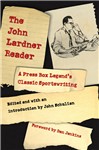
 Read the beginning of the Introduction from The John Lardner Reader: A Press Box Legend's Classic Sportswriting, edited and with an introduction by John Schulian:
"Since TV and talk radio started throwing crazy money at them, more and more otherwise admirable sportswriters have been only too happy to install whoopee cushions where their regard for the language used to be. It’s a natural reaction, I suppose, like realizing that the only way to be heard in a noisy bar is to shout louder than everybody else. But sly humor and high style have taken a drubbing everywhere sports are written. Worse yet, John Lardner has been forgotten. That’s as wrong as wearing white socks at a funeral.
In a perfect world, there would be lessons in Lardner wherever sportswriting is taught, although I suspect the man himself would have used them as fodder for one of his laugh-out-loud columns for Newsweek. He had a fondness for the sublimely ridiculous, and there was plenty of it going around in the benign era when he was hammering away at his typewriter. Not that he wouldn’t have feasted on such contemporary targets as steroids, overindulged athletes, bloated contracts, conniving agents, and soulless team-owning corporations. But he must have had a hell of a lot more fun writing about characters who are a hell of a lot more fun to read about: gamblers and golf hustlers, fight racket exotics, screwball ballplayers, and the occasional Roller Derby queen.
Consider this:
“When Ezzard Charles won the heavyweight championship by licking J. J. Walcott, two years ago, Ezzard’s manager, Jake (Madman) Mintz, passed out in the ring. Last July, when Walcott won the title, it was Charles who fell, while Jake remained on his feet throughout. That is my idea of a perfect partnership—always one man conscious, to count the house.”
The amazing thing about Lardner—well, one of them, anyway—was his ability to shift from seven-hundred-word sprints for Newsweek to quirky rambles five and ten times that long for magazines like True, Sport, and the New Yorker. He never dropped so much as a semicolon. So it was that he wound up atop the same mountain with Red Smith and Jimmy Cannon, the giants of the newspaper game, and W. C. Heinz, who abandoned a daily column to apply the techniques of fiction writing to magazine journalism. Whether they knew it or not—and it’s likely that even the pugnacious, streetwise Cannon didn’t—they were revolutionaries.
They put a hammerlock on American sportswriting after World War II and marched it right up to the edge of literature. No longer would the business be the province of cliché-spewing hacks and old drunks waiting to be paid off by wrestling promoters. Suddenly the most talented and perceptive men chronicling fun and games (women would come later) aspired to do more than get the score in the first paragraph. There were full-blooded personalities to be written about, earthy vernacular to be captured, sacred cows to be tipped. And there was always the debate about who was the heaviest hitter: Smith, Cannon, Heinz, or Lardner.
Fate cheated Lardner out of his just due when he died too young, at forty-seven, in 1960. The others lived to write another day and then some. There were anthologies of their best work too, the last of Cannon’s posthumous, Heinz’s while he was still living, and Smith’s both before and after he drew his final breath. Roger Kahn did what he could for his favorite sportswriter in ’61 by compiling a splendid collection called The World of John Lardner. But there hasn’t been another such book until the one you hold in your hands."
 UNP blog