
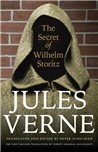
 Read the beginning of The Secret of Wilhelm Storitz: The First English Translation of Verne's Original Manuscript by Jules Verne, translated and edited by Peter Schulman:
"“. . . And get here as soon as possible, my dear Henry. I can’t wait to see you. By the way, this country is magnificent and there’s a lot for an engineer to see in the industrial region of Lower-Hungary. You won’t regret coming.
Yours with all my heart
Marc Vidal”
I certainly don’t regret my visit, but should I really be writing about it? Aren’t there certain things one is better off not talking about even if they could corroborate this incredible story? . . .
It occurred to me that the Prussian from Königsberg, Wilhelm Hoffmann, author of The Walled Door, of King Trabacchio, of The Chain of Destiny, of The Lost Reflection,1 might not have dared to publish this story, and that even Edgar Allan Poe might have thought twice before writing about it in his Extraordinary Tales!2
My brother Marc, who was twenty-eight years old at the time, had been a rather successful portrait artist at the Salons. He won a gold medal, in fact, as well as the rosette of the Legion of Honor. He was one of the highest-ranking portrait artists of his time, and Bonnat would have been proud to count him as one of his students.3
We were mutually bound by the most tender and closest affection. For my part, it was a partially paternal love, as I was five years older than he was. When we were young, we had both been deprived of our mother and father, and I was the one, the big brother, who had to educate Marc. When I realized that he had a striking talent for painting, I pushed him toward a career in art, where great personal and deserved successes were awaiting him.
But here he was on the verge of a unique path, where one risks “stalling,” to use an expression borrowed from modern technology. Why should anyone be surprised, after all, to read such a metaphor from the pen of an engineer working for the Compagnie du Nord?
Indeed, it had all revolved around a wedding. Marc had already been living in Ragz, an important city in meridional Hungary, for a fair amount of time.4 A few weeks spent in the Hungarian capital, Budapest, had allowed him to make many very successful portraits (all very well remunerated) and enabled him to appreciate the particularly warm welcome that awaits artists in Hungary, especially French ones, whom the Magyars consider brothers. Once he had completed his stay, instead of taking the Pes line to Szegedin, which has a branch line linking it to Ragz, he had gone down the Danube to a major town in that district.
Once in Ragz, he was introduced to the Roderich family, which had been frequently mentioned to him as one of the town’s most prestigious families and one of the most renowned names in all of Hungary. Dr. Roderich had been able to add the nice fortune he acquired from his practice to his already impressive estate. Every year he devoted a month to his travels to France, Italy, and Germany. Wealthy patients eagerly awaited his return, as did the poor, to whom he never denied his services. His charitable spirit never looked down upon the most humble and earned him the esteem of all who knew him."
Jules Verne (1828–1905) is the author of many classics of science fiction and adventure, including The Meteor Hunt, Lighthouse at the End of the World, and The Golden Volcano, all available in Bison Books editions. Peter Schulman is a professor of French literature at Old Dominion University. He is a trustee of the North American Jules Verne Society and editor of Verne’s The Begum’s Millions.
To read a longer excerpt or to purchase The Secret of Wilhelm Storitz, visit http://www.nebraskapress.unl.edu/product/Secret-of-Wilhelm-Storitz,674754.aspx.
For notes 1-4, please refer to the print edition of the book.
 UNP blog