
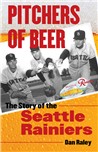
 Read the beginning of Chapter 2, "Sick and the Needy" from Pitchers of Beer: The Story of the Seattle Rainiers by Dan Raley, Photographs from the David Eskenazi Collection:
"After his 1937 franchise takeover, Seattle’s new baseball proprietor turned up at a Pacific Coast League (PCL) meeting held in Sacramento, California, and introduced himself to one of his peers with a handshake and the words, “Sick here.” To which the other man responded in wise-guy fashion: “I’m not feeling too well myself.” Some easily could have questioned Emil Sick’s sanity, if not his future health, for deciding to involve himself in Seattle’s complicated baseball affairs.
Those who knew him understood. Sick enjoyed nothing better than taking a calculated risk. As a student at Stanford University in Palo Alto, California, he didn’t always show up for class, and in the evenings he preferred to go gambling with friends rather than study for upcoming tests. The following day, the Tacoma native made the obligatory classroom appearance and aced those exams with ease. His scores were so high it was suggested to Sick that he become a chemist. To some degree, by later mixing barley and hops together, he did. “He was brilliant, well to the point of genius, but a strong neurotic,” said Diana Ingman, one of Sick’s five children. “Nobody that brilliant is normal.”
Sick, who didn’t graduate from Stanford, could exhibit plenty of backbone, too. With the Nazis coming into power in the 1930s, he wanted a firsthand look at the turmoil boiling in his family’s native Germany, and he impulsively boarded a steamship to Europe. Once there, he questioned the obvious mistreatment of Jewish citizens in a defiant manner. He spoke German and had no problem engaging anyone in heated discussion. Locals finally pulled him aside and suggested his outspoken ways had put him in considerable danger, with Hitler coming to power and squashing anyone else’s opinion. He heeded this advice and toured elsewhere before returning home.
Sick had a zest for adventure and certain fearlessness. Whether it was in brewery business dealings or world affairs or baseball, he was a confident man, always in control. He was comfortable, if not driven, in building a more visible public profile. Privately, he had a nasty temper and could be unbending in negotiations, intimidating even to family members. In their nastiest confrontation, one that nearly drove a wedge between them, Sick and his father, Fritz, argued over the older man’s subscription to German American Bund, a white supremacist and anti-Semitic magazine, before it was cancelled, to avoid business and social backlash.
“He was very demanding,” said Sean Sheehan, one of Sick’s grandsons and later a Seattle assistant city attorney. “He wanted his children and grandchildren to dress right. If not, he’d tell you that you looked like a bum. He was an old-fashioned guy. Emil was quite a formidable presence. When he was in a heavy brood, there was a palpable black air.”
Ten days before Christmas in 1937, Sick demonstrated only his best qualities to a rapt audience of local newspaper reporters bent on quizzing him about his recent baseball acquisition for the first time. He was well organized and charming while fielding questions from all directions. The forty-three-year-old man promised a vibrant, generous leadership. He vowed to build a new ballpark with all of the latest conveniences. He planned to hire an accomplished field manager and acquire half a dozen new players, even prying some of his best ones from Seattle’s neighborhoods.
Sick announced his team would be called “Rainiers.” He would name it after his beer, which was named after the mountain, which was christened after a British explorer. He would not be the first to use this moniker, either for the team or for his beer: in 1919 and 1920, other Seattle baseball teams had called themselves Rainiers, and Rainier beer had been around since the 1800s. Sick’s alcohol-inspired team also answered to an obvious pet nickname used by various newspaper headline writers: “The Suds.” He made everyone in Seattle want a taste of whatever he was selling, by bottling and distributing baseball like no one before in the area."
To read a longer excerpt or to purchase Pitchers of Beer, visit http://www.nebraskapress.unl.edu/product/Pitchers-of-Beer,674748.aspx.
 UNP blog