
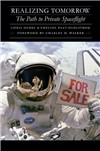
 Read the beginning of the Prologue from Realizing Tomorrow: The Path to Private Spaceflight by Chris Dubbs and Emeline Paat-Dahlstrom:
"The Holland America cruise ship SS Statendam stood at berth in New York Harbor on 4 December 1972 preparing for a curious mission related to the American space program. Tom Buckley, reporter for the New York Times, boarded the ship, unsure what to expect. There was a buzz that this trip would be something special, with big-name headliners: Wernher von Braun, head of the American space program; Apollo astronaut Edgar Mitchell, who eleven months earlier had walked on the moon; and writer Arthur C. Clarke, whose novel 2001: A Space Odyssey had been made into a movie in 1968.
Space artists Don Davis and Rick Sternbach boarded the ship about that same time, toting portfolios of their artwork. They were ambitious youngsters of nineteen and twenty-one attending science fiction conferences when they had been recruited for the cruise. For a little help with graphic design and audiovisual work, they got free passage and a chance to display their art. Sternbach had already drawn pictures of the Statendam flying between the Earth and the moon for the promotional brochure.
At 2:00 p.m., science fiction writer Isaac Asimov walked up the ship’s boarding ramp with some trepidation. He had a mild case of agoraphobia and would have been more than content to stay put in Manhattan. He had traveled on ships twice before, and neither of the experiences had been pleasant. But the chance to be part of the Statendam cruise proved too strong a lure.
Asimov would be joined onboard by other science fiction writers, Robert Heinlein, Frederik Pohl, Ben Bova, and Theodore Sturgeon. A host of luminary scientists rounded out the passenger list: Carl Sagan, NASA adviser and director of Cornell’s Laboratory for Planetary Studies; German-born rocket designer and space visionary Krafft Ehricke; Marvin Minsky, the man breaking ground with artificial intelligence at the Massachusetts Institute of Technology (MIT); radio astronomer Frank Drake, director of the Arecibo Observatory, who was pioneering the search for extraterrestrial intelligence; and physicist Robert Enzmann, who had developed ideas about nuclear-powered rockets.
As Asimov would later explain in one of his regular articles in The Magazine of Fantasy and Science Fiction, he had been recruited the previous spring by Richard Hoagland, “who was aflame to lead a party of idealists” to see the launch of Apollo 17. Hoagland’s vision was to gather scientists, artists,
astronauts, visionaries, science fiction writers—the best space minds—to watch the final Apollo moon mission, then engage in seminars to discuss man’s future in space. The advertising brochures labeled it the “Voyage Beyond Apollo,” an apt name, since this was to be the final Apollo moon landing, the end of an era."
 UNP blog