
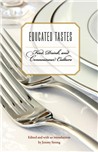
 Educated Tastes is a collection of new essays, edited by Jeremy Strong, that examine how taste is learned, developed, and represented. From the highs (and lows) of connoisseurship to the frustrations and rewards of a mother encouraging her child to eat, the essays in this volume explore the complex and infinitely varied ways in which food matters to all of us.
Strong has given UNP an insight as to how this book began and where the idea came from. Below is an explanation from the author himself:
The background to Educated Tastes starts with an article I published in Gastronomica back in 2006. I’d noticed that offal dishes were appearing on more restaurant menus and that more of my friends were serving them at dinner parties. Since I adore kidneys, pig’s trotters, liver etc. this was a welcome development. Equally, I also thought the trend merited some critical enquiry.
In Britain and North America a conventional wisdom dictated that offal was generally a food of the poor. In this respect it occupied a different place in a register of value compared to southern Europe, the Arab world and parts of Asia, where it has been more highly prized. And yet, I noticed, many offal dishes appeared to be in the process of relocation in the register. Foodstuffs that had regarded as ‘peasant’ fare, the province of the less-well-off, the by-products attendant upon the production of more valuable joints and cuts, were now emerging as trendy restaurant offerings. In tandem with this process it seemed that the actual poor – now of course, mostly urban in the Western world – had lost the skills and tastes to prepare and enjoy these foods themselves. Decades of food education that failed to engage with raw ingredients, coupled with a supermarket culture that adds ‘value’ by doing in factories that which previously had been done in domestic kitchens, had robbed folk of part of their cultural patrimony.
The result of these musings, mixed with some Pierre Bourdieu and reflections on Jamie Oliver, was my article ‘The Modern Offal Eaters’ in the Spring 2006 issue of Gastronomica. To my surprise I got more responses to this than for anything else I’d ever written. People e-mailed me with questions, it got discussed in blogs, occasionally plagiarised by students (which is both irritating and flattering), cited in other papers, and – to my great surprise – quoted in an in-flight magazine. It is worth pointing out at this stage that I’m neither a food historian nor a sociologist, though I’ve always had an interest in food and cooking. My academic background is in literature and film. At the time I was thinking about offal I was actually meant to be researching for two other papers – one on screen versions of Hardy’s Tess of the d’Urbervilles and Jude the Obscure, the other on a film genre or formula that I christened the ‘team film’ including such pictures as The Magnificent Seven, The Great Escape and Ocean’s Eleven. Trying to assemble my materials and thoughts for these three unconnected endeavours was a haphazard process. For a few months my waking hours, and at times my dreams, were filled with heist movies and sweetbreads, Wessex landscapes and chitterlings. More through luck than judgment I managed to complete the three articles which were all published that year. I was particularly pleased when David Howes, the eminent Professor of Anthropology at Concordia University, gave an exceptionally generous and helpful review of my submission to Gastronomica.
That could have been the end of my dalliance with writing on food culture. At the time I was Head of the Media Department at Thames Valley University in West London, working with theorists, film-makers, photographers and journalists. There was certainly no professional imperative to continue with research in this area. The problem was I’d enjoyed working on this just as much as I enjoy my long-standing preoccupation with the novel-to-film process – an interest that began as an undergraduate in English Literature at Exeter University, continued as a graduate student at NYU, and formed the topic of my PhD at the University of Stirling. So in the summer of 2006, I started thinking about the project that would become Educated Tastes. I knew that I wanted to put together a book that would make a real contribution to a rapidly-growing field. I was particularly concerned with that slippery word – ‘taste’ – and the importance of food, food choices, and food knowledge in culture and identity.
I had previously co-edited another book, Genre Matters: Essays in Theory and Criticism, so I had an idea of the advantages and frustrations that attend a project involving many contributors. Of course, the former far outweigh the latter. There’s a wealth of material in Educated Tastes that I could never have thought of or researched on my own. Equally, if you’re ever thinking of editing a book yourself, bear this in mind… it’s still much easier to collaborate (even in the age of e-mail) with colleagues who work on the same corridor than it is when they’re spread across multiple continents with different holidays etc.
I was very keen that Educated Tastes draw on a wide field of disciplines while remaining accessible to a general readership with an interest in food. In this regard I am enormously proud of the contributors who have all succeeded in drawing upon their respective fields without recourse to specialist jargon. There are essays here from writers eminent in such fields as music, philosophy, broadcasting, and landscape architecture but their contributions do not presuppose knowledge of any technical idiom. Over a few months I contacted a number of potential contributors, some of whom I knew personally, others only through their work and reputation. Their responses were overwhelmingly enthusiastic. Shortly I was able to put together a book proposal which I sent to UNP.
At the same time as the groundwork for Educated Tastes was taking shape I also changed jobs, moving to a role that brought me much closer to issues of food production. In April 2007 I became Head of Higher Education at Writtle College. Writtle is a Land-based College offering undergraduate, postgraduate and research degrees in such disciplines as Agriculture, Horticulture, Animal Science and Conservation. It also has a small but well-regarded Design School. Most of my colleagues here are scientists yet it’s clear that much of their research and teaching coincides with matters relevant to my interest in food studies. Sustainability, terroir and the taste of place, the balance between commercial and environmental imperatives, packaging and supermarket culture, and farm-to-fork are frequent topics of discussion. Writtle also provided another contributor; landscape architect and former chef Tim Waterman with whom I’ve passed many a happy hour discussing food and wine.
I hope readers enjoy Educated Tastes, and I’ll welcome their feedback.
Jeremy.
 UNP blog