
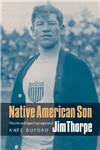
 Kate Buford is the author of Native American Son. In light of the Olympics beginning tomorrow, she writes of an Olympic past legend, Jim Thorpe, and today's Olympic excitement.
As the world gears up for Opening Day of the XXX Olympiad, media outlets are pumping out new alarming stories of security snafus in London along with the usual poignant tales of athletes’ life obstacles overcome.
The hype and frenzy are taken for granted now, but when did they begin? When did the world first realize the potential thrill the Games dangle in front of us every four years? That an athlete will come out of nowhere and astonish us with feats of bodily skill we have never seen before.
Though the first Games of the modern Olympic movement were held in 1896 in Athens, it wasn’t until the Fifth Olympiad in Stockholm in 1912 that one athlete – Jim Thorpe – created the model of the Olympic super-star. First he won the classic five-event track and field pentathlon by a huge margin – and then he did the same thing in the new ten-event decathlon.
At a time when the ancient Greek ideal of the complete athlete was much more revered than in today’s era of the specialized competitor, Thorpe was dubbed by the awestruck king of Sweden as “the most wonderful athlete in the world.” He seemed indeed like a mythic Greek god, able to do anything he set his mind and body to do. The swarm of international reporters in Stockholm beamed the news out to the world. Thorpe was the first global sports sensation.
His time in the 1,500-meter race – 4 minutes, 40.1 seconds – would not be beat by an Olympic decathlete until 1972. He would have won a silver medal as late as 1948. The spread – 688 points – between him and the second-place decathlete is still remarkable. Such gaps in that multi-sport event are rare-to-nonexistent these days.
But then, six months after his triumph, came what has been called the mother of all sports scandals. When it was revealed that he had played minor league professional baseball in 1909 and 1910, Thorpe was stripped of his medals and challenge trophies. His records were erased from the official report and have never been returned.
He had signed the 1912 Olympic Entry Form attesting that he had never received money of any kind for playing sports, thereby satisfying, on paper, the requirement that he was an amateur. The global public, however, ignored that lie and embraced the bigger truth. Baseball had nothing to do with track and field. Thorpe had been robbed, they felt, of his due by the exclusionary elite running the Games — and so had they. Decades before the amateur ideal would be discarded as a snobbish sham, the public recognized that the future belonged to the professional, not to the wealthy wannabe who could support himself.
In the next 100 years sports would become the common passion of our time. The public would insist on seeing the athlete who was the best – and that meant he or she was paid, subsidized, underwritten to make that level of performance possible.
I wrote Native American Son in part to trace that common passion for sports back to its origins. Jim Thorpe personified the great hope of organized sports in its earliest years —and now: that an ordinary person, of humble origins, could be a winner using nothing but the machine of his own body.
A century later the big threshold issue in sports is enhancement drugs. It’s just another form of unfair advantage. Some have suggested, half seriously, that if all athletes take such drugs, we’ll have an equal playing field. Sort of like making everybody professional.
I can guess what Thorpe would say. Even after his Olympic medals and records were gone, he never lost the certainty that he had done something remarkable in Stockholm. He never felt he’d had any kind of unfair advantage and would be – it’s fair to say – pretty derisive at the thought of anybody taking anything to perform better at sports.
He just closely watched athletes more experienced at an event he had not mastered and then copied them. He visualized in his head every movement of an event, like the broad jump. He re-ran the loop in his head over and over. Then he stepped onto the field and did it better than anyone else.
We’ve come a long way since 1912. Or have we?
 UNP blog