
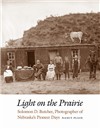
 Below is a guest blog from Nancy Plain. Her new book, Light on the Prairie, is the biography and photographic works of Solomon D. Butcher. Here, we get an inside peek as to why she chose Solomon as her newest book subject.
I can’t remember when I first saw a photograph by Solomon Butcher. But around the time I was searching for a new book project, I found myself scrolling through his remarkable photos on the “Prairie Settlement” website of the Library of Congress. I was hooked. They look straight at the camera, Solomon’s pioneers, and they stand up straight amidst their families and possessions, against a background of infinite prairie. If you peer really closely, you can find little secrets in the pictures—a shy child peeking out from a window, a dog half hidden in a shadowed doorway. During the course of my research, I learned about individual sodbusters. One of my favorite photographs is that of the four beautiful Chrisman sisters, known by their nicknames—Hattie, Lizzie, Lutie, and Babe. Babe didn’t like how she looked in the photo, though. She thought it made her look like a “horse thief!”
I flew from my home in New Jersey to Nebraska, to read through the Butcher Archives at the Nebraska State Historical Society, in Lincoln. Linda Hein, Reference Assistant at the Library/Archives, welcomed me with warm friendship and fascinating stories of old Nebraska, and she was tireless in digging up helpful information and great primary material. I was interested to learn from Linda that descendants of Butcher’s subjects are still calling the society, identifying more people in the photos and sharing anecdotes about their ancestors. The more I read about Nebraska, the more I realized what a pivotal role the state has played in American history as a whole–the Indian wars, westward expansion, slavery, Populism, and more. In Lincoln, it felt good to be in the company of people who love history. All the folks at the society are truly keepers of the flame.
I think that Butcher understood that memory is what binds us together, and he did his part to preserve the memories of the generations that settled the Great Plains. Some of their faces, some of their words will stay with me forever. I especially love the reminiscences of old pioneers, as they recall their childhoods. One woman wrote:
“Please don’t get the impression that life was just a drab existence. There was much that was interesting and beautiful. There was always the family and the great out-doors, birds, bird-nests, flowers, our nice creek where I used to play by the hour wading and trying to catch minnows and tadpoles….How much I loved the evenings when father and mother would sit by our little pine kitchen table and sing from a little hymn book, the only light a little tin lamp….[Father] often sang ‘Down in the Cornfield,’ which I can almost hear as I often listen to the sound of a voice that is still.” (Welsch, Roger L. Sod Walls. Broken Bow, Nebraska: Purcells, Inc., 1968.)
Back home in New Jersey, I always perk up when I hear news of Nebraska. I like to think of it as my adopted state.
 UNP blog