
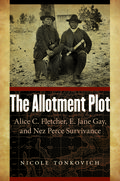
 Nicole Tonkovich is the author of newly released, The Allotment Plot: Alice C. Fletcher, E. Jane Gay, and Nez Perce Survivance. Tonkovich recently began a blog where she will transcribe field diaries kept by Alice Fletcher during
her allotment work. Click here for the first entry. Below she discusses how she discovered her book's topic.
I became aware of E. Jane Gay and Alice C. Fletcher while
watching Ken Burns’s PBS series The West.
I was immediately intrigued–both by the clarity and beauty of Gay’s
photographs and by the fact that these two women were well into their middle
age when they went West, where Fletcher supervised the allotment of lands to
the Nez Perce Indians from 1889 to 1892.
As I delved into the story I was initially attracted to Gay’s
work. In addition to her photographs, she documented the pair’s adventures in a
series of witty and sometimes-acerbic columns published in reform periodicals
of the era. What she was telling the readers of these newspapers differed in
detail and in intent from the reports her friend Fletcher was sending to the
Indian Bureau. Somewhat reluctantly, I began to read Fletcher’s records, as
well. She was in many ways Gay’s opposite: where Gay was acerbic and witty,
Fletcher was earnest and hectoring. Gay had a lively sense of irony; Fletcher
lacked that sense entirely. Yet together they were part of the conception and
administration of a major federal program that impacted not only the Nez Perces
but nearly every Indian tribe in the nation, decimating their lands and
endeavoring to erase tribal identities altogether.
The more I read of the details of how the Nez Perces
received these two women who came among them with the intent to reconfigure–even
erase–their culture, the more I was sure that a major part of the story of
allotment was missing from Fletcher’s and Gay’s records. Tantalizing hints
suggested that Nez Perces mounted a fierce if peaceful effort to resist the
worst outcomes of allotment. And what began as a biography of “two heroic
women,” as the Red Man newspaper
fancifully called them, became a quest to reconstruct a series of encounters,
negotiations, disagreements, false turns and starts, concessions and
compromises about allotment. The allotment went forward, but it did not proceed
as Alice Fletcher had imagined it would, and Nez Perces who were involved with
her gained significant concessions that mitigated some of the worst effects of
the law.
My book is also a meditation about evidence. What
constitutes evidence of a historical event? Does it lie in the official
records, often written to placate or flatter policymakers? How do well-known
story forms that structure our historical understanding? How might we hear the
Native voices, see the conditions through their eyes, and understand their
efforts to save their patrimonies and sovereignty? How has the structure of our
archival record determined what is visible to us as evidence, and thus, what we
imagine to have happened?
In my book, I use Native celebrations of the Fourth of July
as one way to answer some of these questions. Their resistances lie in
performances whose intent is to preserve tradition and adapt it to present
circumstances. These performances may be couched in orator, music, dance, the
visual image, or the written word.
 UNP blog