
Book Birthdays celebrate one year of a book’s life in tweets, reviews, and more. This month we’re saying Happy First Book Birthday to From the Dugouts to the Trenches: Baseball during the Great War (Nebraska, 2017) by Jim Leeke. Leeke, a former news journalist and U.S. Navy veteran, has covered Major League Baseball for a Northern California suburban daily. He is the author of several books, including Nine Innings for the King: The Day Wartime London Stopped for Baseball, July 4, 1918 and Ballplayers in the Great War: Newspaper Accounts of Major Leaguers in World War I Military Service.
About the book:
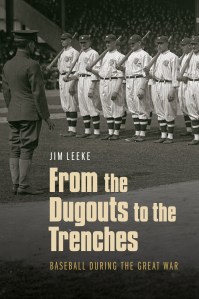 Baseball, like the rest of the country, changed dramatically when the United States entered World War I, and Jim Leeke brings these changes to life in From the Dugouts to the Trenches. He deftly describes how the war obliterated big league clubs and largely dismantled the Minor Leagues, as many prominent players joined the military and went overseas. By the war’s end more than 1,250 ballplayers, team owners, and sportswriters would serve, demonstrating that while the war was “over there,” it had a considerable impact on the national pastime.
Leeke tells the stories of those who served, as well as organized baseball’s response, including its generosity and patriotism. He weaves into his narrative the story of African American players who were barred from the Major Leagues but who nevertheless swapped their jerseys for fatigues, as well as the stories of those who were killed in action—and by diseases or accidents—and what their deaths meant to teammates, fans, and the sport in general.
From the Dugouts to the Trenches illuminates this influential and fascinating period in baseball history, as nineteen months of upheaval and turmoil changed the sport—and the world—forever.
Awards:
Winner of SABR’s 2018 Larry Ritter Book Award
Winner of the 2018 SABR Research Book Award
Reviews:
On the blog:
On Twitter:
On Goodreads:


A word from the author:
 It’s been a memorable year of interviews and events. A highlight was a presentation in Kansas City last fall, jointly sponsored by the Negro Leagues Baseball Museum and the National World War I Museum and Memorial. That event put WWI baseball on the big stage—literally. I was never so nervous giving an author talk before. And receiving two awards from SABR is beyond anything I could have expected from this or any book.
Interest in Great War baseball remains strong this year, with the centennial of the armistice coming in November. I saw a wonderful WWI ballgame in Nashville this spring, played by reenactors and vintage-league ballplayers, all wearing throwback flannels and using period equipment. More events are planned this summer. I only hope that other authors will write about WWI baseball once the commemorations are over. There are many important stories still to be told.
 UNP blog