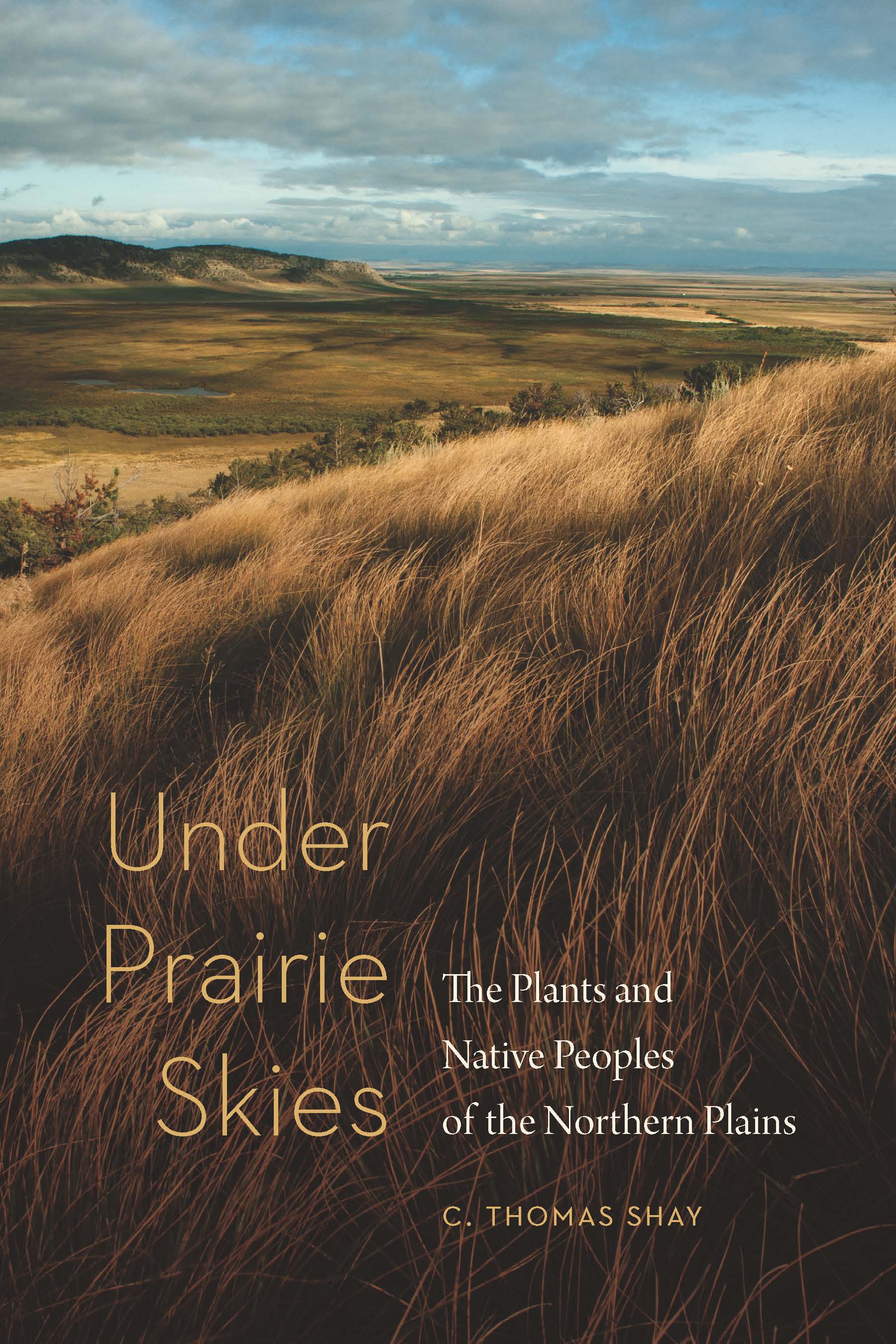
Book Birthdays celebrate one year of a book’s life in tweets, reviews, and more. This month we’re saying Happy First Book Birthday to Under Prairie Skies: The Plants and Native Peoples of the Northern Plains (Bison Books, June 2022) by C. Thomas Shay.
About the Book:
Combining Native voices, ethnobotanical studies, personal stories, and research techniques, Under Prairie Skies shows how, since the end of the Ice Age, plants have been central to the lives of Native peoples. They became linked to the land, both materially and spiritually.
A Word from the Author:
Under Prairie Skies changed my life. Not only did it give me a modest notoriety, it strengthened my self-confidence and stimulated my research. As a result, I’ve been quite busy with Zoom talks and conference presentations this past year! The book’s acceptance has also prompted me to reflect more earnestly upon three current crises: climate, biodiversity, and food sovereignty.
Climate. The indigenous people of the plains and elsewhere have coped with climatic change for thousands of years. As individuals today, we can work to reduce our carbon footprint, such as use more public transport and encourage others to do the same. Personally, I enjoy travelling by bus or train which allows me time to read or simply enjoy the scenery.
Biodiversity simply means the number of species in a local ecosystem, be it marsh, prairie or forest grove. Sadly, the northern plains has lost most of its biodiversity through drainage, farming, building, and the use of pesticides. We cannot rebuild the biodiversity of the past but we can each do our part. We can avoid pesticides and leave wild patches on our properties for the use of small mammals, birds, and insects. A good motto would be: Don’t Mow, Let it Grow! We can also support organized habitat restoration efforts.
Finally, food sovereignty. Ultimately that means abandoning today’s processed foods and returning to more natural fare. This is not only good for the planet, it is good for our health. In the short term, it means setting up gardens to grow heritage varieties of fruits and vegetables and/or supporting local farms. Gardens can even thrive in cold climates. I once visited a greenhouse in Churchill Manitoba in the heart of the subarctic.
Reviews:
“This is a loving memoir of a life lived studying the Northern Plains with all the paraphernalia necessary to allow readers to follow the author into the field.” – L. L. Johnson, CHOICE
“The book is extensively researched and well-worth acquiring just for its fifty-page bibliography, but it is also an excellent way for the novice to learn basic biology, botany, geology, and archeology.” – South Dakota History
“It is a sweeping survey of northern Great Plains landscapes and an engaging retrospective on the lives of the people and plants found there, including that of the author.” – H-Net Reviews
“C. Thomas Shay blends botany, ecology, history and Native American culture in this exquisite book.” – Roundup Magazine
“The history of the use of the plants of the prairies of the Northern Plains is written as a story for the general reader but it supplies the necessary scientific documentation, scientific nomenclature, and references and notes to satisfy more demanding scientific readers.”
– Nebraska Historical Magazine Quarterly
“The book reflects Shay’s life work, applying scientific principles, ethnographic insights, and a sense of awe and wonder at human ingenuity in interpreting a region and a people under prairie skies.” – Journal of Folklore Research Reviews
“This book would make an excellent addition to universities with archaeology, ethnobotany, paleobotany, anthropology, and Native American Studies programs. Beyond the academic, this book would appeal to anyone interested in learning about the ins and outs of archaeological digs as well as the history of the people and plants of the Great Plains region.” – Journal of the Botanical Research Institute of Texas
“It is a wonderful pre-contact tour of the plains region filled with very personal and moving accounts.” – Manitoba Archaeological Newsletter
 UNP blog