Erik Sherman is a baseball historian and the New York Times best-selling author of Kings of Queens: Life beyond Baseball with the ’86 Mets and Two Sides of Glory: The 1986 Boston Red Sox in Their Own Words (Nebraska, 2021). He is the coauthor of five other highly acclaimed baseball-themed books. Sherman is a 2023 inductee to the New York State Baseball Hall of Fame for his baseball writing and hosts the Erik Sherman Show podcast. His new book Daybreak at Chavez Ravine: Fernandomania and the Remaking of the Los Angeles Dodgers was published in May.
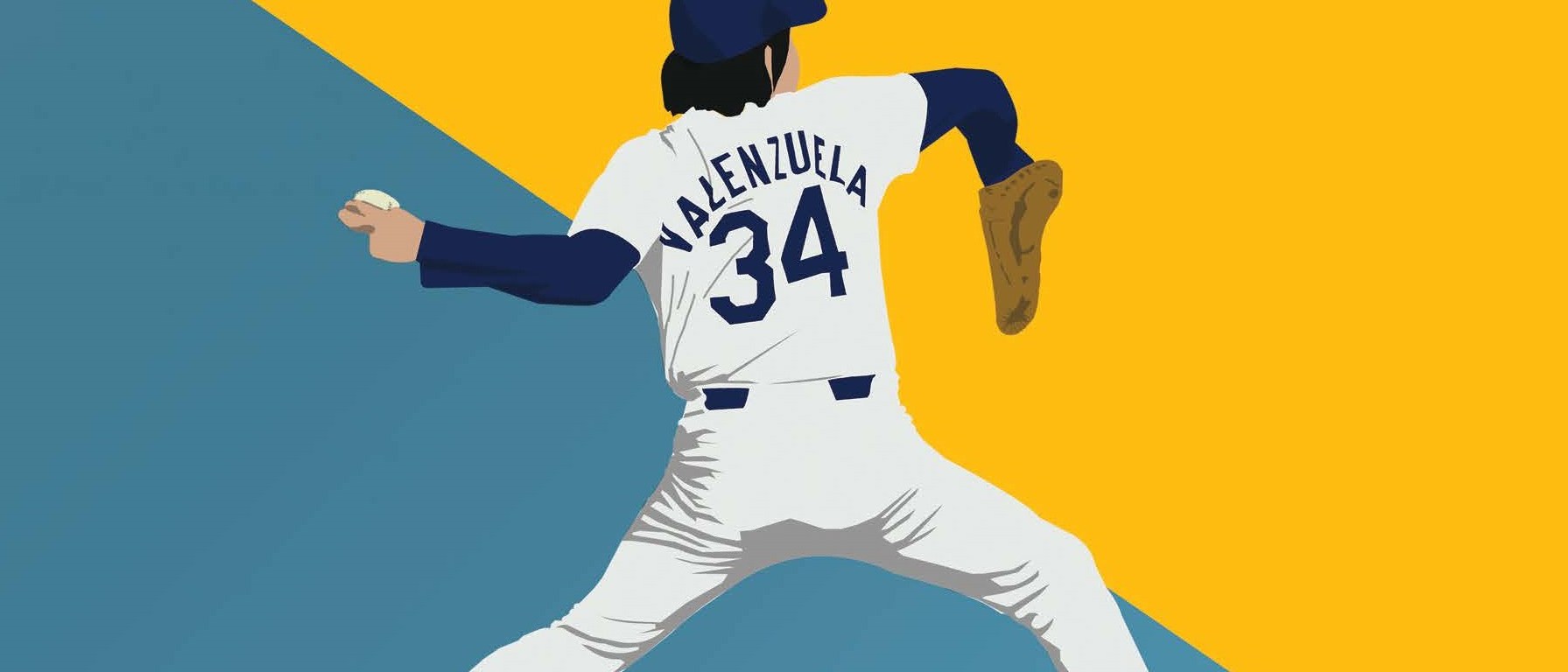
Three years ago, when I decided to write Daybreak at Chavez Ravine—a book on Fernando Valenzuela and his cultural impact on Mexican Americans, Hispanics, the city of Los Angeles, and the entire baseball world—I didn’t believe he had a realistic chance of ever having his #34 Dodgers’ jersey retired. At the time, the Dodgers had a steadfast, if unwritten, rule against the practice of retiring numbers of players who hadn’t been inducted in the Baseball Hall of Fame. The lone exception to this rule was Junior Gilliam, a beloved former Dodgers’ player and coach, who died tragically just prior to the 1978 World Series at the age of just forty-nine years old.
But my belief that Valenzuela would never have his number retired should not be misconstrued as my own feelings on the issue. As a matter of fact, in the final chapter of my book entitled ‘Legacy,’ I argued hard that the so-called ‘Gilliam Exception’ should have been invoked in Fernando’s case. I have longed felt that keeping the Dodgers’ #34 in circulation was one of the great slights in modern-day baseball.
And I was hardly alone.
Proof of this was how no Dodger had worn #34 since Valenzuela’s release from the team in 1991. A big reason why the number was never issued to another player was due to the efforts of the staunch guardian and protector of Valenzuela’s number—longtime team clubhouse and equipment manager Mitch Poole. For years, one of Poole’s duties was to give out uniform numbers to new players. Poole’s employment with the Dodgers goes back to when Fernando pitched for the club.
“We’re all family down there in the clubhouse,” Poole told me. “I felt close to Fernando when he played, but I grew even closer afterward. So I never wanted to give that number out. In my own heart, even I feel like that’s a number that, at least for the Mexican community, shouldn’t be used. Many of them have come to me and said they were very thankful for the fact that nobody did use it. And since no player has worn it since Fernando, I’m kind of happy with that. It’s been my call, but the Dodgers could have overridden me many times, but they chose not to.”
Ironically, even those high up in the Dodgers’ organization didn’t seem to disagree with Valenzuela’s worthiness in having his number retired—with one comparing his influence with two other icons. As recently as 2021, Dodgers’ part-owner Stan Kasten told MLB.com, “When you think of our particular history, which we are so proud of and talk about every day, you can’t talk about it without mentioning Fernando’s impact. We have Jackie Robinson, and we know his status in popular culture. We then have Sandy Koufax, who became an icon for Eastern Europeans trying to assimilate into America right at that time. And then the next wave was Fernando, who captured the attention of the entire Hispanic world.”
So while the Dodgers did the second-best thing for Valenzuela—include him in the inaugural ‘Legends of Dodger Baseball’ class—in 2019, the honor fell short. And my feeling was that after they didn’t retire #34 during the 40th Anniversary of the celebrated Fernandomania season of 1981, they never would.
I wrote in the ‘Legacy’ chapter, “If there is anything in baseball that is truly a “feel thing,” it’s the act of retiring a number. It’s more indicative of what a player means to a club, a city, and its fan base—and in Valenzuela’s case, an entire culture—than mere statistics or other criteria. Time will tell if the Dodgers eventually grasp this concept.”
Well, as it turned out, the Dodgers finally have, and will retire Valenzuela’s number tomorrow on August 11th at Dodger Stadium. But here’s the interesting thing about it. Advanced copies of Daybreak at Chavez Ravine were sent out to some Dodgers’ personnel a few weeks prior to the big announcement. So, (tongue-in-cheek), I will take full credit for convincing the powers-that-be in making this happen for our beloved Fernando! I’m owning it!
 UNP blog
One thought on “From the Desk of Erik Sherman: Celebrating the Retirement of Fernando Valenzuela’s #34”