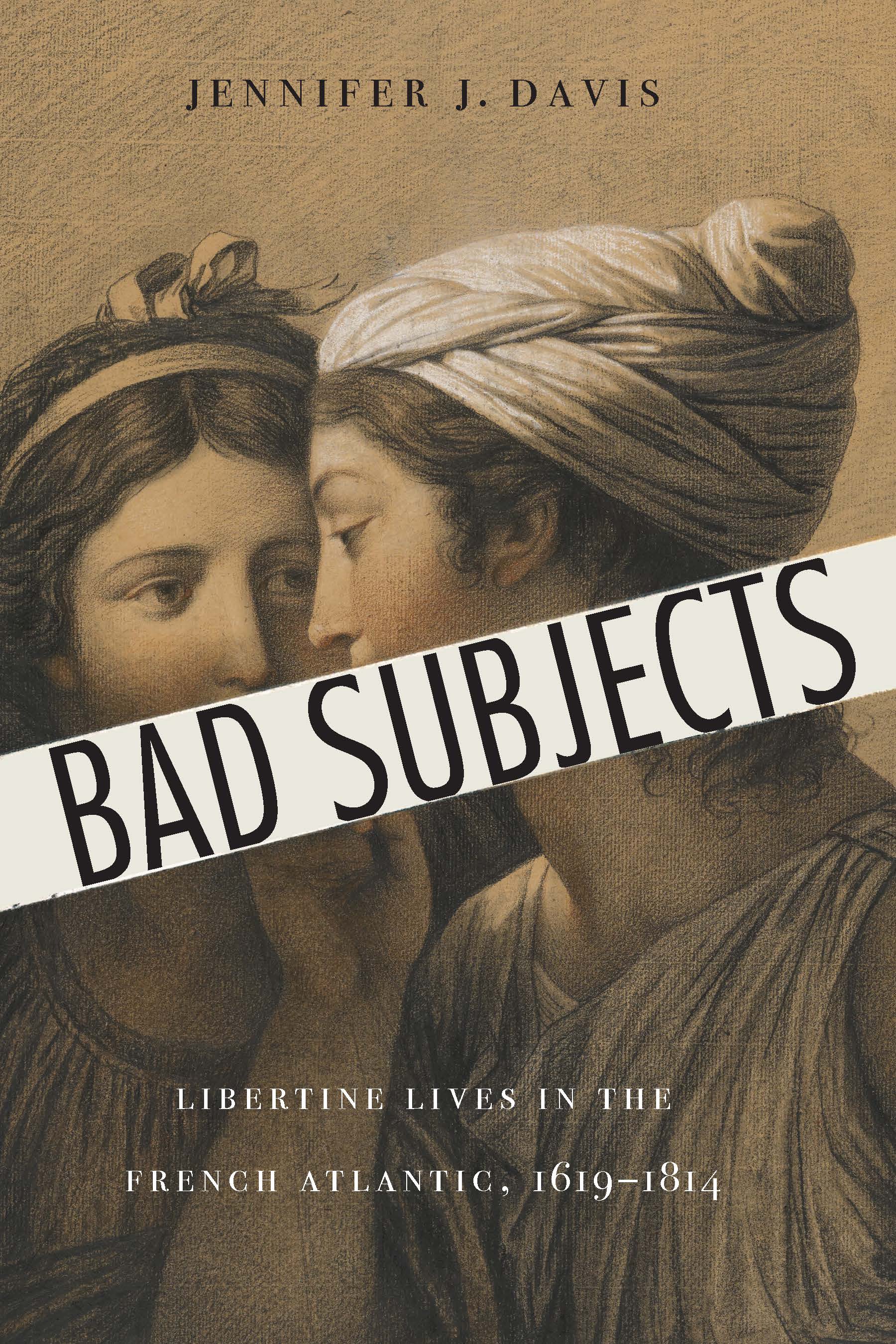
Jennifer J. Davis is an associate professor of early modern European history in the Department of History and an affiliate member of the Department of Women’s and Gender Studies at the University of Oklahoma. She is the author of Defining Culinary Authority: The Transformation of Cooking in France, 1650–1830, and presently serves as an editor for the Journal of Women’s History. Her newest book, Bad Subjects: Libertine Lives in the French Atlantic, 1619-1814, was published last month.
In a lively account that spans continents, Jennifer J. Davis considers what it meant to be called a libertine in early modern France and its colonies. Libertinage was a polysemous term in early modern Europe and the Atlantic World, generally translated as “debauchery” or “licentiousness” in English. Davis assesses the changing fortunes of the quasi-criminal category of libertinage in the French Atlantic, based on hundreds of cases drawn from the police and judicial archives of seventeenth- and eighteenth-century France and its Atlantic colonies alongside the literature inspired by those proceedings.
Introduction
Bad Subjects in the French Atlantic World
The twenty-first-century transatlantic trials of Dominque Strauss-Kahn, the prominent French politician and former head of the International Monetary Fund, momentarily rekindled our interest in libertines. Tried for the sexual assault and attempted rape of a hotel employee in the state of New York and for aggravated pimping at the Carlton hotel in the French city of Lille, Strauss-Kahn’s court cases attracted sustained media coverage and inspired far-ranging conversations about sexual assault and solicitation in France and the United States. While prosecutors in both countries represented Strauss-Kahn’s actions as crimes, the defendant swatted away such accusations. He was no criminal, he maintained. What the prosecution called sexual assault in New York, Strauss-Kahn termed “inappropriate” and a misunderstanding. What the prosecution called pimping and assault in Lille, Strauss-Kahn characterized with equanimity as libertine evenings. Sex acts between consenting adults, he reminded judges during testimony in the Carlton Case, were not illegal. If some of the women attending these gatherings had been prostitutes, he claimed not to have known it, thus undercutting the French state’s central charge. Several of the women testified that Strauss-Kahn’s behavior at these gatherings amounted to “butchery” and “slaughter,” addressing both the violence of his copulation technique and his refusal to wear a condom to reduce the risk of venereal disease. But the courts’ decisions in both France and the United States indicate that Strauss-Kahn’s defense worked. In the United States, Strauss-Kahn settled out of court with Nafissatou Diallo, the woman who had accused him of attempted rape. And in France Strauss-Kahn was ultimately acquitted on all charges. The prosecutor Frédéric Fèvre concurred that the state had failed to demonstrate that Strauss-Kahn had materially benefited from the prostitution of these women. At the end of the day, the prosecutor’s goal was to enforce the law, not a moral code. Fèvre acknowledged that “everyone is allowed to lead the sexual life they wish so long as that remains within the boundaries of the law.” So within months, predictably, legislators and prosecutors took steps to criminalize the actions of which Strauss-Kahn had been accused. As this book goes to press, the French state now outlaws brothels and paying for sex, but these laws did not take effect until 2016. Charges of pimping, rape, and sexual assault— all of which were illegal and had occurred in the regular sex parties attended by Strauss-Kahn— could not be substantiated against the defendant. In the end the French magistrates convicted only one individual: René Kojifer, head of public relations at the Carlton Hotel in Lille, who served one year in prison on the charge of pimping for his role coordinating the evenings. Despite multiple accusations, chains of corroborating text messages, and explicit witness testimony, enough doubt remained regarding Strauss-Kahn’s own role in organizing or commissioning these gatherings that he evaded criminal sentencing and ultimately eluded civil fines.
Strauss-Kahn’s characterization of his behavior as libertine struck some contemporary observers as anachronistic. It is, after all, a term that we more typically associate with the vanished world of the eighteenth-century European aristocracy than today’s jet set. Why the fascination with the libertine as a character? Whether we imagine the diamond-draped heaving bosoms of Dangerous Liaisons, apply the name of “Casanova” to a sexual adventurer, or invoke the Marquis de Sade to commingle one’s torturous pain with another’s sexual pleasure, visions of vanished decadence dominate our understanding of the term today. Libertines were sex crazed. Pornographers. Deviants. And, in a world of strict social hierarchy, only members of the nobility could indulge in such perverse fantasies without fear of punishment from church or royal authorities. However, something pathetic lurks in the figure as well. Thomas Wynn explains that it was because elite Frenchmen had been “reduced by royal absolutism to a parody of the warrior, the aristocratic libertine achieves renown through the conquest of women.” A man whose social purpose had evaporated, the libertine drifted aimless and impotent vis-à-vis the French Crown, seeking consolation in more intimate combat against a reliably weaker foe. This formula presumes that sexual conquest compensated for aristocrats’ eroding political and social power under absolutism. The challenge of seduction and the thrill of physical pleasure motivated the avowed libertine, who required no higher purpose from life than self-satisfaction.
The libertine’s excesses also made a profound impact on the society around him, one that has not always been construed as a negative force. Scholars have documented the political and cultural significance of libertine literature, connecting the ethos communicated in these works to core ideals— including the rise of individualism and the separation of church and state— that shaped the contours of democratic politics and the modern state. In eighteenth-century France, the libertine novel represented both a symptom of and the potential cure for the disease of royal absolutism. Those characters who claimed the freedom to engage in sexual behavior outside of the narrow confines of monogamous reproductive relations paved the way to contemporary civil rights for all.
This book demonstrates that the portrait sketched above represents a partisan caricature that has obscured the contours of the libertine as a category in early modern legal, literary, and social registers. We mistake the libertine if we think it concerns only sex, and we err if we presume that the term describes only social elites, or only men. We lose the force that the term marshaled centuries ago and neglect how its meanings have changed over time. Strauss-Kahn’s trials have the potential to restore one of the central features of the libertine category because he used it to assert the fundamental legality of his actions. Perhaps, he acknowledged, his was a “rude sexuality, rougher than most men.” Scrambling to salvage his career, his reputation, and his fortune, the defendant testified frankly to participation in behavior deemed immoral by the mainstream of his society, but, he insisted, all the sex acts described in the Carlton Case were lawful, between consenting adults. Strauss-Kahn claimed an identity as a libertine precisely because it signaled the fundamental legality of his actions. Libertines admitted to being a “bad subject” of royal, church, or parental authority, but leaned heavily on defenses that their actions did not constitute crimes.
In discussions of libertine behavior, whose liberty was at stake? To do what? And at whose expense? Modern legal codes enshrine individual liberties, but nearly three centuries of case law demonstrate that individuals’ rights exist in dynamic tension with the rights of other individuals and require consideration of the collective rights of our communities at local, state, and transnational levels. In Strauss-Kahn’s portrayal all individuals who attended the soirées libertines were equally free to express their sexuality within the bounds of the law. However, feminist legal theories from the past century that highlight the gender and wealth hierarchies that structure social and legal systems provide methods to interrogate that claim. How did economic, social, and cultural forces unite to legitimate Strauss-Kahn’s sexual liberty? How did those same forces strip individual liberty from the women who accused him of sexual violence
and solicitation? In their testimony they made clear that Strauss-Kahn’s “liberty” in fact constituted abuse of their bodies and violations of their wills. Do these women cede their rights to health and safety standards simply by engaging in sex work, which was itself legal? This case reveals why any analysis of the libertine must ask, first, who can claim liberty and, second, at whose expense that liberty is claimed.
 UNP blog