Michael J. Devine is an adjunct professor of history at the University of Wyoming. Previously he was the director of the Harry S. Truman Presidential Library and a professor of history and director of the American Heritage Center at the University of Wyoming. He is the author of John W. Foster: Politics and Diplomacy in the Imperial Era, 1873–1917. His newest book, The Korean War Remembered: Contested Memories of an Unended Conflict, was published last month.
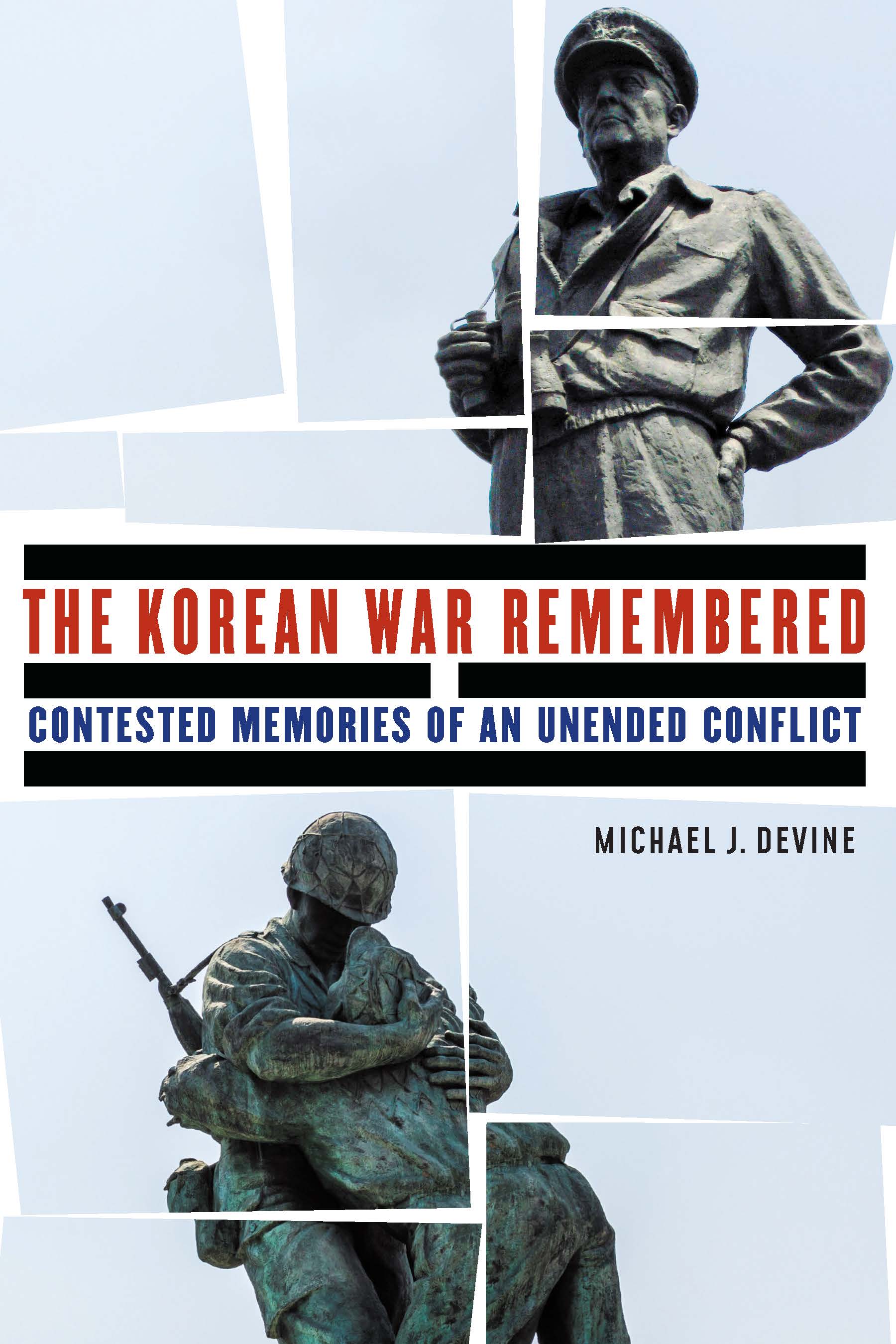
Michael J. Devine provides a fresh, wide-ranging, and international perspective on the contested memory of the 1950–1953 conflict that left the Korean Peninsula divided along a heavily fortified demilitarized zone. His work examines “theaters of memory,” including literature, popular culture, public education efforts, monuments, and museums in the United States, China, and the two Koreas, to explain how contested memories have evolved over decades and how they continue to shape the domestic and foreign policies of the countries still involved in this unresolved struggle for dominance and legitimacy. The Korean War Remembered also engages with the revisionist school of historians who, influenced by America’s long nightmare in Vietnam, consider the Korean War an unwise U.S. interference in a civil war that should have been left to the Koreans to decide for themselves.
Chapter 1
The “Police Action”
In June 1950 an America hardly aware of Korea suddenly found itself involved in a bloody overseas conflict, and the public began to shape an understanding of the war based on its commonly held memory of World War II. But the Korean conflict was not at all like World War II. Initial support for U.S. effort in the Korean conflict evaporated as the costly struggle staggered toward an inconclusive armistice. Even as the fighting continued, the various combatant states began to shape conflicting narratives about the war’s cause and its meaning.
Phil Lagerquist was a local celebrity in Independence, Missouri, when I became director of the Harry S. Truman Library in 2001. The popular octogenarian had retired years earlier from his position as an archivist at the library, where he had worked for many years, beginning his service even before the facility officially opened. Now he walked about the town every day, and Phil could be spotted traversing the streets and sidewalks Mr. Truman had known. Like most of the first members of the library’s staff, Phil had come to know the former president well, and fondly recalled that, until the late 1960s, when old age and health problems took a toll on his energy, former president Truman worked almost every day in his presidential library. There he would meet with visiting foreign dignitaries, local and national politicians, old friends, tourists, and school groups. The former president loved to share memories of his White House years with students, and he took questions from his young audience. According to Phil, Truman was often asked what his most difficult decision as U.S. president had been. His answer was always the same: “The decision to enter the Korean War.” The young students could not have understood the full meaning of the former president’s decisive decision of June 1950. Perhaps even Truman never completely appreciated during his lifetime how profoundly and permanently his actions during the Korean conflict would change American society and the course of East Asian history.
Understanding the conflicted memories of the Korean War in the psyches of the participants requires a careful assessment of the conflict’s causes, conduct, and lasting consequences on the international world order. The war erupted suddenly and shattered the peace brought about by the end of World War II— a peace that proved more fragile than it had appeared. During the second half of 1950, the two Koreas, the Soviet Union, the People’s Republic of China, and fifteen allied countries hastily assembled into a United Nations Command (UNC) under U.S. leadership, all found themselves drawn into a war larger and far more prolonged than any had anticipated. The warfare on the Korean Peninsula raged with savagery for thirty-seven months, devastating the civilian population both north and south of an artificially drawn dividing line, and brought the world to the brink of a nuclear holocaust. Just five years before the war, Korea was a land that had appeared on world maps as nothing more than a province of Japan. It now became, in the early years of the Cold War, the battleground for a clash of the major world powers. Remarkably the war did not expand beyond the mountains and valleys of Korea, and great powers, while destroying Korea, limited their expenditure of treasure and deployment of weaponry on this mountainous region to achieve nothing more than a return to the status quo ante bellum. The war came to an end with an armistice that left all sides dissatisfied. Yet the war changed East Asia and the world in ways both consequential and lasting, leaving the combatants with memories that remain a hindrance to achieving the war’s final resolution.
The Korean War came about because the leader of North Korea wanted it, and he successfully secured the authorization and support of his Communist allies. A full-scale war erupted in Korea on June 25, 1950, when a heavily armed force from North Korea, backed by the Soviet Union with the PRC, crossed the 38th parallel with the intention of conquering South Korea. While caught off guard, President Truman reacted quickly and in a forceful manner not expected by Communist leaders in Moscow, Beijing, and Pyongyang. For months Joseph Stalin, premier of the Soviet Union, and Mao Zedong, chairman of a new Communist regime in China, had been planning an invasion of South Korea. They had both met secretly with the young, ambitious Kim Il-sung of the recently created Democratic People’s Republic of Korea (DPRK) to plot a strategy and pledge assistance for his plan to seize control of South Korea. The Communist leadership anticipated a sudden and decisive victory in just a matter of days over the south’s fledgling Republic of Korea. They anticipated that the United States would do nothing more than stand by while providing asylum to Syngman Rhee and his cohorts. After all, the United States had not intervened with military force a year earlier to rescue its longtime ally Chiang Kai-shek and his Republic of China from Communist takeover in 1949. However, the Communist leadership had misjudged Truman’s determination to save South Korea. Truman saw the invasion by the North Koreans as an effort by Communist rulers in Moscow and Beijing to extend Communism in East Asia, threaten the security of Japan, and disrupt, if not destroy, the credibility of the United Nations. Following thirty-seven months of bitter conflict and nearly five million deaths, it appeared nothing more than the status quo ante bellum was achieved. All involved in the conflict reluctantly settled for an uneasy truce. While it may have seemed that the conflict had left the situation on the Korean Peninsula unchanged, the warfare had in fact altered East Asia and the world in ways unimaginable just a few years earlier.
 UNP blog