
Ruzana Liburkina is a cultural anthropologist and a research associate in the Faculty of Social Sciences at Goethe University Frankfurt in Germany. Her newest book, The Visible Hands That Feed: Responsibility and Growth in the Food Sector, was published last month.
The Visible Hands That Feed provides crucial insights into the rifts and regularities that are characteristic of today’s food systems. These insights attend to the widespread disquiet about the ethics and politics of food production and trade. While challenging utopian thinking, these findings give hope by elaborating on the promising nature of what falls between political and moral agendas.
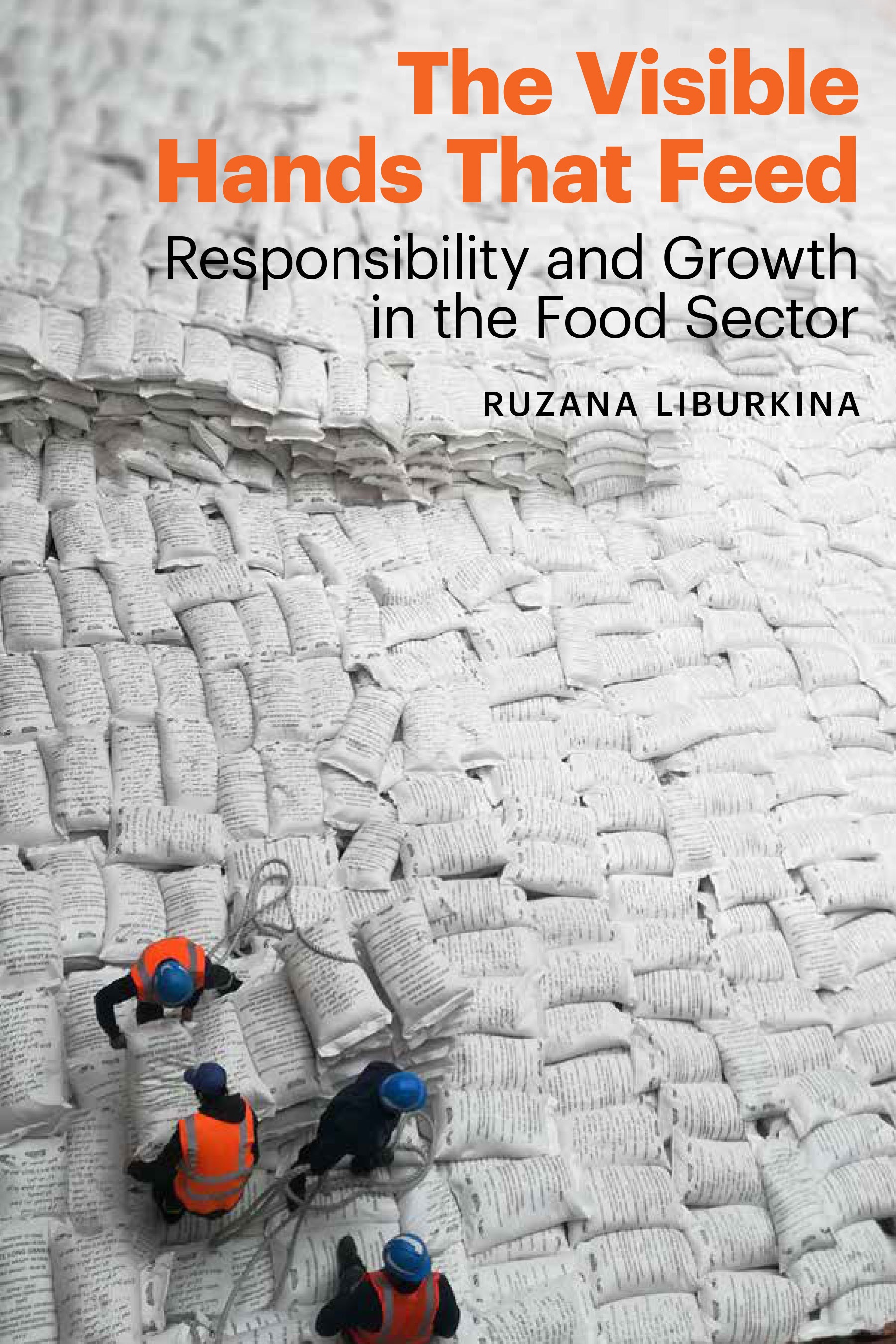
Navigating Food Supply Chains to Find Seeds of Sustainable Futures
“Don’t bite the hand that feeds you,” warns a well-known saying, which means: beware of being ungrateful to those who care for you. However, there is also another reading of the phrase, one that goes beyond a mere call for reciprocity and esteem and refers to a state of dependence: be obsequious and servile, as you are likely to be punished and experience deprivation if you are not. These two connotations of the same phrase remind us that, at times, there is only a fine line between gratitude and submissiveness.
In the course of the research that laid the groundwork for this book, I have seen many of the hands that feed me—me and many others, whose nutrition depends on commercial supply chains rather than their own agricultural activities. Just like the old saying, this book embraces the tension between a call for appreciation and an awareness of power relations. It is a manifestation of gratitude for the work done by those who cultivate, process, transport, and serve food products. Such expressions of regard are rare. They were largely absent from the public discourse back when I conducted fieldwork in the food sector in 2016–18 and only entered it when there appeared to be a danger of infrastructural breakdown caused by the COVID-19 pandemic in 2020, when journalists and experts suddenly went to great lengths to remind us that “forgotten food manufacturers deserve our thanks too” (Fairchild 2020). I am keen to add to the list of instances of appreciation for those who sustain the daily flows of food provisioning in and beyond crises. However, that does not prevent this book from being critical of contemporary food systems; it explicitly refuses to take a naïve stance toward the conditions and prerequisites of the doubtlessly essential work that sustains them. Here gratitude goes hand in hand with a recognition of our dependence on the ways in which contemporary patterns of food production, distribution, and trade are organized.
Such a conjunction of appreciation and critique is only possible if the hands that do the actual work of commercial food provisioning—the hands that almost literally feed the masses— are rendered visible. While everyone can easily picture farmers and regularly see people who serve or sell food in restaurants, canteens, and supermarkets, most of us know very little about what happens in between them. How are our consumption choices connected to patterns of agricultural production? After harvest crops need to be sorted and cleaned, processed, transported, stored, packaged, transported again, mixed with other foodstuffs, processed again, packaged again, transported again, stored again, mixed again with other foodstuffs, cooked, and served—this sequence of events just being one example of multiple trajectories. Rather than discussing abstract supply-and demand dynamics and the invisible hand of the market (Smith [1776] 1937), this book goes granular into the organizations, work routines, and interactions that link forks to farms. It does so against the background of the widely postulated urgent need for sustainable change in food systems—a ubiquitous demand that shapes the present situation in the field of food production like no other. Thus the book zooms in on work realities in the food sector to create an understating of how they relate to the ongoing existential threat posed by climate change, depleted and polluted ecosystems, and economic inequalities, and to the claims and concerns arising from this state of affairs. It grapples with the question of how food industry practitioners may and do organize, make sense of, and hold onto what they do under such conditions.
While The Visible Hands That Feed investigates issues that are characteristic for the ways in which contemporary food systems are organized, its empirical material relates to two specific chains. The latter should not be perceived as proxies for the entire complex nexus of food production, distribution, and consumption. In fact many scholars concerned with the linkages between production and consumption take issue with the linearity of the notion of chains (e.g., Leslie and Reimer 1999; Henderson et al. 2002). Nevertheless, it is hardly contestable that supply chains are a particularly significant phenomenon. They are indicative of how food systems are ordered; therefore, empirically engaging with the workings of supply chains is certainly a limited, yet also a particularly insightful, approach. When it comes to ethnographic work, it is the most productive way of connecting idiosyncratic observations to an understanding of more general forms and dynamics.
In this vein I studied two different food supply chains by ethnographically following them from sites of consumption and food preparation to sites of agricultural production. One of the chains was short and interlinked German enterprises only, whereas the other one was transatlantic and connected field sites in Europe to sites in Uruguay. It is not a coincidence that both supply chains are average rather than exceptional. I focused on basic food commodities—rice and breadstuffs— and on small-and medium-sized enterprises (SMEs). My goal was to catch a glimpse of contemporary patterns of food provisioning beyond sensational, scandalous, or cutting-edge cases that have been sufficiently depicted in other accounts. I investigated workflows and trade connections in order to understand how different forms of what is deemed normal and taken for granted in the food sector assumes form, is stabilized, and may be undermined. Ultimately I wanted to come to grips with how common commercial activities of food production and distribution might or might not become subject to change on the way to becoming more sustainable.
Thinking about what such an endeavor contributes to the exploration of transformation potential, I always recall a question posed to me by Lars, a chef whom I met at the beginning of my fieldwork. After a long day in a large canteen kitchen, he asked me about my general intention and drew a parallel to what he thought might help him figure it out. I was just wiping the countertop when Lars walked in and started a conversation. He said he found it very unusual that I actually spent whole days working with him and his colleagues, and that he was surprised by my detailed and time-consuming approach. He asked whether it was based on the desire to avoid an effect he was familiar with from the realm of kitchen interior design, which often turned out to be inappropriate because architects had no idea how chefs and kitchen staff actually operated. I nodded with satisfaction, as Lars’s question hit the mark: yes, the issue of getting a deep sense of the everyday doings of practitioners in the food sector was an important part of my approach. I did indeed engage with the daily routines in the food sector to generate knowledge that might help experts and decision-makers in charge of rethinking, transforming, and innovating food supply chains and systems. One of my goals is to address such “architects” so that the means and measures they design will not bypass the crucial things that may seem mundane and therefore remain invisible. However, this book does not merely zoom in to refine knowledge for intervention; it approaches the urgent need for sustainable change from a vantage point that goes far beyond technological innovation and optimization. The Visible Hands That Feed sheds light on the politics, ethics, and socialities of the food business. It traces what people involved in food production and trade do and strive for and how this is formed by, and gives rise to, different responsibility relations, truth claims, and economic imaginaries. In doing so it carries fundamental questions about what it means to be human today into the realm of commercial activities in the food sector.
 UNP blog