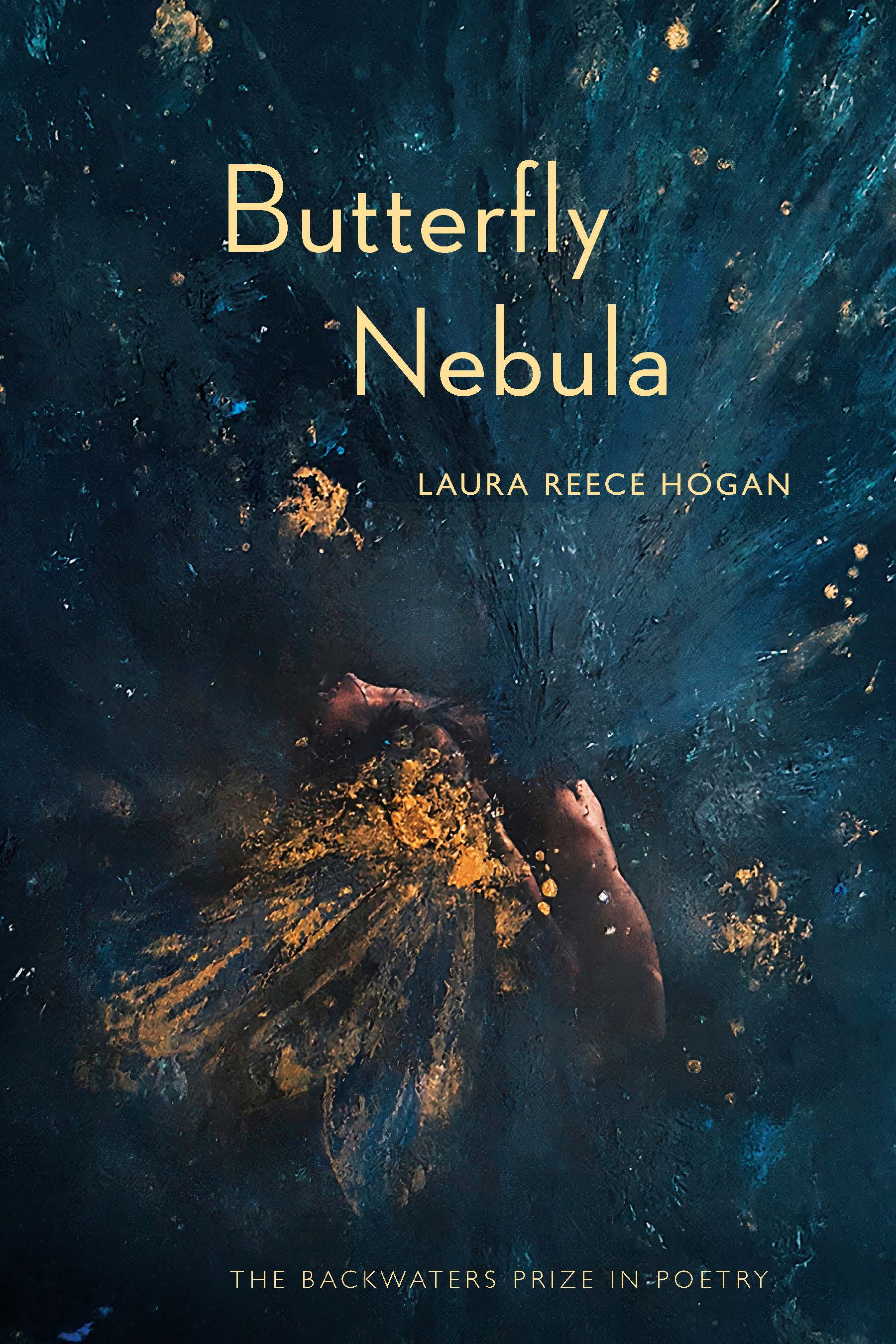
Laura Reece Hogan is the author of I Live, No Longer I, O Garden-Dweller, and Litany of Flights. Her most recent book Butterfly Nebula was published this month by Backwaters Press.
The James Webb Space Telescope, launched in late 2021, has provided the world with captivating images and stunning data about the universe—but has also upended everything we thought we knew about the origins and development of the universe. We can see more clearly than ever before, and further back in time than ever before (to about 500 million years after the Big Bang), and yet astronomers admit that this has seriously challenged the standard model of cosmology. In a sense, the more clarity we have, the more we see what we don’t know.
At the beginning of the pandemic, perhaps feeling the limitations of lockdown and quarantine, I began to write poems about the far reaches of space, the depths of the ocean, and what we might find there to tell us something about ourselves, about our place in the universe and in time, about our purpose and identity, about what is constant and what is constantly changing. The poems began with specific curiosities and delved for universal truths. The more I reached for strange beauty in the world or beyond the world, the more strange beauty I found—in resonant patterns, in clues about meaning and purpose. A bizarre, colonized sea creature called a siphonophore teaches something about the heart. A lyrebird has something to say about deception. A praying mantis discloses desire, while dark matter in the universe reveals longing. The butterfly nebula reverberates with transformative force:
Butterfly Nebula
A stellar death must herald it— the hottest star
throws off its envelope. Torus of dust
eaten and retched all its life. Two violent jets
of gases over 36,000 degrees Fahrenheit must rip
across space many heavy lightyears
out from under
tightened belt of the body, dark slit
running through the waist. A disk of weight, a thumb
of the divine pinches the butterfly almost
to severing. The thing about a resurrection—
the chrysalis must cleave expel the life blood
damp crushed wings
at first unrecognizable. The Magdalene looked
in all the wrong places. She
thought he was the gardener. The split-apart vowels
of her name uttered unfold
across constellation, stretching stream
of ultraviolet radiation making cast-off skin of the dead
star glow in two arching nebular lobes its new form
still gathering energy.
Each gorgeous thing I considered—manatee nebula to firework jellyfish to aspen and so on—kept circling back to a key element: a cyclic pattern of emergence or transformation, whether over days or years or eons. Everything, it seems, including me, including you, exists in a particular moment of process, or as one line in the book has it, “one thing in the act of becoming another.” This happens on such an extensive scale that questions about what is dead and what is alive, what is emerging and what has yet to emerge, are all given a startling new lens.
The thrill of receiving new images and data from the James Webb Space Telescope is not just about seeing what we’ve never seen before. It is also about engaging deeply with what the fabric of the universe has been and is, and speculating about what it will become, and where we humans and our world are situated within that cosmology. In a similar way the poems in Butterfly Nebula teem with creatures and cosmic phenomena that vivify and reveal our common struggle toward faith and identity—toward perceiving both what we know and what we don’t know just yet. The longing and metamorphosis of the human heart and soul are reimagined in an otherworldly landscape of sea slug, stingray, butterfly and moth, moon and star, and celestial events ranging from fast radio bursts to a dozen classified nebulae. Our desire for purpose and renewal collides with the vast constellation of divine possibility in this new collection.
 UNP blog