
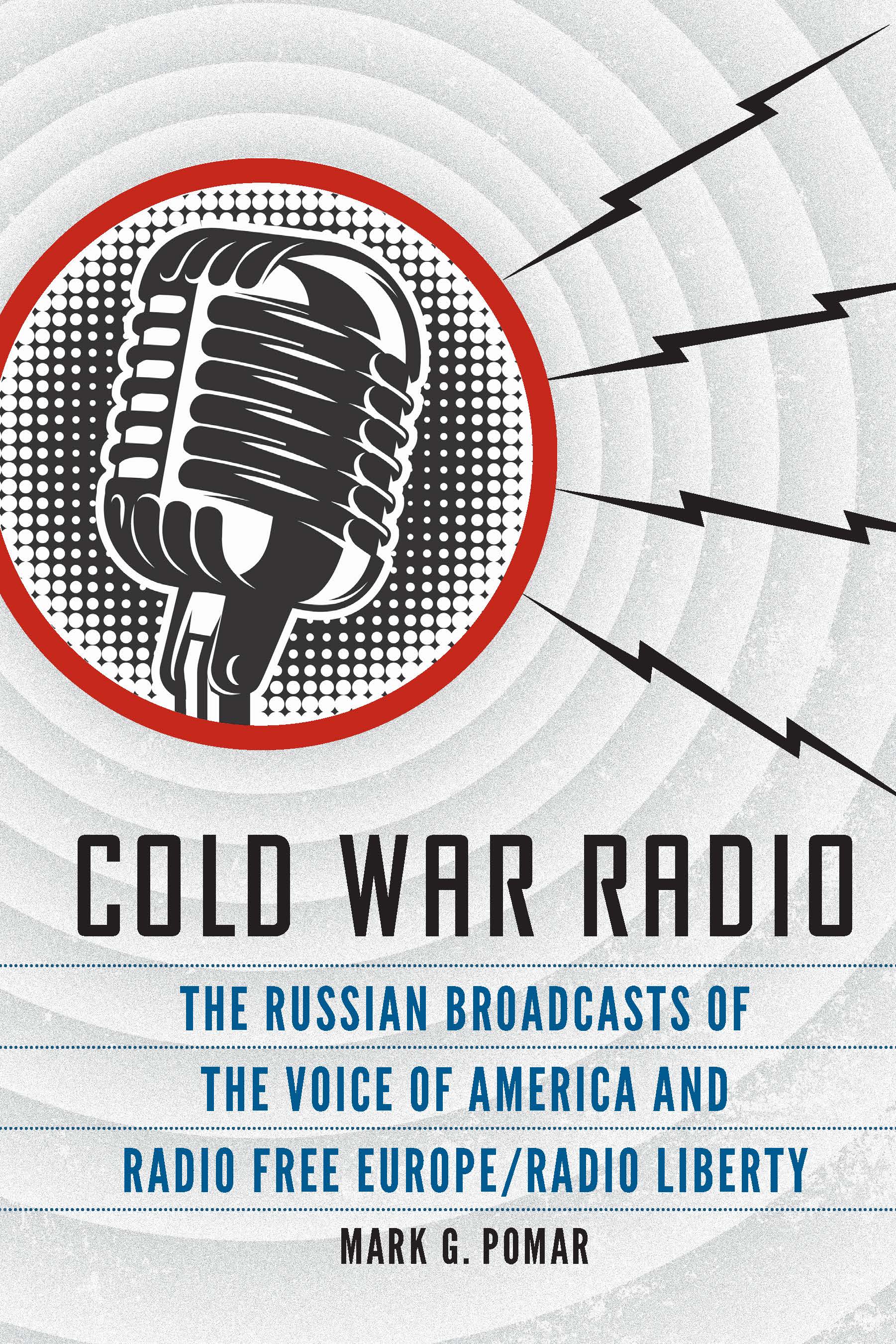
Book Birthdays celebrate one year of a book’s life in tweets, reviews, and more. This month we’re saying Happy First Book Birthday to Cold War Radio (Potomac Books, October 2022) by Mark G. Pomar.
About the Book:
Cold War Radio is a fascinating look at how the United States waged the Cold War through the international broadcasting of Voice of America (VOA) and Radio Free Europe/Radio Liberty (RFE/RL). Mark G. Pomar served in senior positions at VOA and RFE/RL from 1982 to 1993, during which time the Reagan and Bush administrations made VOA and RFE/RL an important part of their foreign policy.
A Word from the Author:
Cold War Radio was completed and submitted to the University of Nebraska Press before the full-scale Russian invasion of Ukraine in February 2022, but the genocidal Russian bombing of Ukraine and the ensuing conflict between Russia and the West have made my book especially timely and relevant. As soon as the book was available to the public in October 2022, I started receiving invitations to speak at conferences, foreign affairs clubs, and universities, including Columbia, Stanford, the University of Texas, Austin, and Tufts University. Within nine months, I participated in over 50 talks, podcasts, and media appearances. Positive reviews soon followed, including one in The Wall Street Journal. Clearly, the original Cold War, which formally ended in 1991, has come back with a roar and vengeance.
My book draws on declassified documents and radio programs to examine how US-funded broadcasting, principally the Voice of America (VOA) and Radio Free Europe/Radio Liberty (RFE/RL), reached audiences behind the Iron Curtain with fact-based programs about the United States, as well as reports about international affairs and developments within the communist world. With the full independence of the countries in Eastern Europe and the dissolution of the Soviet Union, VOA and RFE/RL were hailed by newly elected democratic leaders as heroes. RFE/RL was even formally nominated for the 1991 Nobel Peace Prize.
What makes my book of critical importance today is that I draw important lessons from the broadcasting policies and practices during the Cold War that could be adapted to meet today’s twin challenges of confronting Russia and China. Both countries are now America’s major adversaries (if not outright enemies) and are making major investments in promoting their messages and propaganda throughout the world. If we are to remain a free and prosperous nation, allied with other major democracies, we need a new national security media strategy to reach populations throughout the world. The Cold War years, described in detail in my book, present many tools for developing and implementing that strategy.
Reviews:
“Cold War Radio is a must-read both for scholars of the Cold War and analysts seeking ways to parry foreign disinformation efforts against the United States.” – Gregory Mitrovitch for the Russian Review
“Cold War Radio details the history of the American broadcasters, the push and pull of opinions within those organizations and assesses their role in undermining support for the Communist regimes of Eastern Europe and Soviet Central Asia.” – David Luhrssen for Shepherd Express
“Mark Pomar’s book Cold War Radio is, in my view, the first serious attempt at an unbiased presentation of the World War II and Cold War-era history of the U.S. government-funded and managed Voice of America (VOA) radio broadcasting.” – Tadeusz Lipien
“Pomar’s analysis is most compelling in dissecting the conflicts between American foreign policy (which often sought to find accommodation with the Soviet Union and accepted its existence as a given) and hard-core Russian nationalist ideology (which considered the Soviet state and outrage that could only be destroyed and overcome). – Eric Rubin for the Foreign Service Journal
“In the preface to Cold War Radio, his insightful, absorbing account of the remarkable work of these services, Mr. Pomar recalls an incident from 1984, when he traveled to Cavendish, Vt., to interview the exiled author Aleksandr Solzhenitsyn.” – Martha Bayles for the Wall Street Journal
 UNP blog