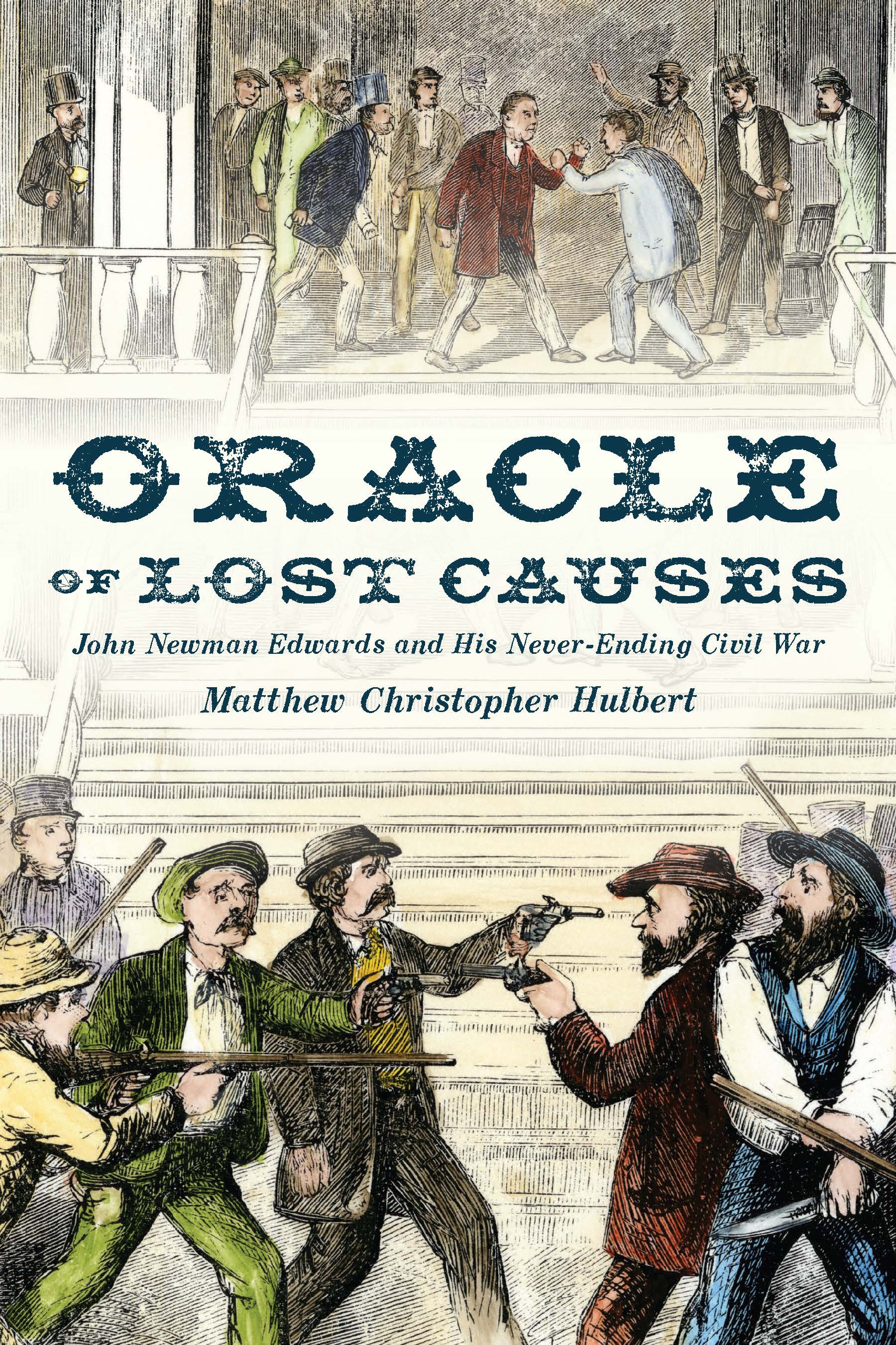
Matthew Christopher Hulbert is an Elliott Associate Professor of History at Hampden-Sydney College in Virginia. He is the author of The Ghosts of Guerrilla Memory: How Civil War Bushwhackers became Gunslingers in the American West, winner of the 2017 Wiley-Silver Book Prize, and coeditor of Writing History with Lightning: Cinematic Representations of Nineteenth-Century America. His newest book, Oracle of Lost Causes: John Newman Edwards and His Never-Ending Civil War, was published last month.
John Newman Edwards was a soldier, a father, a husband, and a noted author. He was also a virulent alcoholic, a duelist, a culture warrior, and a man perpetually at war with the modernizing world around him. From the sectional crisis of his boyhood and the battlefields of the western borderlands to the final days of the Second Mexican Empire and then back to a United States profoundly changed by the Civil War, Oracle of Lost Causes chronicles Edwards’s lifelong quest to preserve a mythical version of the Old World—replete with aristocrats, knights, damsels, and slaves—in North America.
Preface: Coming of Age in an Age of Crisis
The senator from South Carolina [Andrew Butler] has read many books of chivalry and believes himself a chivalrous knight with sentiments of honor and courage. Of course he has chosen a mistress to whom he has made his vows, and who, though ugly to others, is always lovely to him; though polluted in the sight of the world, is chaste in his sight—I mean the harlot, slavery. For her his tongue is always profuse in words. Let her be impeached in character, or any proposition made to shut her out from the extension of her wantonness, and no extravagance of manner or hardihood of assertion is then too great for this senator.
These were the words of Charles Sumner, delivered before the United States Senate on May 19 and 20, 1856. Preston Brooks could not abide them. Or he would not. As a native of South Carolina’s Edgefield District—a place renowned for the frequency with which its residents took to dueling—he had more or less been hardwired to meet verbal challenges with violent force. Because in the minds of antebellum Southerners, if an able-bodied man refused to defend his honor, he’d never really had any honor worth defending.
Andrew Butler, though, was an old man, and he’d recently suffered a stroke. He was also Preston Brooks’s cousin. In short, as Butler could not attend to his own honor, or to the family’s, the task fell to Brooks.
While determining how exactly to deal with Sumner, Brooks considered three main issues. First, he was a Democratic Congressman and Sumner was a Republican Senator—so whatever happened between them was bound to have explosive political consequences. Second, Sumner hailed from Massachusetts; he harbored little interest in Southern “affairs of honor” and would undoubtedly ignore any formal invitation to gunplay. This was of course assuming Brooks considered Sumner a gentleman worthy of challenging in the first place, which he did not. So there could be no proper duel. Third, because Southern honor culture deemed it unmanly for Brooks to shoot at an unwilling or unqualified opponent, he would have to confront the senator some other way, most likely with his fists. And therein lay the problem: Charles Sumner was much, much larger than Preston Brooks. The solution? Ambush.
On May 22, Brooks staked out the Senate chamber. Sumner could be found there most days, and this day was no exception. Fancying himself a man of true cavalier principles, Brooks waited until early evening to make his move. Their “business,” whatever it would entail, was not for the eyes of ladies. When the galleries had finally cleared to his satisfaction, Brooks entered the chamber. He spied his target and began a slow but direct approach. Sumner sat alone, writing. He was oblivious to the man with the gutta- percha cane limping in his direction. Brooks announced his intention to settle their score and brought his cane swooping down all at once. Sumner never saw it coming. He never had a chance.
Though initially stunned by the sudden attack, Sumner attempted to stand. Now, however, the hulking frame that had so worried Brooks actually worked to Sumner’s disadvantage. Like all the other desks on the senate floor, his was bolted to the ground. In times of spirited disagreement, the measure prevented senators from hurling furniture at each other. Now it meant that Sumner’s legs were jammed beneath the desk. This made fighting back, or even effectively shielding his head from Brooks’s cane, all but impossible. Blow after blow after blow came down. Sumner felt his strength failing. In a final, Herculean effort, he managed to lurch upward, tearing his desk free, hardware and all— but to no avail. His body could take no more. He fell to the floor. Blood pooled around him as the grotesque thwack of gutta-percha striking his limp figure echoed throughout the chamber.
For caning Charles Sumner, Brooks was arrested, tried, and convicted of assault. Following a series of heated debates, the House of Representatives resolved not to remove him from office. In a calculated display of defiance, he resigned. And in an even greater show of impudence, the people of Edgefield— who now revered him more than ever— held a special election and sent Preston Brooks, new cane in hand, right back to Washington, DC.
The United States in 1856 was a hotbed of irreconcilable worldviews. A woman felt compelled to kill her own innocent child rather than see the girl returned to a life of perpetual bondage. The man who legally owned them both decried not the murder but the loss of his property. The people of a frontier town found themselves at war, not with displaced Native Americans but against other white Americans who could not tolerate their stance against the spread of Southern slavery. These assaults signaled to easterners that violence went hand in hand with the debate over slavery’s expansion— and would continue to do so. A congressman beat a senator nearly to death inside the capitol building itself and was hailed by his constituents as a hero. The fact that other South Carolinians coveted the splintered remains of Brooks’s cane similarly announced to those same easterners that such lapses of peace would not be confined to the faraway, western margins of civilization.
John Newman Edwards turned eighteen years old in 1856. It was an important milestone, then as now. He became unconditionally eligible for military service— the mark of a fully grown, American man. Born in Virginia, the sectional crisis had been his cradle, and it followed him to Missouri in 1855. Owing to the failed escape of Margaret Garner, the ruination of the Free State Hotel, and the caning of Charles Sumner, that cradle came crashing down just as Edwards emerged from it. Or in still more colloquial terms, John Newman Edwards came of age just as the Republic seemed to be losing its mind.
 UNP blog