
Jim Leeke is a former news journalist, a retired copywriter and creative director, and a U.S. Navy veteran. He is the author of several books, including The Turtle and the Dreamboat (Potomac Books, 2022), The Best Team Over There (Nebraska, 2021), and From the Dugouts to the Trenches (Nebraska, 2017). His latest book The Gas and Flame Men: Baseball and the Chemical Warfare Service during World War I was published by Potomac Books in February.
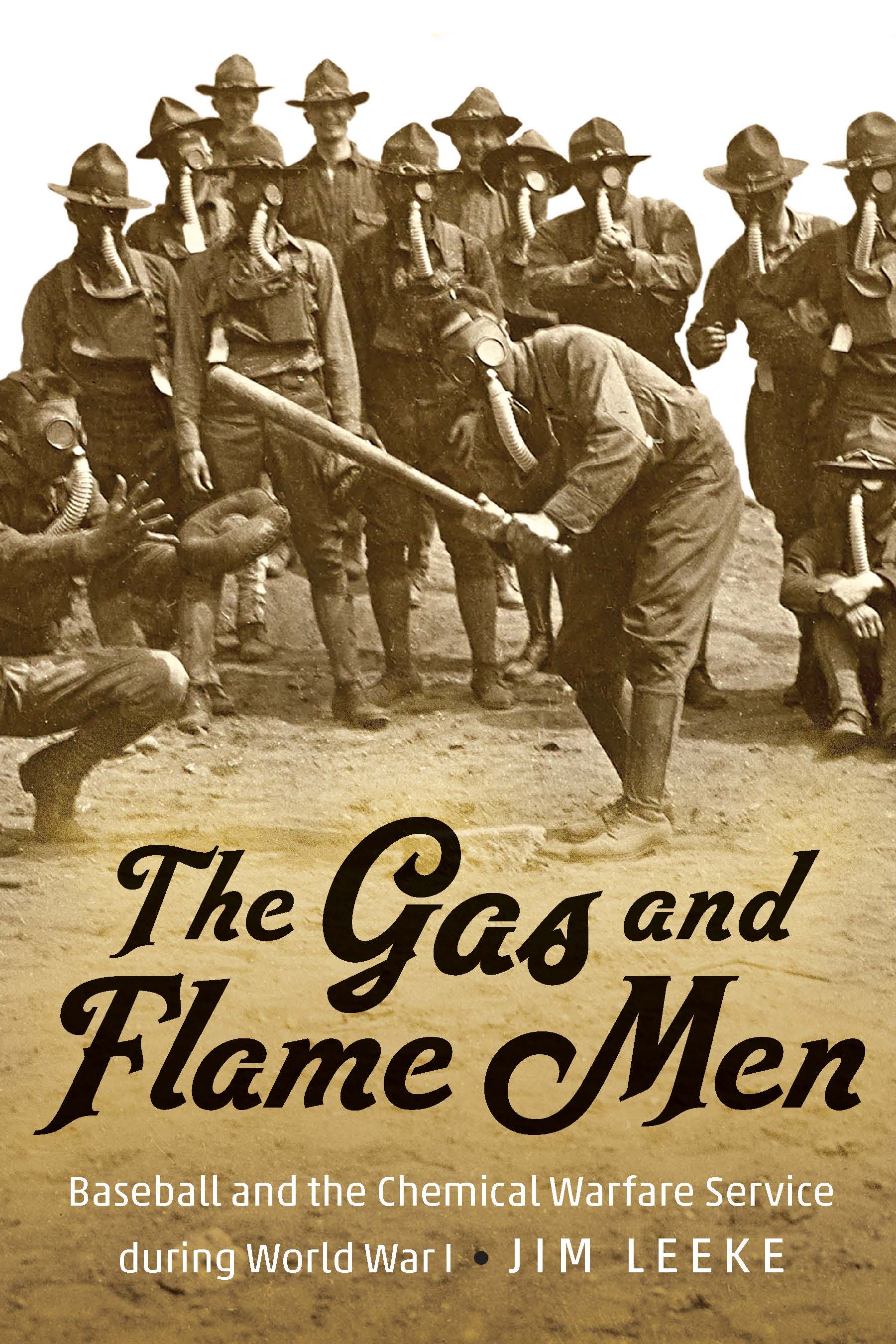
The Gas and Flame Men is the first full account of Major League ballplayers who served in the Chemical Warfare Service during World War I. Four players, two club executives, and a manager served in the small and hastily formed branch, six of them as gas officers. Remarkably, five of the seven—Christy Mathewson, Branch Rickey, Ty Cobb, George Sisler, and Eppa “Jeptha” Rixey—are now enshrined in the National Baseball Hall of Fame at Cooperstown, New York. The Gas and Flame Men explores how these famous baseball men, along with an eclectic mix of polo players, collegiate baseball and football stars, professors, architects, and prominent social figures all came together in the Chemical Warfare Service.
1
Nashville
Charles “Gabby” Street stepped out of a cold spring downpour into a downtown Nashville hotel. Ballplayers from the American League Washington Senators sat around inside playing pinochle and reading newspapers, their late-March exhibition game with the Nashville Volunteers washed out.
The news was as gloomy as the weather, front pages rumbling about the European war and America’s long slide toward involvement. “President [Woodrow] Wilson took steps today to place the nation on a war footing,” one article began. A few players cast their papers aside and headed out for nearby motion picture theaters.
One or two perhaps recognized the big fellow stepping into the lobby. Gabby looked exactly like what he was: an aging catcher and former Senator, who played now for the local team that fans called the Vols. He took life at the gallop, on the field and off.
“Gabby was no angel in younger days, nor was he frugal. Admits he liked to play around with one foot on brass rail,” Sporting News later recalled. Bad habits had hampered his career early on, “and he lacked only the development of a little common sense to land among the majors,” a Washington newspaper once said. “This streak of light dawned on him when he married [in 1907] and decided to settle down.”
Thirty-four years old now, with a wife but no children, Gabby had been up to the Major Leagues and back down again. Fourteen professional seasons behind the plate had left him with bouts of rheumatism and a “collection of knitty fingers,” all but one of which he had broken, some two or three times. He’d once caught eight doubleheaders in nine days, “an experience that would have put nine catchers out of ten in the hospital for keeps.” An inch under six feet tall and weighing 185 pounds, Gabby was tough and determined and not about to give up the national pastime.
He gazed about the lobby, looking for the Kansas farm boy he’d helped shape into a pitching star in the nation’s capital. Walter Johnson was five years younger than the catcher. Fans called him “Barney,” after racecar driver Barney Oldfield, and also “the Big Train.” Both nicknames derived from the tremendous speed of his fastball. Johnson credited Gabby with helping him learn how to pitch in the big leagues after his call-up to Washington nearly a decade ago.
“When ‘Gabby’ Street was in his prime,” the hurler had written, “he was the best catcher I ever saw, I think. Perhaps old-timers can recall back-stops who surpassed him, but to me he was the ideal man behind the bat.” Gabby kept pitchers at ease by chattering like a magpie behind the plate. “‘Ease up on this fellow, Walter; he has a wife and two children,’ he would call jokingly when some batter was hugging the plate and getting a ‘toe-hold’ for a crack at one of my fast ones,” Johnson wrote. “‘This fellow hasn’t made a hit off you since you joined the League,’ would probably be his next remark. And so on throughout the game.”
Johnson clasped his one-time mentor’s hand here in Nashville, a clutch of sportswriters looking on with pencils poised. “The meeting of the smoke king and famous Gabby yesterday was the first reunion these athletes have had since Gabby dropped out of the big show five years ago,” the Washington Herald said. To no one’s surprise, it was the backstop who spoke first.
“Barney, you’re looking great,” Gabby said, his Alabama upbringing evident in his drawl. “So are you,” Johnson replied, lying only a little. “It was a touching sight,” Louis A. Dougher wrote for the Washington Times, “to see these old pals of many wonderful mound battles in the American League shake hands in the lobby of the Hermitage Hotel.”
The friends settled in and began catching up. Johnson was starting his eleventh season in Washington, while Gabby had long since fallen into the Southern Association, a Class A circuit two rungs below the American League. “The star of the king of pitchers still is all a glitter,” the Washington Star’s Denman Thompson wrote. “That of Street lacks the luster of the majors, though in Dixie Gabby still is rated with the wisest.”
The gap in their status didn’t affect the reunion. “Walter Johnson, the noblest pitching Roman of them all, sat in the Hermitage lobby practically all afternoon chinning with Gabby Street,” sportswriter Bob Pigue wrote in the Nashville Banner, “or rather getting chinned by Gabby, as it takes a peach of a bird to get in a word edgewise when this Mr. Charles Gabby Street is anywhere close.”
“I guess I’m getting old,” the catcher said, as time flowed past like rainwater outside, “but I’m good for a couple of more years down here where the sun shines in the summer. My wing is still delivering the goods, my legs are quitting me though, and I do lose some good hits because I can’t get down to first, but they’ll have to come out with a sheriff and his deputies to take me off the diamond. I’m going to stick till they come for me with the hearse.”
The hurler said he was slowing, too, but his former battery mate wasn’t having it. Johnson could lose two thirds of his good stuff, Gabby said, and still be a wonder. “He not only is a wonderful pitcher, but a fine gentleman,” the catcher added after their chinning session. “It was good to see him again, mighty good.”
Vols manager Roy Ellam sent automobiles for the Senators the following day, as the cold and damp weather continued. The players toured Nashville and the surrounding countryside and even visited the state prison sixteen miles away. Back in town cameramen got Gabby and Johnson to shake hands again for the newsreels.
Years from now, when their playing days were done, the Big Train would include Gabby Street on his personal list of all-time Major Leaguers, ranking him with Babe Ruth, Ty Cobb, Joe Jackson, and other horsehide luminaries. “Since Gabby left the major leagues there has never been a catcher in his class,” he told scribes in Tennessee. Then the pitcher added: “He had the best throwing arm in the big show, and whenever a runner would start to steal, Gabby’s peg was on a line and would cut him down. I’ve seen many catchers in the big leagues since Gabby left, but I’ve yet to discover one who can show the stuff that Gabby did in his prime.
“I’m mighty glad to see Gabby doing so well in Nashville, for he’s a great fellow all the way, and deserves all the success in the world.”
The weather never cooperated for the two old pals, and the Senators left town without playing their exhibition with the Volunteers. But other events were vastly more important.
Nearly two years earlier, a German U-boat had sunk the passenger liner Lusitania and begun a ruinous decline in relations between Berlin and Washington. On April 6, 1917, ten days after the Big Train departed Nashville, the United States declared war on Germany. America entered the European conflict on the side of Great Britain, France, and Belgium.
Ballplayers throughout the Southern Association and in other leagues around the country started their year amid uncertainty and worry. “The fast gathering war clouds threaten the most prosperous season in outlook in the history of Dixie’s major [league],” the Nashville Tennessean said, “but unless the pressure of the United States being involved in the world conflict produces unexpected happenings, the season will pass off as successfully as anticipated.”
Nashville’s veteran catcher took the war bulletins stoically. “Gabby Street galloped around the running track some three miles yesterday,” sportswriter Claude “Blinkey” Horn wrote in the Tennessean, “but will never again repeat the long-distance racing, since the scales showed he had sloughed off some four pounds, somewhere on his lengthy journey.” Horn added that Gabby “is already down to fighting trim, and wailed long and loud over the loss of the poundage.”
Staying trim wasn’t all that occupied the veteran backstop’s mind as the Vols prepared for their season opener. Gabby likely was already thinking about a greater and grimmer contest, one he wouldn’t fight with bat and ball in the safety of a grassy park.
 UNP blog