
Gail Shaffer Blankenau is a professional genealogist, historian, speaker, and author. She holds an MA degree in history from the University of Nebraska–Kearney, and in 2023 she received the James L. Sellers prize for her article about the Grayson sisters in a volume of Nebraska History magazine. Blankenau is from Nebraska and currently lives in Lincoln. Her latest book Journey to Freedom: Uncovering the Grayson Sisters’ Escape from Nebraska Territory was published by Bison Books in March.
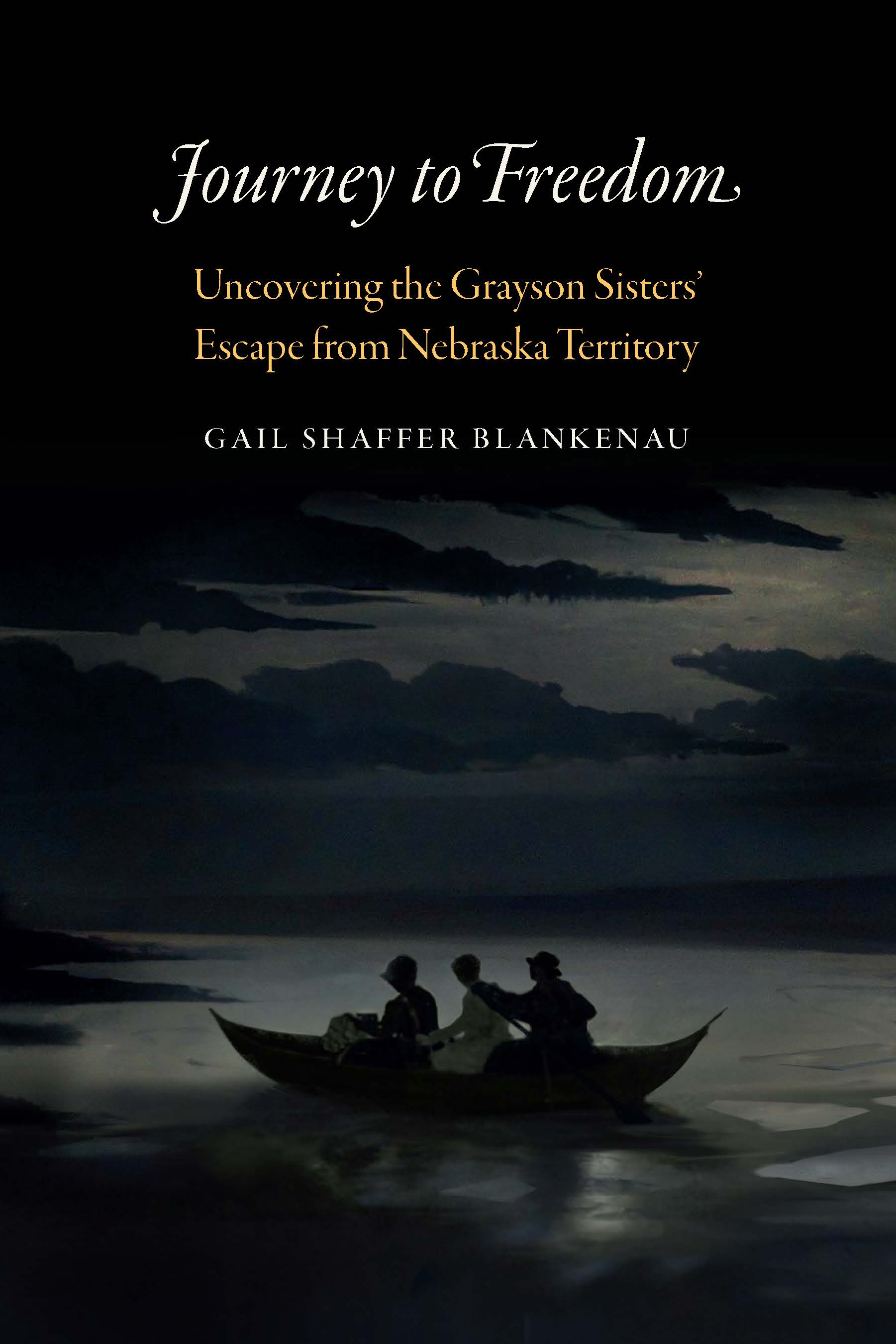
In late November of 1858 two enslaved Black women—Celia Grayson, age twenty-two, and Eliza Grayson, age twenty—escaped the Stephen F. Nuckolls household in southeastern Nebraska. John Williamson, a man of African American and Cherokee descent from Iowa, guided them through the dark to the Missouri River, where they boarded a skiff and crossed the icy waters, heading for their first stop on the Underground Railroad at Civil Bend, Iowa.
Drawing on multiple collections, records, and slave narratives, Journey to Freedom sheds light on the Graysons’ courage and agency as they became high-profile figures in the national debate between proslavery and antislavery factions in the antebellum period.
Introduction
Worshipping heroism, as typically defined, works against the idea that the lives of more common people count and hold lessons for us as well.
—Annette Gordon-Reed, On Juneteenth
On the cold, wintry night of November 25, 1858, two enslaved women, Celia Grayson, age twenty-two, and her sister Eliza Grayson, age twenty, slipped out of a house in the frontier river town of Nebraska City, Nebraska Territory. Twenty-three-year-old Black Cherokee freeman John Williamson, described as “a mulatto of considerable shrewdness and deal of experience in the world for one of his years,” had arranged to meet them. Williamson was a familiar figure in the towns that dotted both sides of the Missouri River, engaged in small trading back and forth between Iowa and Nebraska. He was well positioned to help enslaved people cross the river. The women traveled about eight miles north to a small Missouri River ferry landing called Wyoming Station. Once the trio reached the landing, they boarded a skiff (flat-bottomed rowboat) to cross frigid waters running with ice. The young women were headed for their first stop on the Underground Railroad at Civil Bend, Iowa.
The next morning Celia and Eliza’s enslaver, Stephen Friel Nuckolls, whom friends and family called by his middle name, discovered the women’s absence and sprang into action. He sent word to his two brothers in Glenwood, Iowa, and a brother-in-law in Sidney, Iowa, telling them to post lookouts at strategic river crossings. He then gathered a search party. The next issue of the local Nebraska City News declared that Nuckolls’s female “servants” had been “enticed” away by “some vile, white-livered Abolitionist” and would “doubtless be found in some Abolition hole.” Nuckolls offered a $200 reward for their return.
The announcement did not contain any descriptions of the women. In other newspaper accounts, Eliza was described as “stout and sharp,” meaning she was strong and intelligent. Another writer, given to flowery language, called her a “ginger-hued damsel.” There are no descriptions of Celia.
While history has not been silent on the existence of slavery in Nebraska Territory, historians have taken a small view of it. Early historians framed slavery in Nebraska as little more than an interesting item of curiosity because the numbers of enslaved people in antebellum Nebraska were always small. But how small? Federal territorial census counts of enslaved and free Black people ranged between eleven and eighty-two from 1854 to 1860. The earliest censuses were certainly undercounts. One newspaper asserted in 1855 that there were “no less than forty slaves in Richardson County alone,” which could have been an exaggeration, but it is almost certain that enslaved people were there without being counted. The number of enslaved people in Nebraska Territory was in constant flux.
According to researcher James Bish, most of the Blacks in Nebraska in 1860 were free, and just ten enslaved people lived in Otoe and Kearny Counties, as well as at Fort Randall. Bish stated that “Commander Charles May of Fort Kearny owned two slaves and junior officers owned five more.” Yet the digitized census pages online reveal no enslaved people in Charles May’s household. They count six Blacks at Fort Kearny with no designation of whether they were enslaved or free. Questions remain as to whether some of these Blacks counted as free were actually working under conditions of enslavement.
The 1858 Nebraska City tax census counted twenty Black people total, some enslaved and some free, out of a population of 1,483—a little over 1 percent of Nebraska City’s population. Other evidence reveals that federal appointees to government positions brought enslaved people into the territory who never made it into any census count.
Moreover, for those people enslaved in the territory, the issue was important regardless of the numbers. They came from places where the numbers of enslaved people had been small and the landscape challenging. Indeed, the terrain had not prevented the institution from taking hold with steady growth. No matter what the numbers were, slavery in Nebraska was their everyday reality.
Between fifteen thousand and twenty thousand people sought their freedom during the 1850s in the United States, yet only a fraction of these incidents merited wide publicity. Why did Celia and Eliza’s story capture national headlines? At least part of the reason was their location in Nebraska Territory, established with Kansas Territory in the 1854 Kansas-Nebraska Act. The legislation included provisions for new territories to choose whether to become free or slave states. Both abolitionists and pro-slavery settlers turned their focus to Kansas, lying south of Nebraska, as having the most potential to become the country’s next slave state. Anti- and pro-slavery factions poured in to settle in Kansas and attempt to tip the population balance their way. The factions clashed and violence broke out, leading to the period known as “Bleeding Kansas,” highlighting the contentious and ongoing national dispute over the expansion of slavery into the West.
While the battle lines were clearly drawn in Kansas, some consciously sought to downplay enslavement and its prospects in Nebraska Territory. J. Sterling Morton, an early Nebraska City settler and later a prominent political figure in the territory, used the Nebraska City newspaper to denounce “Black Republicans,” “Radicals,” and their antislavery rhetoric on a regular
basis. Newspapers swung between “nothing to see here” dismissals of the issue as a waste of time and editorials claiming there was no reason slavery should not exist in Nebraska, where the institution could be a positive good.
In this context, Celia and Eliza’s flight to freedom became, as Richard J. M. Blackett has noted in other cases, “politically charged with national implications.” The women’s actions took center stage in the fractious national debate over slavery. Were Celia and Eliza enslaved or free? This question was entangled in the larger question whether the territories were slave or free until they voted on the issue. Would the doctrine of popular sovereignty—a government subject to the will of the people—settle the argument once and for all?
 UNP blog