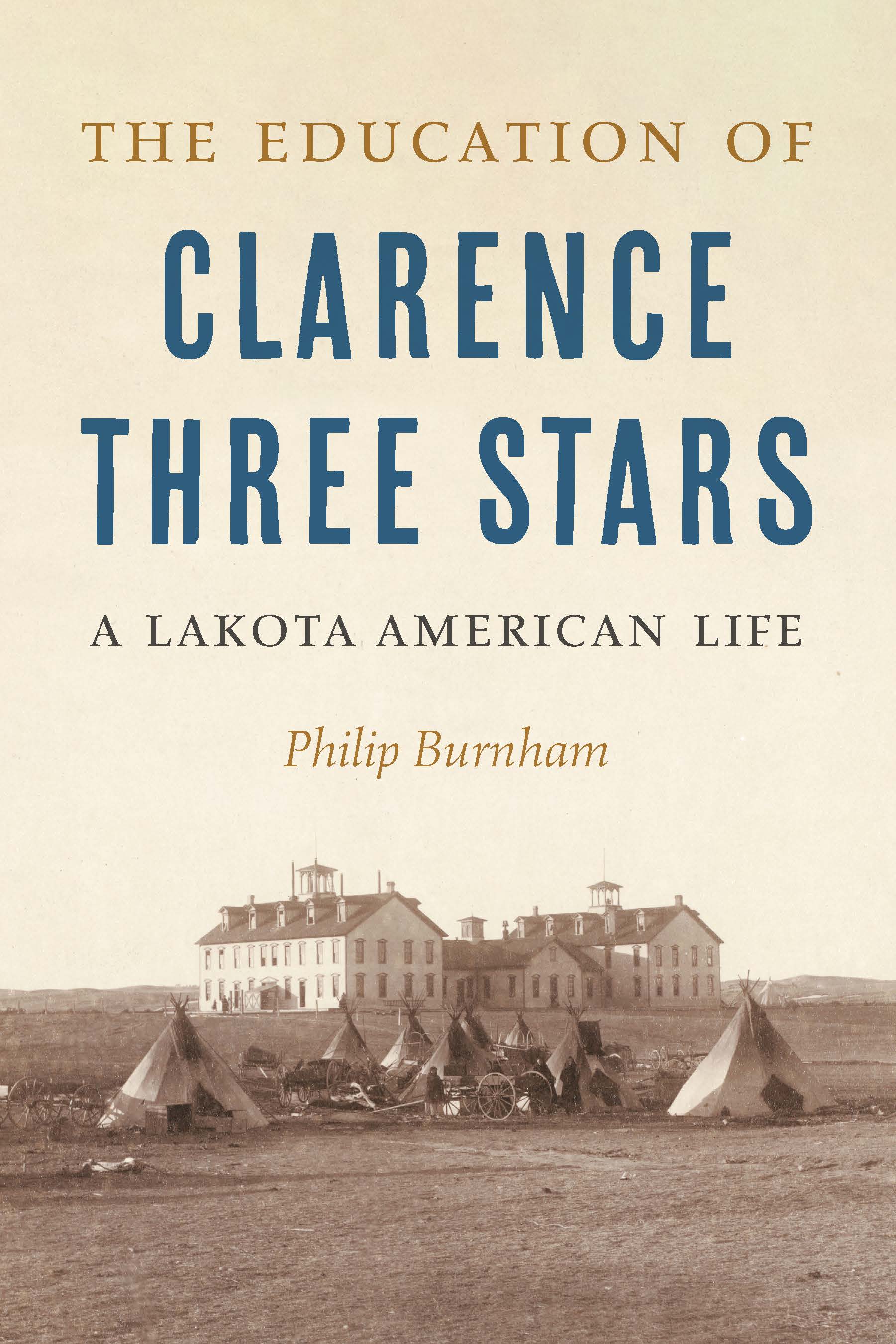
Philip Burnham is a retired associate professor of composition at George Mason University, a former reporter for Indian Country Today, and a freelance writer. He is the author of Indian Country, God’s Country: Native Americans and the National Parks and Song of Dewey Beard: Last Survivor of the Little Bighorn (Bison Books, 2014), winner of the 2015 Spur Award for Best Western Biography, among other books. His most recent book The Education of Clarence Three Stars: A Lakota American Life was published by Bison Books this month.
Think of all the great American Indian names in our history: Geronimo. Sitting Bull. Crazy Horse. Chief Joseph. Most of them were great warriors and chiefs who led extraordinary lives. But they weren’t exactly ikce wicasa, as the Lakota say, or of the common people. Sometimes those of more modest stature hold in the story of their lives an entire era, one in which they struggled with the challenges of the day as members of a family, a community, and a whole people. It’s too bad that history has a way of forgetting all about them.
So it is with Clarence Three Stars (a.k.a. Packs the Dog), a Lakota boy who was told, at age fifteen, that everything he had learned in life up to that point was wrong. He set off from Pine Ridge agency for Carlisle Industrial School in 1879, a member of the first class of Native boys and girls sent to the most famous Indian boarding school in our history. Once I began to understand the obstacles Clarence faced at Carlisle, and what he went on to make of the rest of his life, I decided to write down his story. He would become, you might say, a modern warrior long after the last shots of the Indian Wars had been fired.
His story wasn’t easy to dig up, though. History buries most lives so deep that sometimes only family are left to remember. Friends and colleagues would often ask, “Why do you want to tell the story of a man nobody’s ever heard of?”
“Well,” I’d say, “novelists have been doing it for hundreds of years.” David Copperfield. Emma Bovary. Jim Loney. The Kapshaws and Lamartines of Louise Erdrich. Who had ever heard of them until they burst forth from between the covers of a book? And if novelists can do it by force of imagination, why can’t historians do the same with facts and documents and true stories to guide them?
The Education of Clarence Three Stars, then, is no novel. It recounts the life of a man, a family, and a tribe, culled from letters, reports, classroom lessons, and institutional records, all concerning a boy who started life in a Lakota camp and grew up to become a trailblazing teacher, activist lawyer, county judge, and the duly elected president of the Oglala Sioux Tribe. But his was no simple success story, no Horatio Alger tale where hard work powers the hero to a life of wealth and high status. It’s a Lakota version of the American story, one that reveals the hardships and compromises of assimilation and renders the many choices confronting Lakotas even today as they try to make the best of two cultures, two languages, two ways of seeing and understanding the world.
Above all, Clarence Three Stars was a teacher. He knew from first-hand experience the dark chapter of Indian boarding schools. He attended them in Carlisle and Philadelphia and taught at another on Pine Ridge, not to mention the non-residential day schools he managed during his career. He ran a bilingual classroom generations before the idea would be institutionalized in American education. And he guided hundreds of Lakota children along a painstaking path of learning he devised in the little red schoolhouses that dotted the landscape of Pine Ridge a century ago.
His life (1864-1931) bridged a transitional era in Lakota history. His own grandfather lit the spark for the infamous Grattan Battle of 1854. Clarence knew the great Red Cloud well. Charles Eastman was a friend. Richard Henry Pratt, Carlisle School founder, was a father figure and a foil. Commercial titan John Wanamaker was a mentor. The writer Luther Standing Bear was a close friend—until a bad loan got in the way. And Three Stars didn’t wilt in the long shadow they cast. He interpreted for visiting dignitaries. He testified in Washington on official delegations. He was a real estate entrepreneur, owned a dry goods store, managed a ranch, and prayed as an Episcopalian, all with his wife Jenny and seven children by his side. He was an activist in the draft controversy of World War I and an advocate in the early campaign for the return of the Black Hills to his people. More than anything, he knew the people of Pine Ridge—progressive and traditional, Christian and skeptic, schooled and unschooled—as well as anyone could.
His story is a true one. You won’t find it in any other books. And it speaks to our own century as much as it does to any that have come before.
 UNP blog