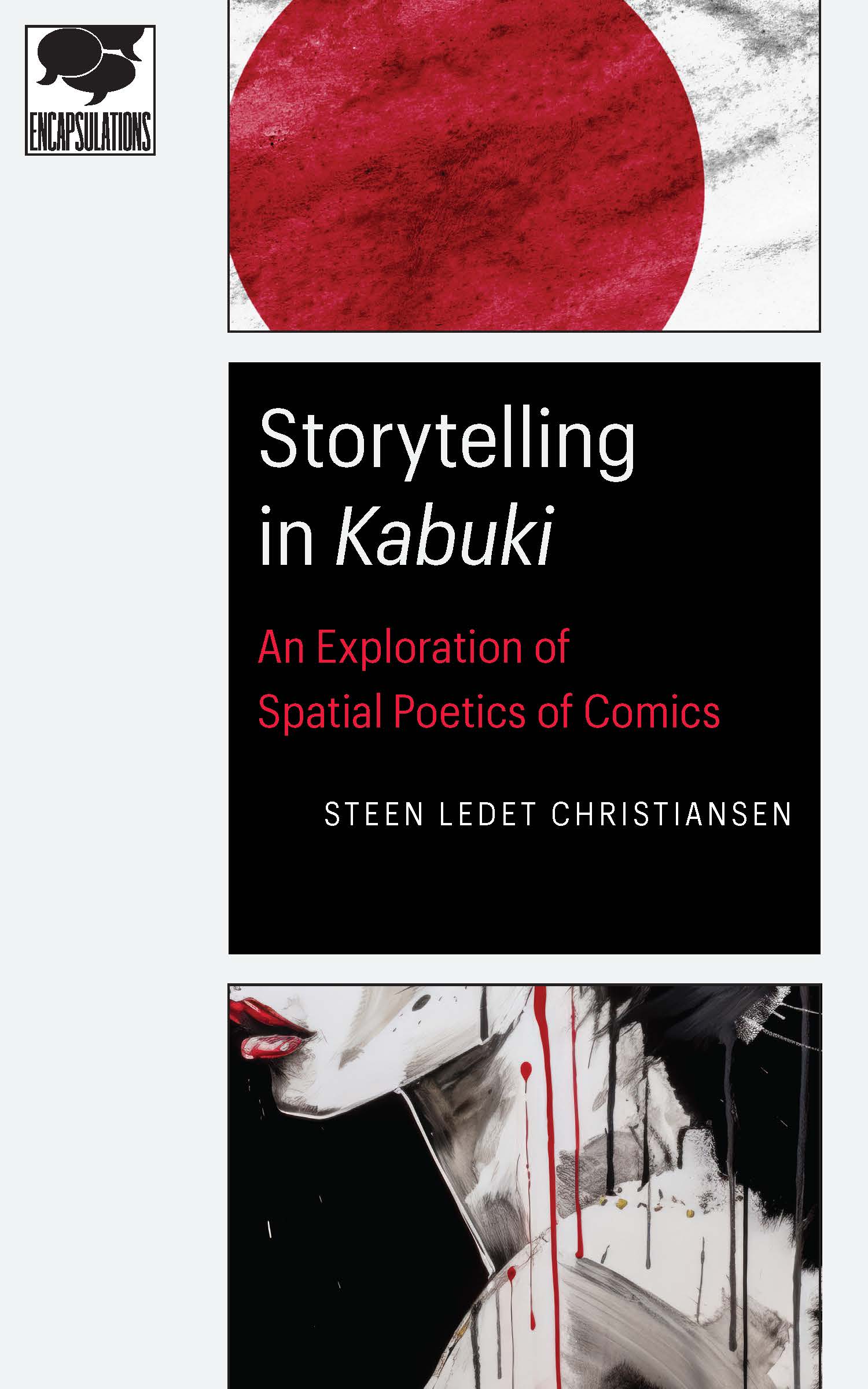
Steen Ledet Christiansen is a professor of culture, media, and aesthetics at Aalborg University. He is the author of Drone Age Cinema: Action Films and Sensory Assault and The New Cinematic Weird: Atmospheres and Worldings. His latest book Storytelling in “Kabuki”: An Exploration of Spatial Poetics of Comics was published by The University of Nebraska Press in April.
Steen Ledet Christiansen’s Storytelling in “Kabuki” explores the series created by David Mack—a slow, recursive narrative that focuses on the death of Kabuki and her past. The series ran from 1994 to 2004 in a variety of miniseries, one-shots, and spin-offs, rather than following a conventional American monthly release schedule. Most of the series explores different perspectives on the same event and adds background to Kabuki’s past, usually through surreal sequences, dreams, and near-death experiences. The flexibility of comics’ approach to chronology, space, focalization, narrative, and fictionality enabled Mack to produce an unusual experience. Kabuki tells a story that can only exist via comics.
Introduction
Let Us Space
Kabuki, by David Mack, tells a story that employs a wide range of comic book techniques. Comics’ plastic nature allows Mack to weave together repeating events, dying dreams, bipolar hallucinations, and metafictional loops, along with thrilling science fiction action, martial arts fights, a love story, and the traumatic experience of losing a parent, into a coherent whole. Kabuki starts out as a relatively conventional comic book, but after the first collection Mack begins exploring the dynamic potentials of page layouts and panel relations across issues. The relatively straightforward premise of Kabuki as a science fiction action thriller comic is offset by its far more complex spatial arrangement. In this way, Kabuki presents a useful opportunity to explore how space functions in comics. Space should be understood as the spatial arrangements of comics’ visual expression. As a visual medium, comics arrange components spatially to produce narrative, atmosphere, symbolic interaction, and many other patterns. Space is a core part of comics’ visuality because comics’ static nature means that everything they express must be expressed spatially. That spatial arrangement is key to understanding comics’ visual hierarchy.
Comics capture relations of space in what I call spatial form; every part of the comics page is pregnant with aesthetic potentials, and comics must be understood as a relational practice that explores these potentials. As for defining comics, I agree with Kai Mikkonen that it is somewhat futile to search for a definition. This is not because definitions are useless but because formal definitions tend to privilege one or another formal element of comics as the necessary one and disregard what Bart Beaty terms the “comics world,” which are all the creators, practices, institutions, companies, readers, and so forth that participate in whatever is called comics at any given time. As Beaty recognizes, formalist and functionalist definitions are part of this comics world, but there are no strict boundaries around it. Fuzzy logic and fuzzy sets blend what is thought of as comics, suggesting that any comics definition will also necessarily have a historical component.
Still, as formalist (and minimalist) definitions go, I have a preference for Thierry Groensteen’s “iconic solidarity,” which interprets comics as “interdependent images . . . participating in a series,” simultaneously separated and coexisting. While few works meet that criterion, examples being comics that have a series without images (as in Alpha Flight issue 6, by John Byrne) or novels that employ interdependent images in a series (such as Mark Z. Danielewski’s The Fifty Year Sword), Groensteen’s definition speaks to something crucial for comics’ expression. Although not explicit in Groensteen’s definition, space is evident in both the independence and interdependence of images. There is some degree of sequential-spatial relation between images, and there is a series of these relations. While variations are many, we can argue that the phrase “interdependent images” speaks mainly to images on a single page and “participating in a series” speaks mainly to consecutive pages. Both dimensions of Groensteen’s definition are part of comics’ spatial form. Such a conception of comics includes notions of sequence, juxtaposition, and succession yet does not require them to always be present. Written text is also avoided as a necessary element, though it may certainly be present, which will inevitably mean spatially present.
Problematically, this current definition would not exclude painting, photography, and other visual arts. Yet this is the trajectory that Beaty traces; comics are not separate from other visual arts, except by definition. Mack often references painters in his works, borrowing and adopting their styles for briefer or longer stretches. He also uses photography and a host of other mixed-media practices in his comics. Scott Bukatman identifies an affinity between Mike Mignola and the sculptor Auguste Rodin and their rendition of bodies in stasis. Comics as a medium are embroiled in art, and only historical contingencies have deemphasized this connection.
In any case, Kabuki is a comic. It tells a story through images and text, it was published by comics publishers, it was distributed by comics distributors, its creator worked in comics both before and after Kabuki, and it draws heavily on comics conventions, genres, and formulas, much more so than any other visual art. By whichever definition of comics chosen, Kabuki will be understood as a comic. For this book, I will remain within Groensteen’s formalist-minimalist definition, in order to develop a spatial poetics of comics. Spatial poetics is understood here as the plurality of ways that comics employ the spatial arrangements of its visual aspects—layout, repeating motifs, and so forth—as well as the sequential spatiality of comics’ narrative form.
The contribution of this book is thus not a clarification of what comics are but, instead, what comics can do, specifically what comics can do with space. Although it is a detailed study of one particular concluded comics series, the ideas developed here are certainly not limited to just this one comic or creator. What my emphasis on space, spatial form, and a new set of concepts can do is provide different insights into the poetics of comics, a concern that goes beyond any particular definition of comics.
I propose four main aspects of comics for understanding spatial form: (1) rhymes, understood as the way that specific motifs repeat across panels and pages, that is, in width, height, and depth; (2) choreographies, as the way that space and time exist as an interaction on the comics page and in series; (3) perspectives, as the way that spatial positioning impacts storytelling both as focalization and as reader positioning; and (4) rhythms, as the way information is arranged spatially across the page, sequence, or series. Each of these aspects will be elaborated on in the subsequent four chapters.
 UNP blog