
David Brauer is a communications, public relations, and marketing professional with more than two decades spent in the sports industry. His experience includes leadership in NCAA Division I athletics and summer collegiate baseball. A former baseball publicist at two Division I schools, he is a longtime college baseball aficionado and twenty-plus year College World Series attendee and season ticket holder. His latest book The Wizard of College Baseball: How Ron Fraser Elevated Miami and an Entire Sport to National Prominence was published by Nebraska this month.

The College World Series, an annual highlight of the summer sports calendar, is underway in Omaha and drawing national media coverage. Fifty years ago, the initial CWS appearance for Ron Fraser’s Miami Hurricanes sparked a seismic shift in the sport that led to today’s popularity.
In 1974, the West Coast was the epicenter of college baseball. USC had won five of the previous six national championships from 1968-73. The other preeminent power, Arizona State, claimed the 1969 title and finished as runner-up in both 1972 and 1973.
Fraser and the Hurricanes reached Omaha for the first time in 1974 sporting colorful orange and green uniforms. Miami gained notoriety on the field for a 7-3 victory over USC that prompted an Omaha World-Herald headline stating, “Trojans’ Nose Bloodied by the New CWS Bully.” While the Hurricanes eventually dropped a winner-take-all rematch with the Trojans, their runner-up finish put the college baseball world on notice.
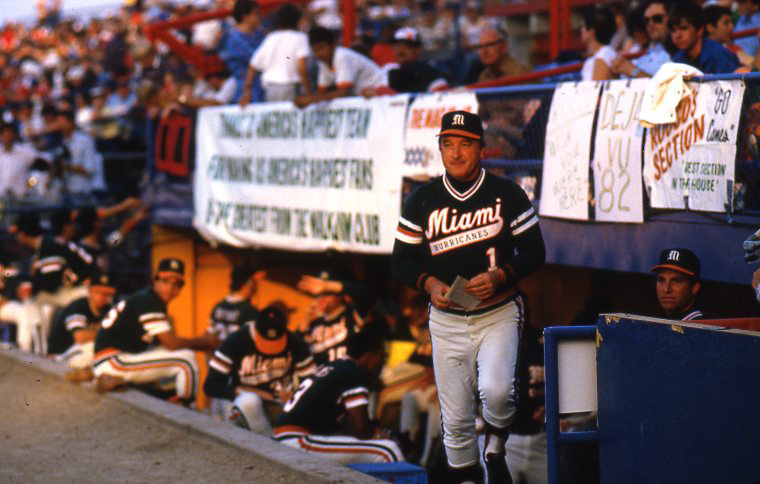
Fraser ushered in a new era of college baseball while his program ascended to the top. Known as “The Wizard of College Baseball,” Fraser built the best stadium in the country and boasted previously unprecedented attendance figures. His noteworthy, often zany, promotions drew national attention, and he introduced the first mascot specific to college baseball, the Miami Maniac (which doubled as the official College World Series mascot from 1983-91).
On the field, his teams were perennially among the sport’s best, appearing in five consecutive College World Series from 1978-82. Fraser’s 1982 team won the national championship, the first NCAA Division I team title for any Florida-based school, and executed the most famous trick play in College World Series history (the Grand Illusion). Three seasons later, in 1985, Fraser won his second national championship, defeating star-studded teams despite having a roster without a single future Major Leaguer. The Miami Hurricanes became college baseball’s premier program during the 1980s.
Fraser finished his Hall of Fame career just one win short of the 1992 championship game during his final season. He retired as the NCAA’s win percentage leader (.742) and ranked second in career victories (1,271) while making 12 College World Series appearances and winning a pair of national championships.

Fraser’s coaching resume is among the best in history, but he etched his legacy by masterfully initiating the growth of modern college baseball. He was well ahead of his time and developed lasting achievements still felt today – three decades after his retirement.
College baseball interest exploded after Fraser camped out at ESPN headquarters and convinced the fledgling network to televise games. The College World Series went from limited tape-delayed broadcasts to every game airing live, making it a fixture of ESPN’s summer programming. A handful of regular season telecasts airing in prime Sunday night television slots, and often featuring Fraser’s Miami teams, grew into the wide availability seen today with nearly all Division I games on television or a streaming service.
“The College World Series on ESPN was incredibly important in college baseball’s rise to prominence,” said Allan Simpson, founder of Baseball America. “Miami was at the forefront of everything that was happening, and the reason was [Ron] Fraser.”
Fraser’s outlandish promotions and ballpark giveaways spurred attendance and turned Miami baseball into a “must-see” event in a metropolitan area bursting with leisure and entertainment options. He made his program a self-sustainable business and generated surprisingly more revenue than many basketball and some football programs. As Fraser shared his blueprint with coaching peers, college baseball boomed in the Southeast, a location that had mild interest previously, and made gains in the colder-weather climates of the Northeast and Midwest. Today, the Southeastern Conference (SEC) is the sport’s standard for success with five of the last six national championship teams (dating back to 2017) and several of the nation’s top stadiums and attendance figures.
Fueled by Fraser’s television and promotional influence, college baseball’s national attendance more than doubled from 5.3 million in 1979 to 12.8 million in 1983. The College World Series also saw a staggering gain by going from 8,707 fans per game in 1979 to nearly double with 14,762 in 1989 and currently surpassing 20,000 fans on a regular basis. Charles Schwab Field, Omaha’s $131 million stadium that opened in 2011, is a monument to the popularity of the College World Series and college baseball, which trails only men’s basketball in NCAA Division I Championship revenues.
The Wizard of College Baseball traces the entertaining and inspiring stories of Fraser’s work in building a powerhouse program and setting the stage for college baseball’s rise to its current popularity. “Fraser did for college baseball what Arnold Palmer did for golf and what Muhammad Ali did for boxing,” said Skip Bertman, a former assistant coach under Fraser who later etched his own legacy at LSU with five national championships. “He was a superstar 30 to 40 years ahead of his time.”

 UNP blog