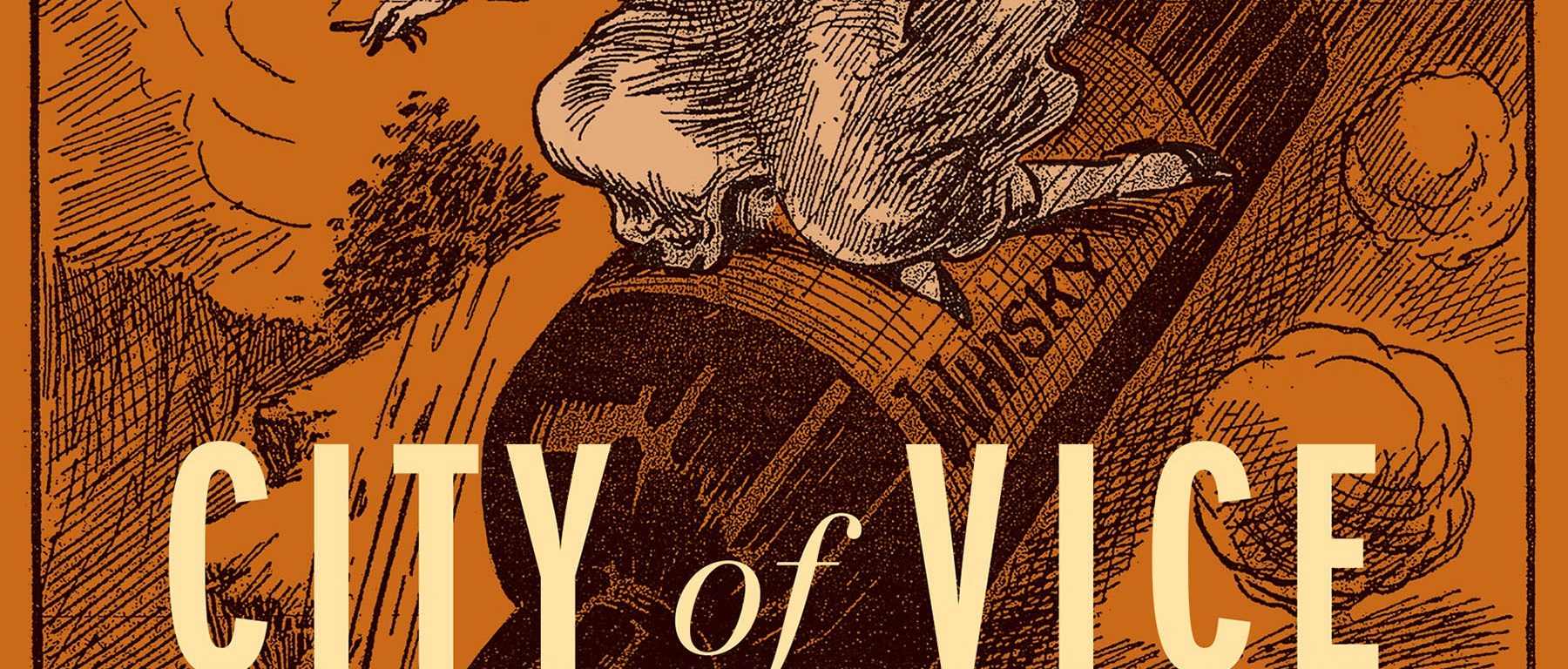
James Mallery is a licensed architect specializing in existing and historical buildings in Los Angeles. He has a PhD in history and has taught architectural history and U.S. history at various institutions. His new book, City of Vice: Transience and San Francisco’s Urban History, 1848–1917, was published in June.
San Francisco’s reputation for accommodating progressive and unconventional identities can find its roots in the waves of transients and migrants that flocked to San Francisco between the gold rush and World War I. In the era of yellow journalism, San Francisco’s popular presses broadcast shocking stories about the waterfront, Chinatown, Barbary Coast, hobo Main Stem, Uptown Tenderloin, and Outside Lands. The women and men who lived in these districts did not passively internalize the shaming of their bodies or neighborhoods. Rather, many urbanites intentionally sought out San Francisco’s “vice” and transient lodging districts. They came to identify themselves in ways opposed to hegemonic notions of whiteness, respectability, and middle-class heterosexual domesticity. With the destabilizing 1906 earthquake marking its halfway point, James Mallery’s City of Vice explores the imagined, cognitive mapping of the cityscape and the social history of those who occupied its so-called transient and vice districts between the late nineteenth century and World War I.

Introduction
Over the brief, five-year period of California’s gold rush, the small town of San Francisco transformed from a small trading outpost into a bustling city of uprooted migrants and transients. From an 1848 population of around one thousand, by 1860 it reached nearly fifty-seven thousand as itinerants flocked to California from Peru, Mexico, Chile, China, Europe, the Pacific Islands, Australia, the East Coast of the United States, and other ports throughout the globe. Men composed greater than 90 percent of gold rush migrants. Women made up just 2 percent of San Francisco’s population in 1849 and increased to only 15 percent in 1852. Almost instantly scores of lodging houses, restaurants, gambling halls, brothels, saloons, and blood sport venues opened for the population of overwhelmingly young, single, and migratory men who seemed to engage in “vice” unhindered. Ten years later San Francisco still had three men for every two women, and the imbalance continued well into the twentieth century. San Francisco maintained an extraordinarily mobile population; in 1860 only 5 percent of San Franciscans had lived there eight years before. By the last decade of the nineteenth century, a favorite ballad in San Francisco—“There’ll Be a Hot Time in the Old Town Tonight”—suggests that the city maintained much of its “vice-ridden,” wild-west identity long after many hoped it had disappeared.
San Francisco was part of a larger, regional, multicultural borderland—Herbert Bolton’s “Spanish Borderland.” By definition, borderlands involved interactions between at least two transient or native groups. They occurred in physical spaces at the edges of social and political spheres and hence encompassed complex, multidimensional contacts. In a western borderland example, historian Nayan Shah describes western labor camps as “borderland spaces” where waves of temporary laborers produced unique cultures characterized by conflict, disorder, and “murky social and sexual ties.” While all nineteenth-century American cities witnessed a large degree of mobility, San Francisco—the West’s largest borderland city—was distinct due to the enormous scale and diversity of migratory waves that flowed into and out of it.
Unlike older American cities of the East Coast, the large majority of San Franciscans were first- or second-generation migrants from various regions throughout the globe. Nearly everyone appeared to be anonymous, lacking local ties and social reputation. Taken regionally, the West had a relatively small number of native-born residents in 1900. In San Francisco, 51 percent of all residents were born outside of California, compared to 41 percent in California overall, and just 10 percent in New York. San Francisco’s maritime laborers, Chinese working men and women, “fruit tramps,” homeless refugees following the 1906 earthquake, “commission girls,” sex workers of the city’s “vice districts,” working women living in hotels and apartments, and even visitors to San Francisco’s suburban roadhouses and racecourses seemed to lack social stability and surveillance. They were all in some way separated from a home and the domestic sphere.
Urban historians have engaged various aspects of San Francisco’s transient and migrant history. Some spoke of the explosive growth of the gold rush city, such as Oscar Lewis’s San Francisco: Mission to Metropolis (1966) and Gunther Barth’s Instant Cities (1975). Architectural historian Paul Groth wrote a fascinating history of temporary, non-domestic housing in Living Downtown (1984). Others explored how radical growth affected San Francisco’s sensitive, western environment, such as Terence Young’s Building San Francisco’s Parks (2004) and Philip Dreyfus’s Our Better Nature (2008). Barbara Berglund engaged how residents of the young city earnestly worked to establish American cultural institution’s in Making San Francisco American (2007). Several others have addressed how various groups challenged mainstream borders of sexuality, gender, and race, such as Nayan Shah’s Contagious Divides (2001) and Clare Sears’s Arresting Dress (2015). City of Vice builds on these and other studies by exploring the development and maintenance of San Francisco’s most impoverished and marginal districts composed primarily of transient and migratory men and women between the gold rush and World War I.
Over the last half of the nineteenth century San Francisco transitioned from a borderland town into the largest urban center in the West. During this process, as white, middle-class American men and women came to dominate the region, San Francisco underwent what Jeremy Adleman and Stephen Aron note as a transition from “borderlands” to “bordered lands.” Through the process of border creation and maintenance, San Francisco’s dominant classes created minorities—deviants from new hegemonic norms. They went to great lengths to maintain distinct borders defined by demographic differences (class, race, ethnicity, ability, and gender) and cultural distinctions (language, national origin, and religion) in their efforts to maintain middle-class, white American superiority. Enforcers of urban borders sought to prevent “vice,” “filth,” non-domestic sexuality, and violence from scattering into so-called respectable neighborhoods. The goal to hold the urban border of deviance was constant in latter nineteenth- and early twentieth-century San Francisco—keeping filthy hoboes from wandering into respectable districts, limiting saloon licenses and fraternal working-class cultures, restricting “vice” to segregated red-light districts and streets, and curtailing middle-class women from visiting cafés and resorts in the city’s tenderloins.
Lodging and “vice” zones are the most misunderstood districts of the cityscape. Even for the most astute urbanist, it is exceedingly difficult to entirely separate biased language from descriptions of them. Hence, the multifaceted districts and their dramatic, distinctive stories have often been overlooked by urban historians. This manuscript engages many, but not all, of San Francisco’s historic lodging and “vice” districts. It understands lodging districts as locations where the city’s disadvantaged, often transient or migratory residents found spaces to sleep in rooming houses, boardinghouses, lodging houses, parlor houses, apartments, and hotels. (It does not speak to upper-class hotels, though in some ways they were also seen as anti-domestic.) Such lodging concentrations evolved into districts that contained all of what was needed to survive outside of the home. “Vice” districts (always understood as in quotes) were entertainment arenas beyond “virtuous” womanhood and the domestic home, and in this way were seen as masculine. Vice districts were never as monolithic as the singular term implies. They included lodging options, workplaces, and community functions, but the simple presence of “vice” dominated urbanites’ imagination. Most overlapped with lodging districts, though municipal authorities often precisely defined the edges of segregated “red-light” districts.
Through newspapers and community meetings, middle- and upper-class San Franciscans created cognitive maps that included lodging and vice districts that solidified power structures of the dominant classes, affected urbanites’ occupation and navigation of the cityscape, and fostered alternative identities of the men and women who lived in them. Hegemonic newspapers largely imagined cognitive or mental maps in the process of broadcasting anti-urbanistic, racist, xenophobic, classist, ableist, and genderist narratives. Such constructions contrasted with mainstream ideals of gendered stability and the “home,” which produced minorities defined according to their “queerness” or “strangeness.” San Francisco maintained its lodging and vice borders largely though the gendered shaming of its women who allegedly failed at the ideals of purity, domesticity, and submissiveness, and of its men who failed at achieving a “breadwinning” status able to support a family of dependents. San Franciscans did not passively accept such gendered shaming. Rather, many such urbanites occupied districts where they felt relatively free to embody achievable definitions of independence set in opposition to mainstream constructs of respectability and domesticity.
This book’s historical argument traces shifts in the conceptualization and physicality of San Francisco’s lodging and vice districts. Beginning in 1849, the multicultural borderland of gold rush San Francisco appeared entirely filled with masculine excesses apart from middle-class, Protestant female respectability. Between the mid-1850s and the 1870s lodging and vice districts solidified—conceptual remnants of the gold rush. The last two decades of the nineteenth century witnessed the clearest delineation of vice and lodging zones. For San Franciscans, perpetuating their precarious state of civilization meant that they needed to maintain such district borders. In the wake of the traumatic 1906 earthquake, the fear that such districts had entirely collapsed led to rushed attempts to reestablish their boundaries. Next, in multiple diverse ways, Progressive businessmen, urban missionaries, housing reformers, sanitarians, clergy, City Beautiful proponents, and anti-vice reformers challenged and tangibly reshaped the city’s lodging and vice districts. As in other American cities, Progressives in San Francisco optimistically embraced the notion that their actions could bring change, and so they confronted city streets understood as vice-ridden or “vicious” and dangerous directly.
Physical urban spaces have meaning because society cognitively maps them as part of a historical process. Henri Lefebvre argues that space is a product of social experience, and both Lefebvre and Michel Foucault show that urban spaces are social constructs that illuminate power struggles over race, class, and gender. Historians draw on the works of Lefebvre to explore urban space. Catherine Cocks, for example, when writing about urban tourists of the early twentieth century, notes that “place is neither empty nor innocent of ideology” but rather a potent product of social forces. Anh Sy Huy Le similarly argues in his discussion of San Francisco’s Chinatown that space is not a void but filled with life-shaping ideology and political structures. Amid rapid growth, urbanization, and industrialization, San Francisco’s advantaged classes imagined stories about its lodging and vice districts to define themselves in contrast to the men and women who lived and worked within them.
San Francisco’s production of urban space supported the city’s dominant, capitalistic structures of power. As Lefebvre argues, the survival of capitalism itself depended on the production of fragmented and hierarchically structured space. Similarly, Edward Soja contends that concentrated power structures used the construction of urban space to manipulate various groups within the urban population. Moreover, capitalism propagated itself by “maintaining its defining structures,” inclusive of districts and space types in the cityscape. Districts such as the waterfront, Chinatown, and hobo Main Stem supported San Francisco’s class of merchants, boosters, and capitalists who sought to manipulate and perpetuate them in their economic and entertainment interests. City of Vice uncovers several examples of such top-down manipulations of space. However, it principally focuses on how the production of space leaned heavily on circulated prejudices and presuppositions.
To a large degree, San Franciscans “produced” lodging and vice districts by defining them as opposed to hegemonic norms. Such districts were depicted as anti-domestic because occupants performed activities such as eating, sleeping, and having sex in settings ideally reserved for the home. Deviance to such norms created “strangeness” or “queerness” that normalized marriage, family, biological reproduction, Americanness, and “whiteness.” City of Vice links a handful of diverse groups because they all stood in contrast to mainstream society’s regimes of normalcy. Most San Franciscans spoke of such men and women—the minority of the bordered city—as failures to live up to hegemonic constructs of marriage, gender, race, class, and physical ability. To use an example discussed by Nayan Shah, men and women of San Francisco’s Chinatown were “queer” due to their nonnormative American religion, language, dress, and gendered arrangements. San Francisco’s newspapers described its lodging and vice districts in terms of their danger, unworthiness, idleness, “filth” or nearness to disease, non-whiteness, nondomestic forms of housing, work outside of the home for women—and likely far from their home for men—and non-domestic sexuality.
In the process of producing districts with borders, San Franciscans gave meaning to their city’s topography of poverty, deviance, danger, and racial difference by constructing mental maps. They conjured landscapes to locate the proverbial “other side of the tracks.” In Image of the City (1960), urbanist Kevin Lynch writes of the “mental image” of the “readable city” seen in the ways that various groups imagine their cities differently—their popular nodes, paths, borders, districts, landmarks, and edges. Lynch argues that urban districts do not “connotate something fixed, limited, precise, unified, or regularly ordered.” Rather, the dominant society cognitively maps the cityscape through “substantial agreement among members of the same group.” In other words, while distinct groups have different cognitive maps, the dominant group reaches consensus through what Dominique Kalifa calls the “social imaginary.” City of Vice exposes the ways that the city’s popular presses, relief agencies, reformers, developers, and merchants depicted San Francisco’s lodging and vice districts—their evils, hazards, and deviances—to craft cognitive maps between the 1849 gold rush and World War I. While never precise or universal, the study of socially produced cognitive maps sheds light on how city streets were conceptualized, manipulated, and navigated, if not entirely avoided.
 UNP blog