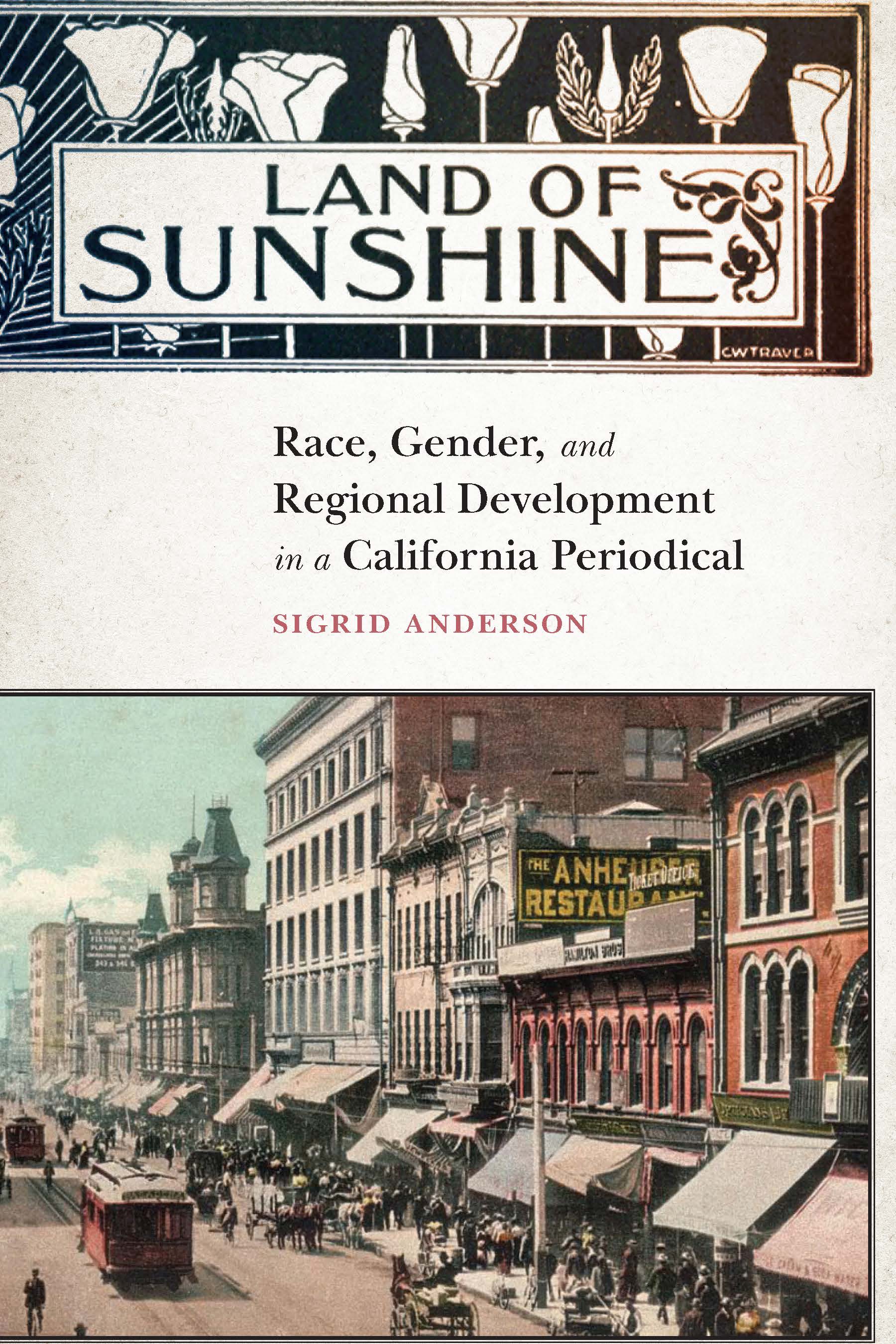
Sigrid Anderson is the librarian for English language and literature at the University of Michigan’s Hatcher Graduate Library and a lecturer in the Department of American Culture. Her book, Land of Sunshine: Race, Gender, and Regional Development in a California Periodical, was published by Nebraska in July.
Although denied the right to vote, late nineteenth-century women writers engaged in debates over land settlement and expansion through literary texts in regional periodicals. In Land of Sunshine, Sigrid Anderson uncovers the political fictions of writers Charlotte Perkins Gilman, Mary Austin, Constance Goddard DuBois, Beatriz Bellido de Luna, and Edith Eaton (Sui Sin Far), all of whom were contributors to the Southern California periodical Land of Sunshine.
In this magazine, which generally touted the superiority of the West and its white settlers, women authors undercut triumphalist narratives of racial superiority and rapid development by focusing on the stories of hardship experienced by the marginalized communities displaced by white expansion. By telling stories from the points of view of marginalized peoples who had been disempowered in the political sphere and shaping those stories to offer solutions to land settlement questions, these women writers used literature to make a political point. Land of Sunshine unpacks the competing visions of Southern California embedded in this periodical while revealing the essential role of magazines in place-making.
Introduction
Creating the Land of Sunshine
When Charles Dwight Willard and Harry Ellington Brook, two members of the Los Angeles Chamber of Commerce, founded the monthly periodical Land of Sunshine in 1894, they sought to attract “travelers, health seekers, and intending settlers” to Southern California to boost the region’s economy. Land of Sunshine was conceived as a promotional tool in the wake of the 1893 economic depression, which was described by Errol Wayne Stevens as “the first large-scale crisis of capitalism that modern Los Angeles experienced.” The editors articulated their focus on attracting new development in the opening pages of the second volume:
Southern California needs more people to settle on its unimproved lands, to go into business in its cities, to put capital into its enterprises, to develop its latent possibilities in many directions. The coming of these people means an increase in the value of every foot of land in Southern California, and an increase in the volume of every business. To those already on the ground it means not only an advancement as well; for with the addition of a great population will come the culture and advantages of eastern city life. . . . All these things are possible, and within the sight of the next generation, if not of this.
As this declaration makes clear, Land of Sunshine’s publishers hoped to bolster settlement in Southern California in order to inject capital and develop the land. In their eyes, more people moving to the region meant more money and more business, and more development would allow Los Angeles to have a rich cultural life comparable to that of eastern cities. To this end, the editors sought to entice people to the region by filling the journal’s pages with photographs and articles describing the area’s attractions, from its mild climate and bustling downtown to its rich history.
In the magazine’s second year, Charles Lummis, journalist, amateur ethno-historian, and self-proclaimed authority on the West, became editor of Land of Sunshine, marking a shift in the publication from Chamber of Commerce advertising pamphlet to platform for both documenting what was seen as the region’s vanishing ethnographic and cultural past and celebrating the area’s potential for white prosperity. Throughout Lummis’s tenure, the magazine’s reach expanded, communicating a vision of a prosperous and culturally rich Southern California to readers across the country. Its readers included Theodore Roosevelt and the naturalist John Muir, and its circulation ranged between 9,000 and 12,000 in the late 1890s before reaching a high of 15,000 in 1904, even more than the 14,000 that The Atlantic enjoyed at its height.
Land of Sunshine’s self-appointed role as arbiter of the “authentic” U.S. West, as well as its unabashed boosterism for Los Angeles’s white future, illustrates how western periodicals created a regional identity. The vision of westerners and the future of the West that Charles Lummis and his colleagues circulated celebrated white easterners who had chosen to move to California and who would dominate its future. Throughout its pages, in images, paratexts such as ornamental initials, poetry, fiction, and articles on commerce, ethnography, and the natural world, Land of Sunshine conjured up an idea of the U.S. West in which white settlers and businessmen prospered in robust health due to the region’s ideal climate, natural resources, and rich historical and cultural backdrop. Louis Althusser’s notion of interpellation is useful for understanding the ways in which magazines like Land of Sunshine functioned to create a class of white readers who were also potential settlers in the region. By featuring images of happy white families, successful entrepreneurs, and healthy toddlers, the magazine “hailed” its implicitly white readers, creating subjects who came to see themselves as the future of Los Angeles. As Lummis declared in his description of the work of short story writer Ella Higginson, the author’s work was to be recognized for “mak[ing] tangible the basic but forgotten truth that Westerners are Easterners moved.”
Land of Sunshine was a key text in articulating and disseminating Lummis’s vision of Southern California as the site of a prosperous future for whites and preserving romanticized histories of Indigenous peoples and Spanish colonialists. Although Lummis protested Native land dispossession, he simultaneously promoted rebuilding as tourist attractions the Spanish missions where Indigenous peoples were forced to labor, celebrated Native baskets and blankets as commodities for white collectors, and published articles exoticizing the Chinese immigrant community. Every textual, visual, and paratextual element in Land of Sunshine shaped an idea about Southern California as a space for cultural tourism, white regeneration, and robust health against a backdrop of quickly disappearing marginalized groups that represented the past.
At the same time, local color literary works published in the magazine, especially those by women writers, just as frequently intervened in and challenged Land of Sunshine’s hypermasculine message about land development by white interests in the region. Land of Sunshine’s local color fiction—overwhelmingly written by women—shows the genre’s potential to create a narrative counter to the triumphalist account of white progress, a narrative in which Native peoples and other marginalized groups are not shoved aside and forgotten but instead are centered in narratives that highlight the human consequences of settler colonialism. These texts complicated Lummis’s vision by adding layers of nuance and discomfort, especially by foregrounding the effects of white expansion on communities that were not part of Land of Sunshine’s imagined future. They wrote back into the narrative the consequences of settler colonialism, which, according to Alex Trimble Young and Lorenzo Veracini, involves “colonists who come to stay. Their primary aim is to dispossess, displace, and destroy Indigenous peoples rather than exploit them for their labor.” Settler colonialists operated under “logics of elimination and exclusion,” and this violence established “Native land as free.” Rather than consigning Indigenous groups to the pages of ethnographic journals, creating memorials to Spanish history that served as tourist attractions, or dismissing Chinese immigrant communities as incomprehensibly foreign, the women writers presented the human costs of elimination and exclusion by writing marginalized groups back into the story. Writers like Mary Austin, Edith Eaton (Sui Sin Far), Constance Goddard Du Bois, and Beatriz Bellido de Luna used their regional literary texts and the platform of the turn-of-the-twentieth-century California periodical to tell the stories of groups dispossessed by land development and erased by white narratives of progress.
Women’s writing in Land of Sunshine is central to this story because the magazine’s promotion of local color fiction created an opportunity for women to enter into political debates that were otherwise closed to them. As Janet Dean has argued in relation to interventions by “writer activists” in debates over Native rights, “Women took up conventional print forms to enter debates over Indian policy both because they were compelled by gender norms and because it was a way to make their voices heard in a social climate that constrained them.” In other words, they “turned to popular print as a side entrance to public debate.” Women’s local color texts in Land of Sunshine shine a light on how the magazine’s (and the region’s promoters’) privileging of white communities and interests destabilized marginalized peoples and spaces. Land of Sunshine played a unique role in shaping ideas about the West, including publishing works by women that offered a critique of white triumphalism and the erasure of the suffering it caused.
 UNP blog