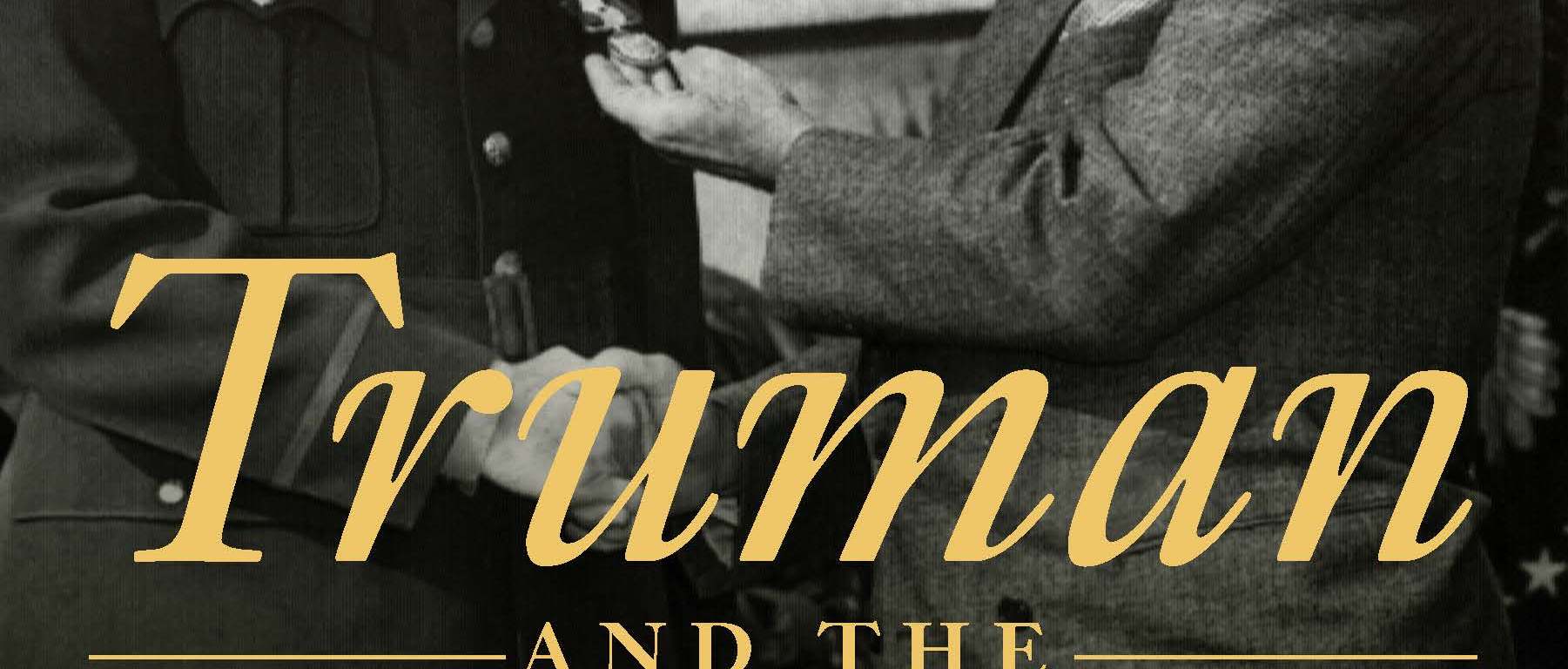
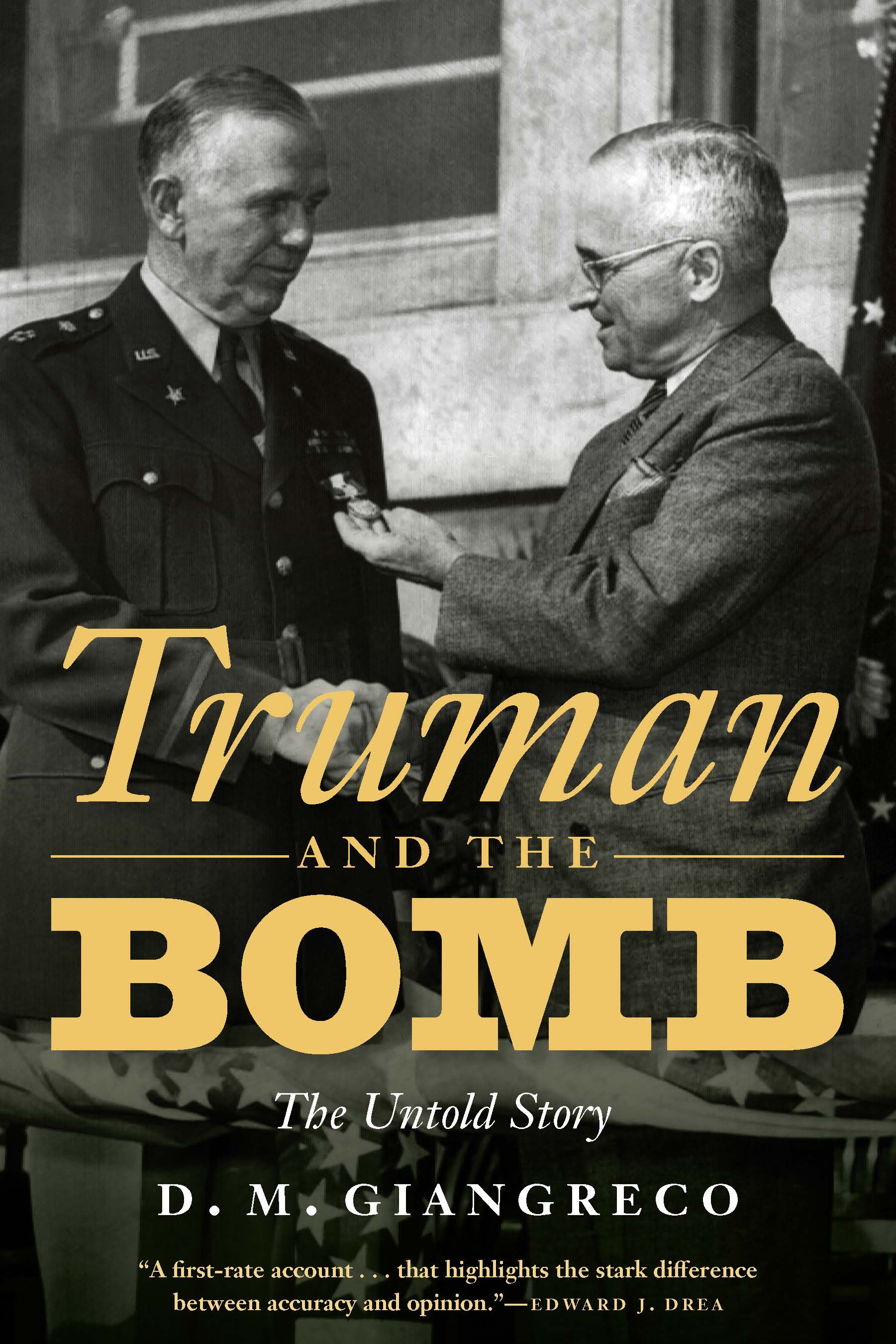
Book Birthdays celebrate one year of a book’s life in social media posts, reviews, and more. This month we’re saying Happy First Book Birthday to Truman and the Bomb: The Untold Story (Potomac Books, 2023) by D. M. Giangreco.
About the Book:
Many myths have grown up around President Harry S. Truman’s decision to use nuclear weapons against Imperial Japan. In destroying these myths, Truman and the Bomb will discomfort both Truman’s critics and his supporters, and force historians to reexamine what they think they know about the end of the Pacific War.
Myth: Truman didn’t know of the atomic bomb’s development before he became president.
Fact: Truman’s knowledge of the bomb is revealed in his own carefully worded letters to a Senate colleague and specifically discussed in the correspondence between the army officers assigned to his Senate investigating committee.
Myth: The huge casualty estimates cited by Truman and Secretary of War Henry Stimson were a postwar creation devised to hide their guilt for killing thousands of defenseless civilians.
Fact: The flagrantly misrepresented “low” numbers are based on narrow slices of highly qualified—and limited—U.S. Army projections printed in a variety of briefing documents and are not from the actual invasion planning against Japan.
Myth: Truman wanted to defeat Japan without any assistance from the Soviet Union and to freeze the USSR out of the postwar settlements.
Fact: President Franklin D. Roosevelt and President Truman desperately wanted Stalin’s involvement in the bloody endgame of World War II and worked diligently—and successfully—toward that end.
An award-winning historian and author of many books and articles on Truman, Giangreco is perfectly situated to debunk the many deep-rooted falsehoods about the roles played by American, Soviet, and Japanese leaders during the end of World War II in the Pacific. Truman and the Bomb, a concise yet comprehensive study of Truman’s decision to use the atomic bomb, will prove to be a classic for studying presidential politics and influence on atomic warfare as well as its military and diplomatic components.
A Word from the Author:
Truman and The Bomb is less than half the length of my 2017 expanded edition of Hell to Pay: Operation Downfall and the Invasion of Japan, 1945-1947. It is geared to a more general audience and classroom use, plus has an extremely large number of appendices. The book examines the highly secret and extensive US-Soviet cooperation against Japan during the last ten months of the war under the Roosevelt and then Truman administrations and that cooperation’s relationship to expected US casualties during the invasion of Japan.
Everyone knows about the Manhattan Project, of course, but the other secret war-termination projects, Milepost and Hula (detailed in Hell to Pay) and now Operation Keelblocks supporting the Soviet offensive, show the whole “racing the enemy” notion to be complete nonsense. I’m being urged to rework Appendix Q, “Planned US Naval and Air Operations in Support of the Soviet Invasion of Manchuria,” into an article or research note. I really must make time to do so. Appendix Q includes orders from the Joint Chiefs, who were then meeting with their Soviet counterparts at the Potsdam Conference, to implement Operation Keelblocks supporting the upcoming Soviet offensive.
I hope educators make good use of the appendices. In particular, the information presented in Appendix D, “The Manhattan Project: A Chronology of its Expansion and Subsequent Congressional Investigations,” will come as a surprise to many readers. The appendix produced by Michael Kort, “The Historiography of Hiroshima: The Rise and Fall of Revisionism,” provides a marvelous background to the historical debate that undergraduate students will find particularly valuable.
Reviews:
“D. M. Giangreco’s sweeping critique of revisionist interpretations of President Truman’s decision to use the atomic bomb against Japan is certain to stir renewed controversy. Giangreco vividly recreates the passion and emotion of the summer of 1945 in a first-rate account of the decision to use the weapon and the postwar historiography surrounding its use. Relying on documentary evidence, he highlights the stark difference between accuracy and opinion in historical writing.”—Edward J. Drea, author of Japan’s Imperial Army: Its Rise and Fall
“D. M. Giangreco has rendered obsolete most of what has been written on the subject.”— Robert James Maddox, author of key works on the history of the atomic bomb and American foreign policy.
“Giangreco takes aim at ‘revisionist’ historians who claim Truman’s motivation to authorize employing the atomic bomb was made for nefarious reasons . . . Truman and the Bomb is relevant to today’s national security professionals. Giangreco delivers a highly readable account that touches on the political and military aspects of a key presidential decision during war. This momentous decision during World War II is still felt today.”—Clayton K S Chun, Parameters
“Aimed at a more general audience and especially at educators at all levels who teach about Truman and the use of the atomic bombs . . . the book should be essential reading for anyone who enters that debate in the future.”—Wilson D. Miscamble, Missouri Historical Review
“Giangreco has made an extremely useful work for understanding the dropping of the atomic bombs and the debates surrounding it both among decision-makers and later scholars . . . The greatest benefit of the work, especially for teaching purposes, is the structure. Beyond the “myths” organization—allowing faculty to build readings around each—is that while there are only 115 pages of narrative, it is followed by 96 pages of appendices.”—Robert Clemm, The Journal of Military History
“With fewer than 115 pages of text, but almost 100 pages of documentary evidence as appendices, and more than 30 pages of notes, this little tome fairly demolishes the interpretations of the revisionists.”—Russell K. Brown, The Journal of America’s Military Past
“Giangreco’s close analysis of these documents is thought-provoking, and makes a strong case that Truman believed dropping the bomb would save lives. Readers will come away with new insights into a world-changing event.”—Publishers Weekly
Interviews:
[Abridged] Presidential Histories
American History Hit with Don Wildman
 UNP blog