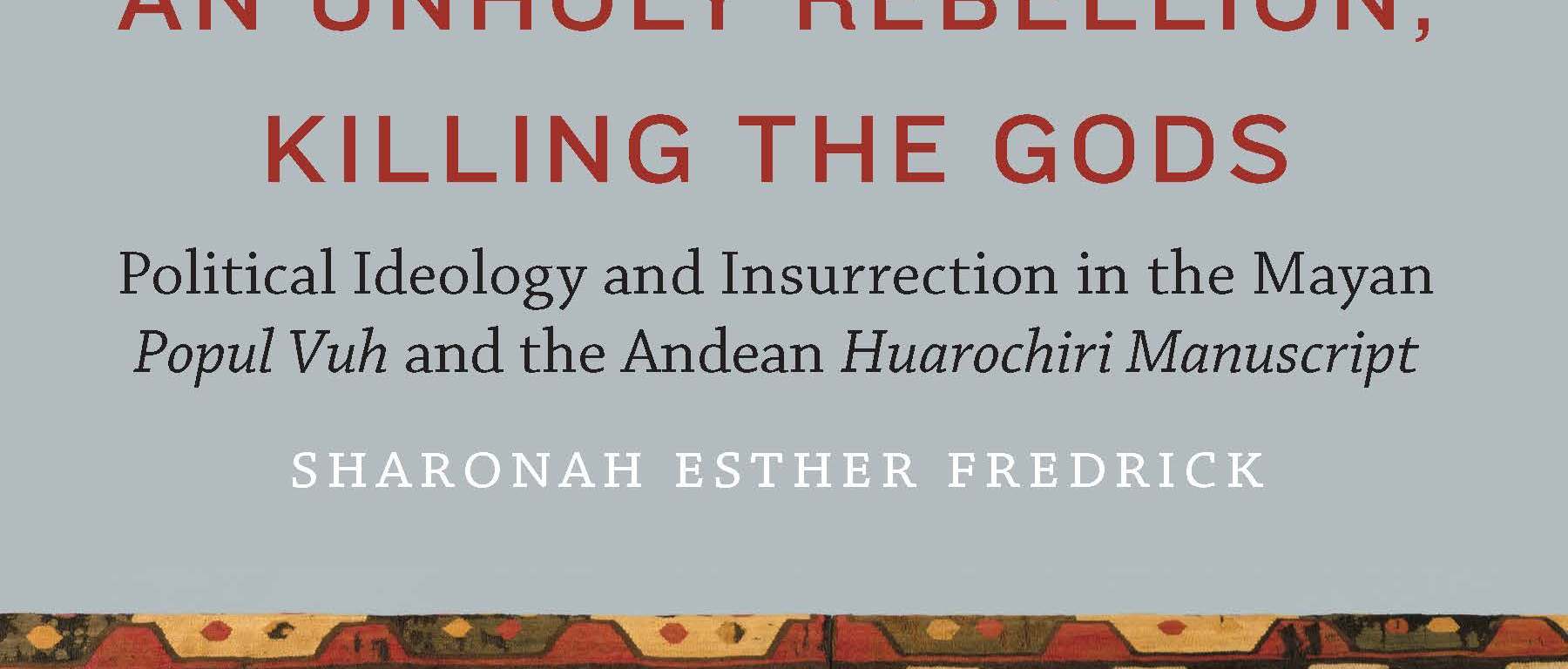
Sharonah Esther Fredrick teaches in the College of Charleston’s Department of Hispanic Studies. She is the Colonial Americas editor for Routledge Resources Online—The Renaissance World. Her newest book An Unholy Rebellion, Killing the Gods: Political Ideology and Insurrection in the Mayan Popul Vuh and the Andean Huarochiri Manuscript was published this month.
All my life I have been inspired, in both Spanish and English, by the Indigenous cultures of the Americas, and their many forms of resistance to Early Modern colonialism. I am equally interested in the philosophies that certain Indigenous civilizations evolved, and continue to evolve, to live in more sustained balance with the earth. In my lectures and writing, I focus on this universalistic aspect of Mayan, Andean, and Southwestern Indigenous teachings.
Female piracy in the Caribbean and Pacific during the 16th-18th centuries also fascinates me, and I frequently delve into differing attitudes in Renaissance-era England and Spain towards the inhabitants of the “New World”.
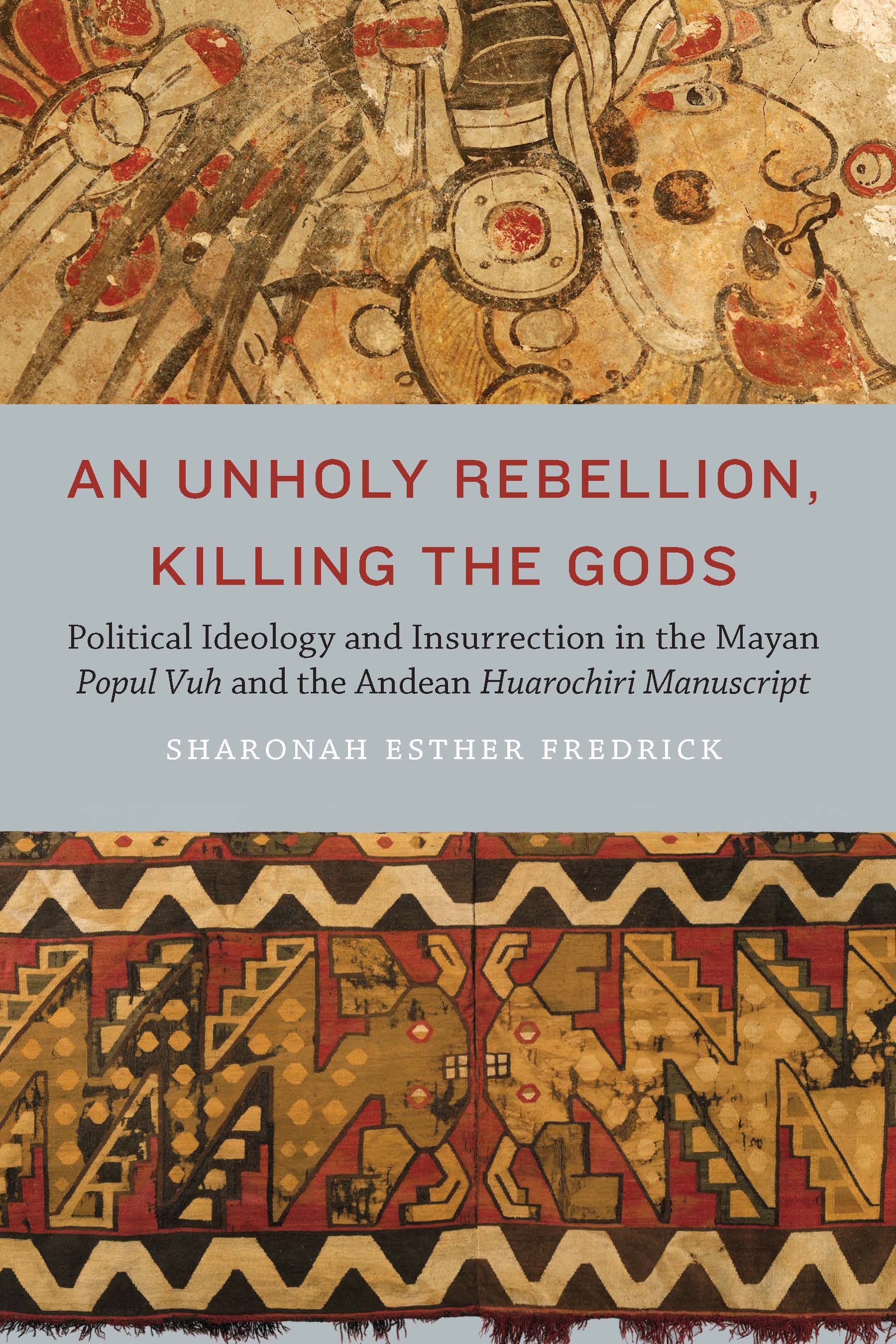
All of these interests come together in my first book An Unholy Rebellion, Killing the Gods: Political Ideology and Insurrection in the Mayan Popul Vuh and the Andean Huarochiri Manuscript.
How does it all jell? Because the thread that unites all of this is how rebellion—against an unjust conqueror, and/or against your own people—is vital and necessary for life to be livable. The values that Mayan and Andean literature present speak to us with an urgency today. Their anonymous authors expressed them whilst grappling with the repercussions of the collapse of the Aztec and Inca superstructures, from the 1500s through the 1700s; and whilst battling Spain’s newer, religiously intolerant empire. This was literature written under stress!
Many of their ideas are thousands of years older; like Western thought, Native American thought does not develop in a vacuum. It confronts new challenges; it morphs and transforms.
The texts that I analyze were codified and written in Quiche Maya and Quechua, respectively. They are, in my opinion, an articulation of human rights concepts that most folks associate with Enlightenment-era European concepts. But these two literary epics, the Guatemalan Popul Vuh and the Peruvian Huarochiri Manuscript, predate what we think are Western ideas of individual and community-based freedoms.
Some Westerners understood that many Indigenous cultures were more humane than their own . . . I’m thinking of the Liberator of Argentina and Protector of Peru, General San Martin. In the 19th century, San Martin was allied with the Native people of Huarochiri during Peru’s independence struggle. And of course, I’m also thinking of Bartolome de las Casas, the Spanish priest who defended the rights of Mayas in Chiapas in the first half of the 1500s. Neither the rebellious Popul Vuh nor the equally rebellious Huarochiri Manuscript had been “published” in a general sense during the lifetimes of San Martin or Las Casas, but both Las Casas and San Martin admired the struggles of Andean and Mayan peoples and their indomitable spirit.
There were Westerners who condemned the mass killings of Spanish and English imperialists in the Americas, and, long before that, of Jewish, Muslim, and Albigensian religious minorities on European soil. So too, there were Native American thinkers who questioned the need for politically motivated human sacrifice. Journalist Charles Mann, in 1491, drew an accurate comparison between public executions in Renaissance-era Europe and the sacrifices in the Aztec Temple in Tenochtitlan. Mayan and Andean thought, in my opinion, begins that process of questioning, and finally opposing, political misuse of faith-based arguments. And all this while beheadings and public burnings, in the name of religious warfare, were still quite the rage in Europe.
My book is the first study of its kind to attempt a comprehensive comparison between these two most important Native American epics of Latin America: the Mayan Popul Vuh and the Peruvian Huarochiri Manuscript. I try to avoid clichés of “othering” and “subaltern status”. Instead, An Unholy Rebellion situates the Mayan and Andean narratives within the paradigms of their own civilizations’ developments. As a scholar of Indigenous cultures, I wanted to let those civilizations tell their own story, and not clobber them with Western theorizing.
I want to convey the power of different Native American philosophies within the context of the Spanish conquest of the Americas. I am not presenting this as some stereotypical anti-Western diatribe. Native scholars, after all, present us with a much more complex picture . . . What I do in An Unholy Rebellion is illuminate the profound spiritual disagreements, and the evolving ideologies of the Mesoamerican and Andean worlds, before and after their contact with the Spanish Conquest. The Indigenous texts ask us: why should we submit to foreign conquerors when we told our own gods we were no longer willing to sacrifice to them? That is a hard and fascinating question, and to attempt to answer it, I have connected colonial-era New World literature with archaeology and Native American studies. Readers who enjoy interdisciplinarity will understand.
An Unholy Rebellion illustrates the schisms and shifts in the Native civilizations and literatures of Latin America in a way that other literary studies, which relegate Native literature to a “prelude” to Spanish-language literature, have not yet done. I have placed Mayan and Andean Indigenous literature in active dialogue with colonial Hispanic and English writing, firmly within the Latin American Canon. I’m not suggesting that we get rid of the Latin American and/or Universal Literary Canon. Rather, we have to WIDEN our idea of universal literature to include, and in fact, emphasize, Mayan and Andean writing and philosophy. I have no doubt that Cervantes would perceive the same depth of thought in Mayan and Andean authors that the Western Canon sees in Don Quixote. The panorama that I present is more of a “pluriverse” (pluralistic literary universe) where subversive Mayan and Andean heroes can converse with Robin Hood.
Although I’ve spent much time in Central America and the Andes, I do remember thinking that, since I am not a fluent Quechua or Maya speaker, perhaps I should choose another project? But the powerful message of these magnificent Indigenous literatures, even in the Spanish and English translations that I read, was strong enough to convince me of something . . . and I hope that my readers will be convinced of this too: that along with Shakespeare, Cervantes, and Plato, along with the Upanishads, the Bible, and the Koran, it is high time to include the masterpieces of Native American thought in world literature.
 UNP blog
Excellent blog; superb book! Great to see something from the Native American perspective when dealing with Latin American history.