Maura Jane Farrelly is an associate professor of American studies at Brandeis University. She has worked as a reporter in Atlanta, Washington DC, and New York. Her books include Papist Patriots: The Making of an American Catholic Identity and Anti-Catholicism in America, 1620–1860. Her latest work Compliments of Hamilton and Sargent: A Story of Mystery and Tragedy on the Gilded Age Frontier (Bison Books, 2024) was published last month.
In Compliments of Hamilton and Sargent Maura Jane Farrelly explores the history of the Gilded Age United States, using the lives of three people from prominent East Coast families who moved to Wyoming to start over as her guide. Robert Ray Hamilton, John Dudley Sargent, and Edith Drake Sargent.
All three experienced some form of humiliation after newspapers speculated on their possible shameful secrets: bigamy, blackmail, murder, incest, baby-selling, mental illness, and more. All three fled to Wyoming, believing distance and remoteness would hide their shame. But by the 1890s the West was no longer a place where anyone could hide. Compliments of Hamilton and Sargent is a story about the early demise of our right to be forgotten.

Prologue
Stories
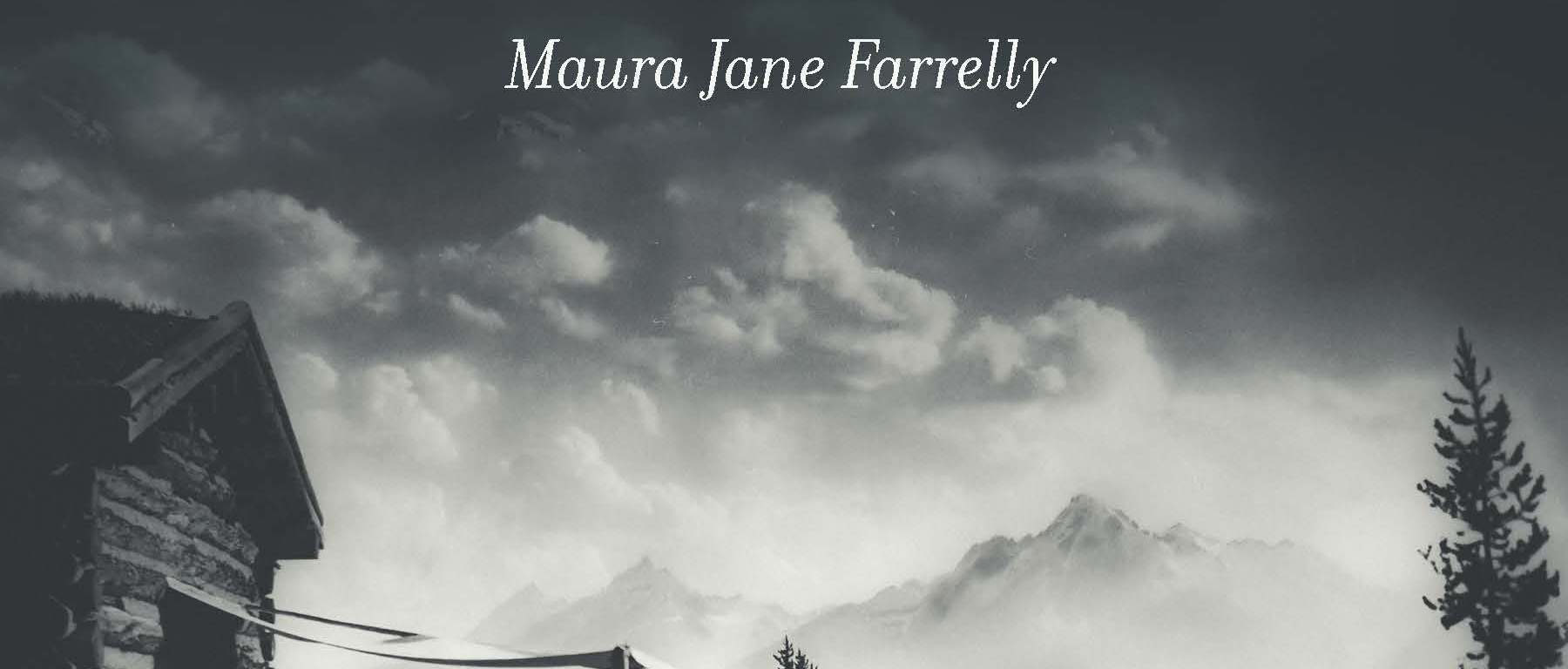
I wrote this book because of a photograph my mother found in her parents’ house after my grandmother died. A lone woman in silhouette stands outside a rough-hewn log cabin, playing a violin in the shadow of the Teton Mountains. A Victrola is situated in the grass in front of her, suggesting the music she’s creating is not without accompaniment. Her hair is piled on top of her head. She wears a loose Garibaldi blouse, popularized in the 1860s by the leader of the Italian unification movement, and a slim, high-waisted skirt known as a “Rainy Daisy” that debuted in the 1890s. It had a higher-than-usual hemline, so that active women could wear it while hiking or playing tennis and not have to worry about tripping over themselves or having the skirt get wet. On the back of the photograph, in her tight script, my grandmother had written the name “Edith Sargent.”
Curious about who this woman was, I did what all good scholars do when faced with a question about the past: I hopped on Google. After narrowing my search, combining Edith’s name with words like “violin” and “Wyoming,” I finally discovered a letter to the editor in the online archives of the New York Times. It was written in August 1913 by a woman named Edith Sargent who took great exception to the way the Times had covered the death of her husband.
According to the newspaper, John Dudley Sargent had been a “recluse.” He’d killed himself earlier that summer in the valley between the Gros Ventre and Teton Mountains known then as Jackson’s Hole. “I am here to state as a loyal, loving wife that the man was incapable of committing murder,” Edith angrily told the newspaper’s editor. “He was never unbalanced except by melancholia, which does not prompt people to murder their chums.”
In its coverage of John Dudley Sargent’s death, the Times had resurrected rumors about his relationship with a man named Robert Ray Hamilton. “The stories to which Mrs. Sargent objects originated among ranchers in Jackson’s Hole who did not like Sargent and Hamilton,” the paper explained in an effort to give Edith’s letter some context. “The stories had to do with the death of Hamilton and the first wife of Sargent. They were to the effect that Sargent knew more about Hamilton’s death in October 1890 than was ever brought out by official investigators.”
The Times reminded its readers that Robert Ray Hamilton had been a state lawmaker from the Murray Hill district of Manhattan before he died. He was “the son of Gen. Schuyler Hamilton of this city,” it noted—meaning he was the great-grandson of Alexander Hamilton, the nation’s first treasury secretary. Ray Hamilton had also been “the central figure in a scandal in 1889,” the Times recalled, “in which a woman by the name of Eva Mann and a purchased baby figured.”
Thus began my journey down the rabbit hole and into the den of other people’s secrets that became the setting for this book. The secrets I uncovered soon involved more than just murder, suicide, baby-selling, and a founding father’s family. They also involved bigamy, blackmail, debt, rape, incest, guillotining, corpse-skinning, child abuse, mental illness, and (not to be outdone by any of that) elk-poaching.
Suffice to say there were days when I found myself wondering whether this story was one I had any right to pursue and tell.
The older I get, the more comfortable I become with the reality that people are complicated, and that the most interesting people often have secrets, lives that are characterized to a greater or lesser degree by mystery or deliberate obfuscation. Teaching and writing about history has also helped me come to terms with this truth. Historians will rarely admit it, but archival research is often voyeuristic. Almost all of us go into an archive hoping to find something we were never meant to see, something that was meant for some other set of eyes and is available to us now only because the person who created it or for whom it was intended is no longer alive to protect it from the prying eyes of others.
This book is a story about the secrets that shaped the lives of three Americans in the late nineteenth century: Robert Ray Hamilton, John Dudley Sargent, and Edith Drake Sargent. Exposed secrets are usually humiliating, and humiliation is what drove Ray, Jack, and Edith—independently from one another—to leave their lives in the eastern United States and settle in Wyoming, a wild and isolated region along the last remnants of America’s frontier.
Ray hoped to free himself from a messy marriage that had attracted quite a bit of press attention in New York City. Jack was tired of being passed around by wealthy family members in New England who were more interested in business and philanthropy than they were in raising him. And Edith went west after a reporter for the Boston Globe discovered she’d had a romantic relationship with an infamous criminal in Paris who’d generated headlines all around the world.
When they settled in Wyoming, Ray, Jack, and Edith were doing what generations of Americans before them had done, starting with those Puritans who left England in 1630 and founded the city of Boston along the shores of Massachusetts Bay: they were moving west, to what they believed to be an unsettled and uncivilized part of the world, because they hoped that doing so would make it possible for the humiliations and persecutions of their old lives to be forgotten.
In the case of Ray, Jack, and Edith, however, the strategy did not work. They were not forgotten—not in their own time and, to some extent, not even in ours. Robert Ray Hamilton is memorialized on a plaque at Riverside Drive and Seventy-Sixth Street in Manhattan that reduces his life and career to the scandal over his marriage. Jack is the subject of a folk opera called Marymere, which was showcased at the Brooklyn Academy of Music in January 2020, shortly before all live performances were shut down because of COVID-19. Just about any travel guide to Grand Teton National Park will tell you that Signal Mountain within the park was named for the “signal” fire set by the search party that found Ray Hamilton’s body in the Snake River in 1890. And a historical marker on what used to be John Dudley Sargent’s homestead—now a biological research center in the middle of Grand Teton National Park—calls Jack the “undesirable offspring” of a prominent East Coast family (the same family that produced the portrait painter John Singer Sargent). It also echoes the newspaper coverage Edith found so objectionable when it informs visitors Jack was “suspected of murdering his first wife and his partner, Hamilton.”
Meanwhile, Edith herself is a bit of a cult figure in Jackson Hole. I had no idea who she was when my mother showed me her picture, but many long-time residents of Jackson, Wyoming, would have recognized her instantly. The Chamber of Commerce there has used her image to promote tourism in the region (that is almost certainly the disappointingly mundane reason my grandmother had the photograph on the cover of this book in her possession). Edith Sargent is a character in a musical titled Petticoat Rules, which has been staged several times over the last twenty years by the Off the Square Theater Company in Jackson. And graduate students working at the biological research center on what used to be Jack Sargent’s homestead have a tradition of grabbing bear spray and heading out into the woods to find Edith’s “violin tree,” a now-dead white bark pine that Edith is said to have climbed—sometimes naked—during the years she lived on the homestead so that she could privately play her violin and “gobble peanuts,” according to one particularly amusing version of the story.
The stories of Ray, Jack, and Edith and the secrets that defined their lives reveal truths about what it means to be a human being that transcend time and culture, even as they also caution us that “the past is a foreign country,” to quote the British novelist L. P. Hartley. “They do things differently there.”
 UNP blog