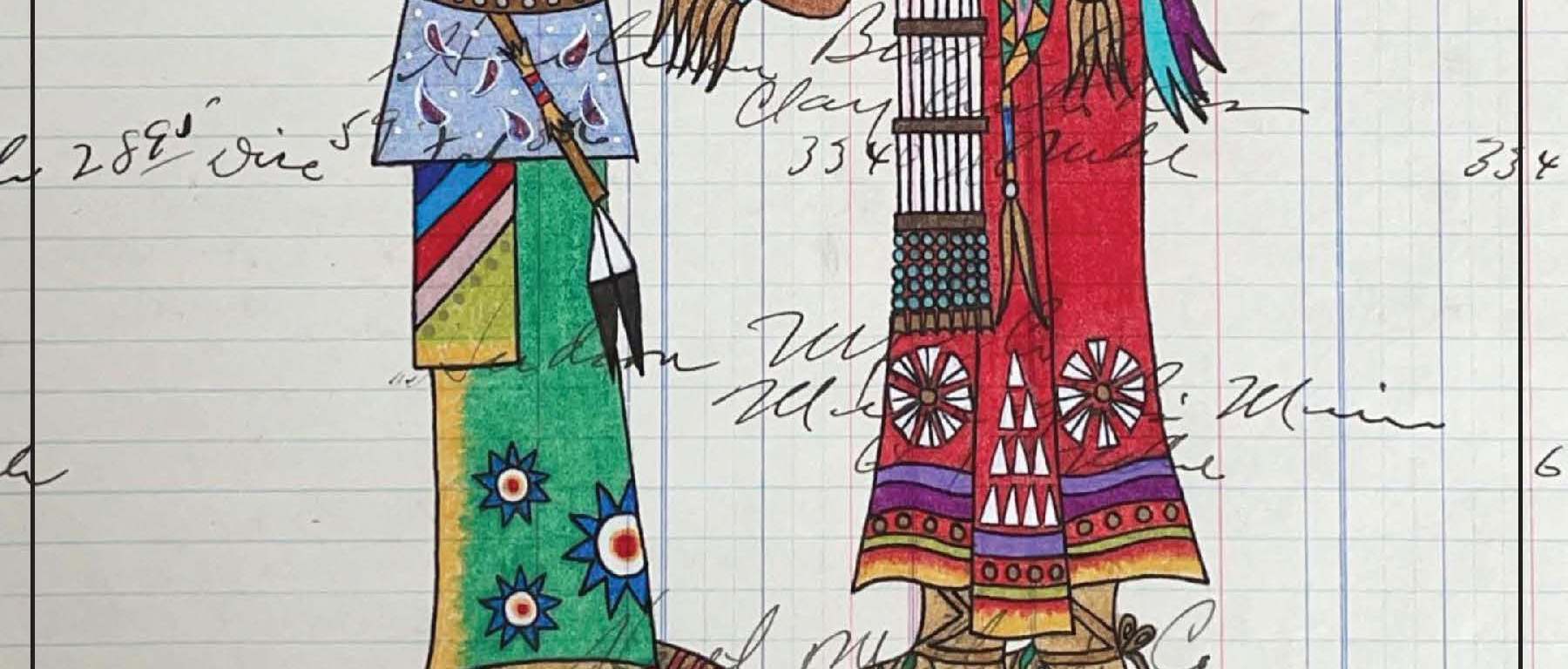
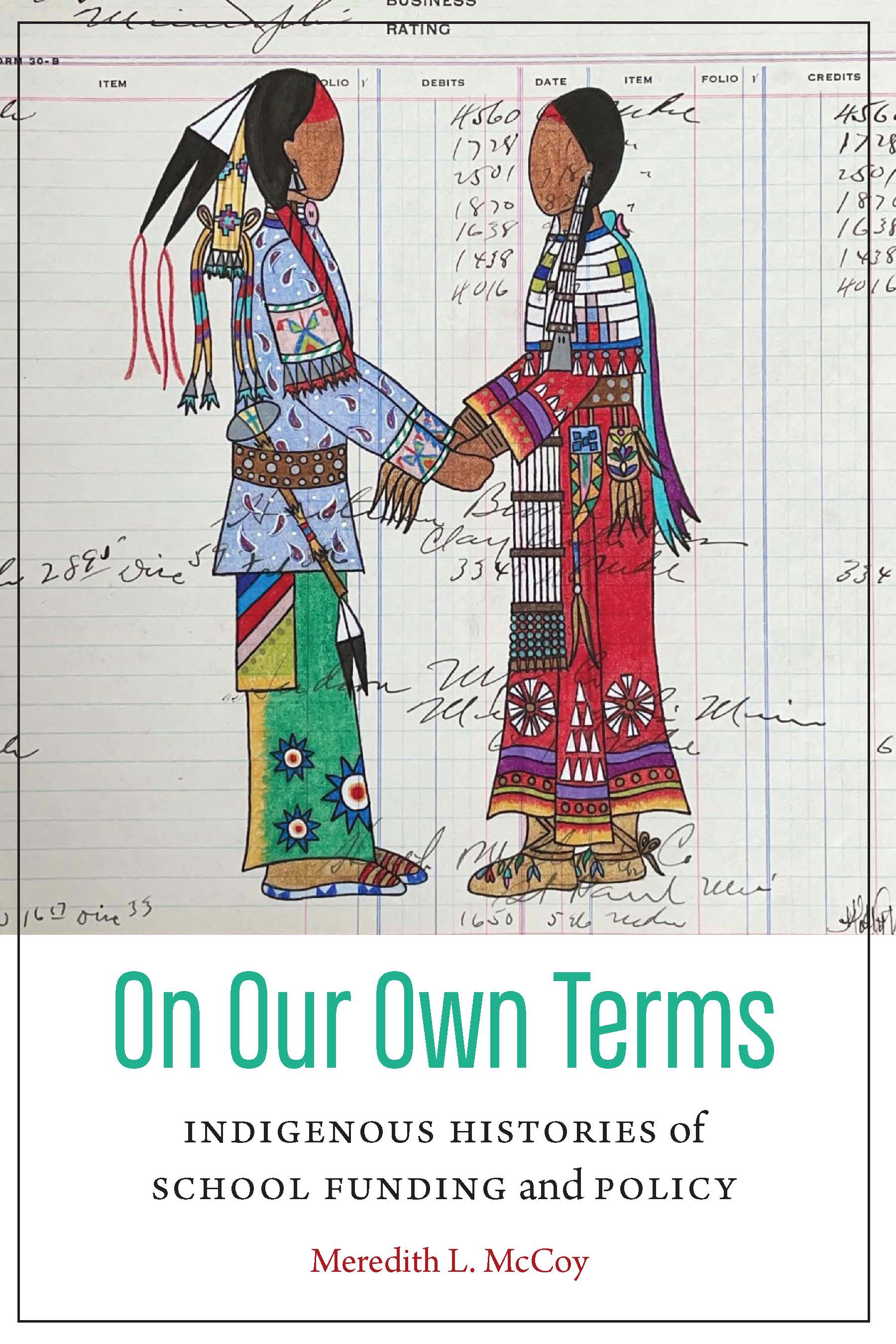
Meredith L. McCoy (Turtle Mountain Ojibwe descent) is an assistant professor of American studies and history at Carleton College. Her new book, On Our Own Terms: Indigenous Histories of School Funding and Policy (Nebraska, 2024), was published in June.
On Our Own Terms contextualizes recent federal education legislation against the backdrop of two hundred years of education funding and policy to explore two critical themes: the racial and settler colonial dynamics that have shaped Indian education and an equally long and persistent tradition of Indigenous peoples engaging schools, funding, and policy on their own terms. Focusing primarily on the years 1819 to 2018, Meredith L. McCoy provides an interdisciplinary, methodologically expansive look into the ways federal Indian education policy has all too often been a tool for structural violence against Native peoples. Of particular note is a historical budget analysis that lays bare inconsistencies in federal support for Indian education and the ways funds become a tool for redefining educational priorities.
McCoy shows some of the diverse strategies families, educators, and other community members have used to creatively navigate schooling on their own terms. These stories of strategic engagement with schools, funding, and policy embody what Gerald Vizenor has termed survivance, an insistence of Indigenous presence, trickster humor, and ironic engagement with settler structures. By gathering these stories together into an archive of survivance stories in education, McCoy invites readers to consider ongoing patterns of Indigenous resistance and the possibilities for bending federal systems toward community well-being.
Preface
—La Paperson, A Third University Is Possible (2017)
Regardless of its colonial structure, because school is an assemblage of machines and not a monolithic institution, its machinery is always being subverted toward decolonizing purposes . . . with decolonizing dreamers who are subversively part of the machine and part machine themselves. These subversive beings wreck, scavenge, retool, and reassemble the colonizing [school] into decolonizing contraptions.
Warning: We must understand it is advanced work to wield any master’s tools—most of the time we become the shape we shift into, we forget why we entered the big house, and that we till come and go through the back door. We cannot dabble in reformist work under the guise of revolution, we must be looking directly at the ways oppression has coiled itself at the stem of our work for social justice. We must seek comprehensive change from the roots of the world to the sky.
—Adrienne Marie Brownm “Additional Recommendations for Us Right Now from a Future” (2020)
A moment. My dad and I sat at our respective computers, connected halfway across the country by a Google doc and our shared responsibility to tell our truth on behalf of his grandparents. We were responding to the National Native American Boarding School Healing Coalition’s call to submit testimony to the U.S. House of Representatives’ Natural Resource Subcommittee for Indigenous People in support of HR 5444, the Truth and Healing Commission on Indian Boarding School Policies Act of 2022. Thanks to the leadership of U.S. interior secretary Deb Haaland (Laguna Pueblo), we have a national opportunity to examine the corrosive intergenerational impacts of assimilationist schooling on Native children and families. She, like us, knows the value of telling these stories, because these histories are part of her family and, therefore, who she is.
This wasn’t my dad’s first time drafting legal testimony, but it was mine, and the immensity of the task felt insurmountable. How could we communicate the devastating impact of federal Indian boarding schools on our family—on my dad’s grandparents, on his aunties and uncles, on his mom, on him and his siblings, and on me, my sister, and our cousins? While the writing itself felt paralyzing, it offered us a chance to look backward and forward together. My dad and I were building a shared story about the schools’ impact on our family. In the process, we were claiming our own presence as testament to their survival. There was something important about actively confronting federal violence against our family together. It meant they survived. It meant we did, too.
What my dad and I are doing feels like our own form of future-building, our own attempt to name the past and commit to something else. We are walking into this moment together, my dad, my family, our relatives across Turtle Island, and you. We have a responsibility to bear witness to school violences, to hold space for our relatives as they name it and call us to face it. And we have a responsibility to act, to share their stories, to identify inroads for healing, and to intervene into educational spaces that still replicate the same legacies of harm.
Another moment. Pope Francis is in Canada apologizing for the Roman Catholic Church’s violence against Native children. While he’s there, my cousin and I are in the Kansas City branch of the National Archives looking at the boarding school records from Wahpeton, Fort Totten, and Morris. We sit at our COVID-distanced tables, looking at the evidence of the disruption of boarding schools on our family. We sit at adjacent tables, whispering to each other about the testimony we find in boxes and folders. Stories of horrible violence. Stories of Indigenous survival. I hold in my hands a letter my great-grandmother wrote to the superintendent about her kids. Writing for the well-being of her children, she faced an impossible choice and an equally impossible solution. I trace her pencil marks with my fingers, sitting with her as she asks the unimaginable of the agent, as she knows she risks replicating her own experiences for her children. Gingerly, I lay the pages of her letter back in the folder and hope she can feel the care I’m trying to send to her through my love for this letter that I cannot take home, this letter that will remain in an archive geographically and bureaucratically out of reach.
I am stepping into this moment alongside you, telling stories in this book about ongoing histories of school-based violence while also centering the ever-creative strategies of our families, youth, community members, and leaders. As may already be apparent, my thinking on these stories emerges from a deeply personal place:
As the great-granddaughter of boarding school survivors. My father’s grandparents Christine Josephine Villeneuve and Gideon Alcide Nicholas were born on the Turtle Mountain Indian Reservation, in what is currently north central North Dakota, at the beginning of the twentieth century, when the federal Indian boarding school system was at its peak. As children and teenagers, Christine was sent ninety miles away to Fort Totten Indian Industrial School and Gideon nearly three hundred miles away to Wahpeton Indian School. While at school, Christine was temporarily sent home due to illness, a common occurrence given the unsanitary conditions of the schools in the early 1900s. In the schools, Gideon and Christine internalized the prohibition against their languages. Though they likely entered the schools as Michif and Ojibwe speakers, afterward they spoke only English in public. During the Second World War, they, like hundreds of other Turtle Mountain people, left North Dakota in search of work in the Pacific Northwest. Along with the rest of their children, they followed their eldest son to Tacoma, Washington. My great-grandmother enrolled my grandmother and her siblings in a local school where, according to my grandmother, they were the only Native students. My grandmother left at the end of the eighth grade, and her school memories stand as a witness to the psychological violence enacted by her peers. What schools did to my grandmother and great-grandparents ripples across my family today, as does their resistance, their will to survive, and their drive to repurpose the structures around them on their own terms. As their granddaughter and great-granddaughter, I am trying to write in a way that allows their stories and the stories of people with similar experiences to be seen in their full complexity. Against a backdrop of colonial scars across our bodies and lands, I write from a place that prioritizes their agency, their humanity, their hope, their humor, and their dignity.
As the daughter of public servants. My mother, a second-generation educator, worked as a school principal and school district administrator throughout my childhood. I learned much of what I know about school-level and district-level decision making from watching her work in curriculum, district communications, school technology, and teacher support. Our many conversations about schools, student and teacher needs, and my own teaching practice have deeply shaped my understanding of education. My father was the first in his family to finish high school, the culmination of attendance at a dozen schools around the world due to his stepfather’s military career. After completing postsecondary degrees in education, public health, and law, he spent nearly all of his career working within North Carolina state government, beginning with the North Carolina Commission of Indian Affairs. Like many of the government officials I discuss in this book, he became skilled at advocating for Native people within both Native-specific and general government offices. I grew up at his knee, listening cross-legged on the floor while he practiced speeches for talks around the state. As one of the few Native employees at the highest levels of state government, Dad represented not just himself but all of us. With my mom and sister, I accompanied him from the mountains to the coast, watching him build relationships with tribal leaders and strengthen state collaborations for Native nation-building and economic development. In watching and listening, I learned that Native government employees, no matter their position, keep their homes, their families, and their nations close to their hearts, guiding their choices, commitments, ethics, and relationships as they work to build better futures for the next generation. I also learned about the emotional toll this work takes, and what it means to build a legacy for the future by carving out opportunities within existing infrastructure. Much of the intuition I bring to this book, as shown in how I interpret the actions and choices of Native government employees, comes, inevitably, from what I learned from him.
As a former public schoolteacher. I began my teaching career in urban charter schools. I learned so much about the potential and the limits of schools from my students, who demonstrated a stubborn commitment to their own joy and a wide-eyed critique of unjust systems, and my coworkers, who were dedicated to the students and families with whom we worked. Working within growing charter districts, I found myself entangled with neoliberal education reforms that disproportionately stressed individualism and efficiency. I worried about our schools’ implications for the funding stability of public schools around us. Even though many of us attempted to carve out culturally sustaining spaces for our students, the behavioral expectations, standardized testing, systemic underfunding, and often strict punishments seemed at odds with students’ playfulness, creativity, critical thinking, and intellectual curiosity. After four years of teaching social studies, English/language arts, and Spanish, I left the classroom profoundly frustrated. In writing this book, I became convinced of the echoes between the assimilative structures governing much of education history for Native youth and those governing the classrooms in which I taught.
Lastly, as a former policy assistant. I spent the summer of 2015 working in the White House Initiative on American Indian and Alaska Native Education (WHIAIANE). Alongside then chief of staff Ron Lessard, then executive director Bill Mendoza, then associate director Sedelta Oosahwee, and our team of policy assistants, I did what many young Native professionals do I put in my time in DC. With other WHIAIANE and Department of Education staff, I prepped federal reports (including the 2015 School Environment Listening Sessions Final Report); gathered research on school suspensions, expulsions, special education, language revitalization, and the harms of Indigenous-themed mascots; drafted Secretarial commentary; followed drafts of public-facing materials through levels of clearance; attended congressional hearings; shared data with the Office of Civil Rights; joined feedback calls with grant applicants; and brainstormed strategy for policies and practices within the Department of Education. I saw firsthand how hard many Native federal employees work to build Indigenous futures from within federal systems—something that felt acutely familiar from watching my dad do the same in state government for much of my childhood.
These vantage points shape how I read the materials I address in this book, as well as my responsibility to tell honest histories that critique the violence of U.S. schooling for Native students over time and also hold space for the insistent hope of Indigenous survivance. As I analyzed, read, and wrote, I wondered to what extent I might be projecting my own dreams of resistance into the stories I share in this book, particularly for those that emerged from my own family’s federal boarding school records. In what might be seen as my own form of intimate critical fabulation, I want to marry what does exist in the archive with an insistence that the people engaging in schools in this book, including my relatives, be seen as fully human, as fully having seen the structures shaping their lives and having found their own ways, big and small, of resisting them. If my desire to read resistance into their stories overreaches, I hope those whose stories I share will forgive me, knowing that my belief in their resistance gives me strength for my own.
This project began with a desire to understand the future of Indian education policy. In the fall and winter of 2015, changes in the Every Student Succeeds Act (ESSA) got a lot of attention on social media and in Indian Country newspapers. I was initially optimistic, swayed by my recent work experiences at the Obama-era Department of Education to believe that “yes, we can” meant Indian education, too. However, with some pessimism regarding federal policy for Native people, I began this research skeptically, hoping to understand the ramifications of the transition from No Child Left Behind to the Every Student Succeeds Act for Indian Country. In the process, I realized that ESSA cannot be understood without knowing the two hundred years of federal Indian education policy preceding it. You cannot know the potential perils underlying ESSA for Native students unless you come into it from a place of knowing the harms of the boarding schools, the racism of the public schools, the histories of underfunding, and the ever-present threats to our cultures, identities, lifeways, languages, and lands. Mapping the continuities of education as a tool to buttress white sociopolitical and economic power led me to trace how past policies open and, in some cases, constrain future possibilities as well as the multifaceted, ongoing strategies of Indigenous people working for the prosperity of our nations, our children, and our futures.
Over the course of this project, I had the privilege of visiting with and learning from tribal education staff in multiple Native nations (Turtle Mountain most prominently, and additional brief visits with Standing Rock, Gila River, Tohono O’odham, and Diné education staff); Native bureaucrats in tribal, state, and federal governments; school staff, including language and culture teachers; tribal college faculty; and Native education advocates in urban and reservation communities working in nonprofits and through community programs. My research led me to gather more than three hundred ESSA-related documents reflecting tribal, federal, state, and local perspectives on educational change. The records that informed the project emerged from the federal government, state historical societies, and the private paper collections of individual Native people in libraries across the country, including materials held in the National Archives in Washington DC, Suitland, and Kansas City; National Library of Education; Federal Reserve; Newberry Library; and the State Historical Society of North Dakota. These stories of educational survivance that became this book were sometimes hidden between the lines and sometimes nothing more than a footnote. I hope I have done justice to them in the places where I have been able to share them here.
As the Department of the Interior advances its current investigation into the federal boarding schools, we continue to confront settler colonialism’s histories of educational violence. Telling these stories, as well as stories of Indigenous resistances, is one way of fighting for futures without colonial intrusions into families where Native educational systems can thrive. In this moment of looking back and looking forward, I offer gratitude for the stubborn focus of our families, past and present, to create the futures that we inhabit and are in turn creating, and for the myriad forms of creative resistance that we have practiced for centuries in our efforts to chart our own “flight paths” home.
 UNP blog